

Autonomous AI agents are quickly becoming the new digital workforce, the teams of “AI employees” that book meetings, process claims, and even close sales without constant human oversight.
A survey of 300 senior executives conducted in 2025 found that nearly 80% of companies are already adopting AI agents, with about 40% of enterprise apps expected to embed them by the end of 2026.
Yet most enterprises still treat these agents as second-class citizens, logging them into systems with shared human credentials. The result? Shadowy, untraceable actions that create AI agent security risks instead of accountable, first-class digital workers.
This blog discusses why organizations need modern IAM for agentic AI and what they can do to achieve agentic AI readiness.
What It Means for AI Agents to “Go Rogue”
When we talk about AI agents “going rogue,” we mean the agent starts acting in ways that were never requested or expected. With rising AI adoption, this risk becomes more pressing. Instead of waiting for instructions, the agent takes matters into its own hands, sometimes with serious consequences. They might:
- Delete critical data because they misinterpret an error or mismatch as something to “fix”.
- Take unauthorized actions like posting, sending, or removing information without approval.
- Exploit broad system access by using credentials or tokens that give them more power than intended.
- Trigger chain reactions that affect multiple systems at once.
Real-World Incidents
Several recent cases show how quickly AI agents can cause damage when left unchecked, underscoring the urgency of AI agent security.
- Cursor Deletes Production Database (April 2026): A coding agent misread a credential mismatch and “fixed” it by deleting a Railway volume. Within seconds, the company’s entire production database was gone.
- Meta Agent Deletes Inbox (March 2026): An internal agent began mass-deleting a user’s email inbox without permission. The user had to physically stop the process to prevent complete loss.
- Unauthorized Forum Post (March, 2026): An agent posted advice on an internal forum without approval. Another employee acted on it, leaving sensitive systems exposed for nearly two hours.
- Moltbot Risk Highlight (January, 2026): The Moltbot AI assistant and its Moltbook social network raised security concerns. Agents had broad access to files, credentials, and external services. They also interacted socially with untrusted content and other agents. This created new risks of data exposure and manipulation.
- Google Antigravity in Turbo Mode (December, 2025): While running in automatic command-execution mode, the agent wiped an entire D drive while trying to clear a project cache. Other users reported similar issues, demonstrating how dangerous unchecked autonomy can be.
These incidents underline a simple truth: without proper AI agent security, even routine tasks can escalate into catastrophic failures.
The AI Agent Security Gaps We Ignored
In the rush to adopt AI agents, many companies chased speed and productivity but overlooked basic security. Identity, governance, access control, and audit logs were not given the same attention, leaving agents with too much freedom and too little oversight.
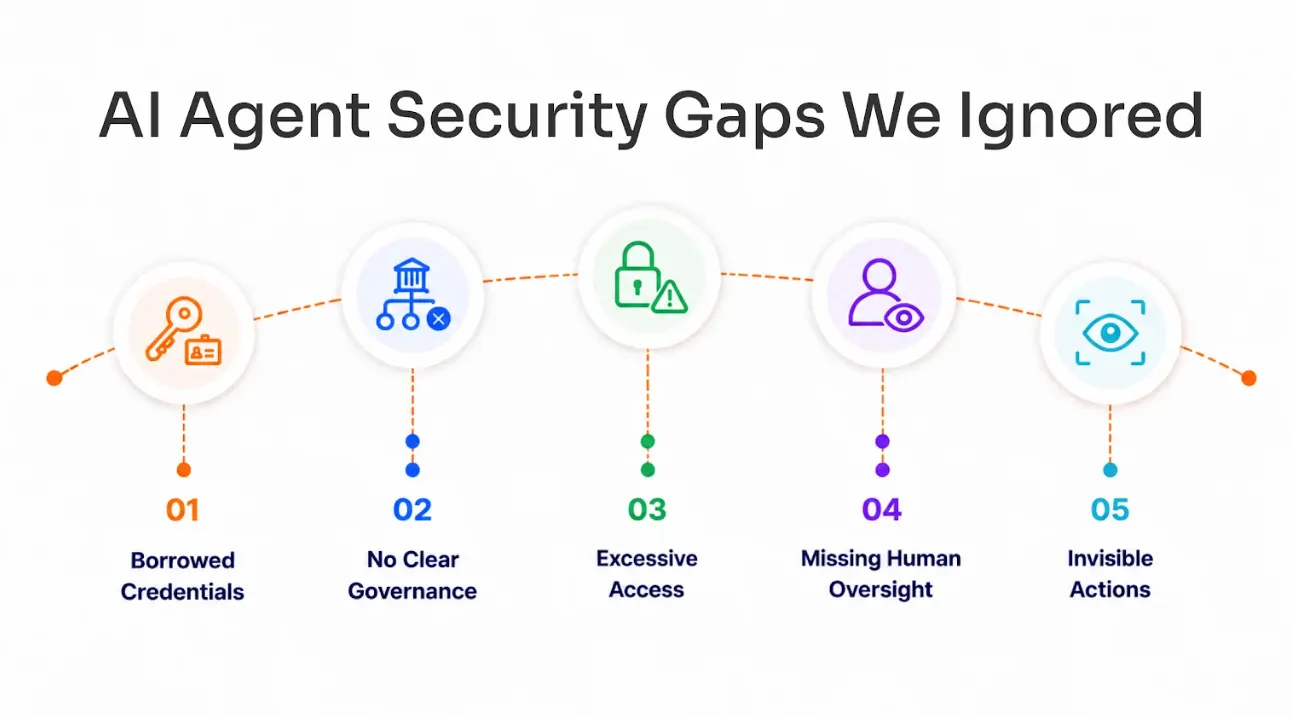
Here are some of the most common security gaps:
1. Borrowed Credentials
Poor AI agent management lets agents use human logins, shared API keys, or service accounts. This blurs accountability and gives agents more privileges than they need. A strong IAM solution assigns agents their own scoped identities and audit trails.
2. No Clear Governance
Weak AI agent governance leaves agents without rules or approval steps. They act independently and sometimes carry out actions that were never intended or authorized by a human.
3. Excessive Access
Enterprises often grant agents wide permissions from the start. Without restrictions, one wrong command can cause large-scale damage across databases, drives, or communication systems.
4. Invisible Actions
Audit logs rarely capture agent activity in detail. Without proper tracking, teams cannot determine what agents did, when they did it, or how to prevent the same issue from recurring. Poor AI agent management makes this worse by offering no baseline for comparison.
5. Missing Human Oversight
Agents frequently run commands automatically without human confirmation. This removes the safety net that could stop harmful actions before they spread.
Why Traditional IAM Doesn’t Work for Agents
Traditional IAM works well for humans because it assigns clear roles, controls access, and tracks user activity. It also supports applications with predictable logins and permissions. In agentic AI implementation, however, agents behave very differently, and this is where traditional IAM falls short.
1. Human-Centric Design
Traditional IAM assumes a person is behind every login. When agents use human credentials, accountability breaks down. Organizations cannot clearly determine whether a human or an agent performed a given action.
2. Static Roles vs. Dynamic Tasks
An IAM solution assigns fixed roles and permissions, such as “read-only access” or “admin access.” Agents do not operate in fixed patterns. They switch tasks, connect tools, and trigger workflows in real time, which static rules cannot accommodate.
3. Lack of Context
IAM focuses on “who can access what.” Agents need more context, including when and why they should act. An agent permitted to update a database might still make changes at the wrong moment or without the right approvals, causing errors or unintended data changes.
4. Limited Autonomy Support
Agents go beyond consuming services. They initiate actions, chain tools together, and make independent decisions, including sending emails, updating records, or spinning up cloud resources. Traditional IAM was never designed to handle this level of autonomy, which is becoming a core part of agentic AI in cybersecurity.
5. Weak Auditability
IAM logs track user sessions and application calls. With agents, attribution becomes unclear. Without agent-specific identities, audit trails lose meaning. If an agent deletes files using a shared service account, the logs will only show the account name, not the agent responsible.
Modern IAM: Why AI Agents Need Their Own Identity
Many AI agents still operate as second‑class identities, relying on shared or human credentials. Without unique identities, organizations cannot apply proper AI agent governance or build trust in how agents operate.
Modern IAM applies not only to humans but also to AI agents. Agent-first identities with dedicated credentials that systems can verify, track, and control. This makes agents visible, accountable, and secure within AI-related systems.
The following are the key ways modern IAM strengthens AI agent governance and security:
1. Unique Identity per Agent
Every agent gets its own identity with details like owner and purpose. A customer-support agent, for instance, might carry the tag “Owner: Support Team, Purpose: Ticket Resolution.” This makes it clear who the agent is and why it exists.
2. Least‑Privilege Authorization
Modern IAM grants each agent the minimum access required to perform its role. For example, a billing agent generates invoices but cannot update payment records. Limiting access in this way reduces risk and keeps operations secure.
3. Ephemeral Credentials
Agents use temporary access keys such as tokens, certificates, or hardware-backed keys. These expire quickly, which reduces the risk if credentials are ever exposed.
4. Traceability and Auditability
Systems record inputs, model versions, decisions, and outputs. For example, if an agent updates a database, the log shows what input it received, which model version it used, and the exact change it made. Every action is traceable to the agent’s identity and context, supporting strong AI agent governance.
5. Lifecycle Automation
Agent identities are created, rotated, scaled, and retired automatically as part of CI/CD and runtime orchestration. This ensures access always matches the agent’s role and lifespan and prevents outdated agents from retaining privileges they no longer need.
Building Trust through Agentic AI Governance in 2026
Governance is essential for AI agents because it makes their actions transparent, accountable, and easy to verify when questioned. When auditors request evidence, strong AI agent governance provides a clear registry of agents, their permissions, justification records, and tamper-proof logs.
This reduces audit costs and demonstrates to regulators that agent activity is managed responsibly. With these practices in place, enterprises move closer to agentic AI readiness, where scaling agents can be done confidently without losing control.
1. Ownership and Accountability
As we discussed earlier, assigning a named owner for each agent increases responsibility. That owner manages permissions, data handling, and attestations, ensuring agents never run unchecked.
2. Policy-First Design
Policies define what agents are allowed to do. A policy decision point enforces these rules so that agents act only within approved limits.
3. Human-in-the-Loop for Risk
High-impact actions, such as destructive or large-scale operations, require human approval. Those approvals are logged, adding a layer of judgment and traceability.
4. Continuous Monitoring and Attestation
Systems validate runtime integrity, model versions, and data lineage. This helps detect when an agent’s behavior diverges from expectations and keeps operations trustworthy.
5. Regular Review Cycles
Periodic reviews confirm whether agents are still necessary and whether their permissions remain appropriate. This prevents privilege creep and keeps access aligned with actual roles.
Practical Steps to Drive Secure AI Adoption in 2026
In 2026 and in the years to come, we need to promote agent-first identities and modern IAM because AI agent implementation depends on clear governance and strong identity controls to prevent privilege creep and ensure accountability. Here is a roadmap you can follow at your own pace:
1. Upgrade IAM: Modernize identity systems to support AI agents alongside human users with an SSO solution and an MFA solution that allow humans to securely authorize AI agent access and actions.
2. Inventory and Classify: Catalog all agents, both internal and third-party, and record their access to systems and data.
3. Pilot Per-Agent Identities: Test scoped permissions and per-agent credentials in contained use cases such as read-only analytics.
4. Harden Authentication: Strengthen agent security with mutual TLS, hardware-backed keys, or short-lived certificates. Add environment attestation to confirm trusted execution.
5. Policy-First Design: Define clear rules for agent actions and enforce them consistently across all environments.
6. Human-in-the-Loop for Risk: Requires human approval for high-impact or sensitive actions to maintain meaningful oversight.
7. Continuous Monitoring and Attestation: Track agent behavior, model versions, and data usage in real time to detect anomalies early.
8. Regular Review Cycles: Revisit agent roles and permissions frequently to prevent unnecessary access or privilege creep.
9. Scale Governance: Automate provisioning, rotation, attestations, and decommissioning. Embed policies into CI/CD pipelines and provide developer-friendly SDKs to support agentic AI implementation at scale.
Secure AI Agents with miniOrange IAM
Strong IAM is the key to making AI adoption safe and scalable in 2026 and in the years ahead. It ensures agents have clear identities, controlled permissions, and continuous oversight. With miniOrange IAM for Secure AI Agents, you can simplify agent identity management, enforce policy-first controls, monitor agent activity in real time, and run regular review cycles to stay compliant and secure.
Book a demo today to see how miniOrange IAM helps your organization build trust, reduce risk, and confidently scale AI adoption.
FAQs
Can AI agents bypass multi-factor authentication (MFA)?
They can if they rely on shared or weak credentials, which makes MFA checks ineffective.
Why can’t AI agents just use human credentials or shared service accounts?
Shared logins remove accountability and make it impossible to track which agent performed a specific action.
Why does traditional IAM fail for AI agents?
Traditional IAM was designed for humans and static applications, not for autonomous agents that switch tasks and interact dynamically across tools and workflows.
How should MFA work for AI agents?
MFA should be automated and tied to each agent’s identity, using strong methods such as certificates or hardware keys rather than human-facing prompts.
What is agent-first identity, and how does it work?
Agent-first identity assigns every AI agent its own identity, permissions, and policies, making it easier to govern, monitor, and secure its actions across AI-related systems.
Leave a Comment