

In the cloud, an identity is no longer necessarily a person. It can be an application calling an API, a workload accessing storage, a service account running an automated process, or a machine interacting with another cloud resource.
Each needs permissions to operate, and each becomes part of an access environment that changes as quickly as the infrastructure itself. This has expanded identity security beyond managing users and accounts to governing a much larger ecosystem of human and non-human access.
Cloud infrastructure entitlement management (CIEM) brings these identities and their entitlements into view, helping organizations understand and control permissions across cloud environments. As cloud operations become increasingly machine-driven and multicloud, CIEM provides an important bridge between traditional identity management and the realities of cloud-native access.
What Is Cloud Infrastructure Entitlement Management (CIEM)?
Cloud Infrastructure Entitlement Management (CIEM) is a cloud security capability that helps organizations discover, analyze, manage, and govern permissions across cloud infrastructure. It focuses on understanding what identities can access, which resources they can reach, and what actions they are allowed to perform.
CIEM covers more than human users. It also accounts for:
- Employees and administrators
- Service accounts
- Applications
- Workloads
- Machines and other non-human identities
The objective is not simply to establish that access exists, but to understand whether the level of access is appropriate. CIEM cloud infrastructure entitlement management helps identify excessive privileges, unused permissions, dormant access, and other entitlement risks so organizations can bring cloud access closer to actual operational requirements.
Key idea: CIEM moves cloud access management from simply knowing who has access to understanding what access they have, why they have it, and whether they still need it.
This makes cloud entitlement management particularly relevant in environments where permissions can be distributed across multiple cloud services, roles, resources, and identity types. Cloud identity entitlement management provides the visibility needed to govern those relationships more consistently and support least-privilege access.
Why Is CIEM Important?
Cloud environments make access management considerably more dynamic. A single identity can accumulate permissions through multiple roles, services, resources, or policy relationships, while those permissions may remain long after the original requirement has disappeared.
This creates several challenges for security and identity teams:
- Excessive permissions: Identities may receive broader access than their responsibilities require.
- Overprivileged identities: Users, workloads, or service accounts can retain powerful permissions that increase the potential impact of compromise.
- Unused entitlements: Permissions may remain assigned even when they are no longer being used.
- Permission sprawl: Access can accumulate as cloud environments, applications, and workloads expand.
- Multiple cloud environments: Different cloud platforms introduce different permission structures and access models.
- Difficult access visibility: Security teams may struggle to determine effective access across identities and resources.
- Compliance requirements: Organizations need to demonstrate that access is governed and appropriately restricted.
- Identity-based cloud attacks: Excessive cloud privileges can give compromised identities more opportunities to reach sensitive resources.
At the center of these challenges is the principle of least privilege: an identity should have only the permissions required to perform its legitimate function.
The goal of CIEM is not simply to know who has access, but to determine whether that access is actually necessary.
CIEM therefore adds an entitlement-focused layer to cloud identity security. Instead of treating permissions as static assignments, it helps organizations examine how access is being used and where privileges can be reduced without disrupting legitimate operations.
How Does CIEM Work?
CIEM works by building visibility into the relationship between cloud identities, permissions, resources, and actual access. The process can be understood through five connected stages:
1. Discover Identities
The first step is establishing visibility into the identities operating within the cloud environment.
This includes human users, service accounts, workloads, applications, machines, and other non-human identities management. Without knowing which identities exist, security teams cannot accurately determine where cloud access is concentrated or where entitlement risks may exist.
2. Discover Entitlements
CIEM then maps the permissions and privileges associated with those identities.
The focus is on understanding the access an identity can actually exercise across cloud resources, rather than looking only at the identity itself. This creates a clearer picture of how permissions are distributed throughout the environment.
3. Analyze Access
Once identities and entitlements are mapped, CIEM analyzes the access relationships to identify potential risks.
This can include:
- Excessive permissions
- Unused or inactive access
- Dormant entitlements
- Overprivileged identities
- Risky permission combinations
The analysis helps distinguish access that is genuinely required from privileges that simply exist because they were previously granted.
4. Apply Least Privilege
The next step is reducing unnecessary access and aligning permissions with actual business and operational requirements.
Rather than removing access indiscriminately, organizations can use entitlement analysis to make more informed decisions about which privileges should remain and which should be reduced.
5. Continuously Monitor
Cloud access does not remain static. New identities are created, roles change, workloads are deployed, and permissions evolve as infrastructure changes.
CIEM therefore supports continuous monitoring of identities, roles, permissions, and cloud resources so entitlement risks can be identified as the environment changes. CIEM process:
Discover → Analyze → Identify Risk → Reduce Privileges → Monitor
This continuous cycle makes CIEM more than a one-time permissions review. It provides an ongoing approach to understanding and controlling cloud entitlements.
Key Features of Cloud Infrastructure Entitlement Management
A CIEM capability brings several entitlement-focused functions together to help organizations understand and control cloud access.
Identity and Entitlement Discovery
CIEM provides visibility into identities and their associated permissions across cloud infrastructure. This is particularly important when access is distributed across large numbers of users, applications, workloads, and service accounts.
Permission Analysis
CIEM examines permissions to identify excessive, unused, dormant, or otherwise risky access. This helps security teams move beyond knowing that an entitlement exists to understanding whether it represents an unnecessary privilege.
Least-Privilege Enforcement
Once organizations identify excessive access, they can reduce permissions to what is actually required. This supports a more precise least-privilege model without relying solely on broad access policies.
Access Governance
CIEM supports ongoing governance by giving teams greater visibility into cloud access and helping them evaluate whether entitlements remain appropriate as identities and workloads change.
Multicloud Visibility
Organizations operating across AWS, Azure, Google Cloud, or multiple providers need visibility that extends beyond an individual cloud environment. CIEM can provide a more centralized view of cloud identities and entitlements across these environments.
Risk Detection
CIEM helps identify overprivileged identities and other entitlement risks that could increase exposure if an identity is compromised or misused.
Together, these capabilities give organizations a more complete picture of their cloud access layer and create stronger connections between IAM, access governance, RBAC, and cloud security.
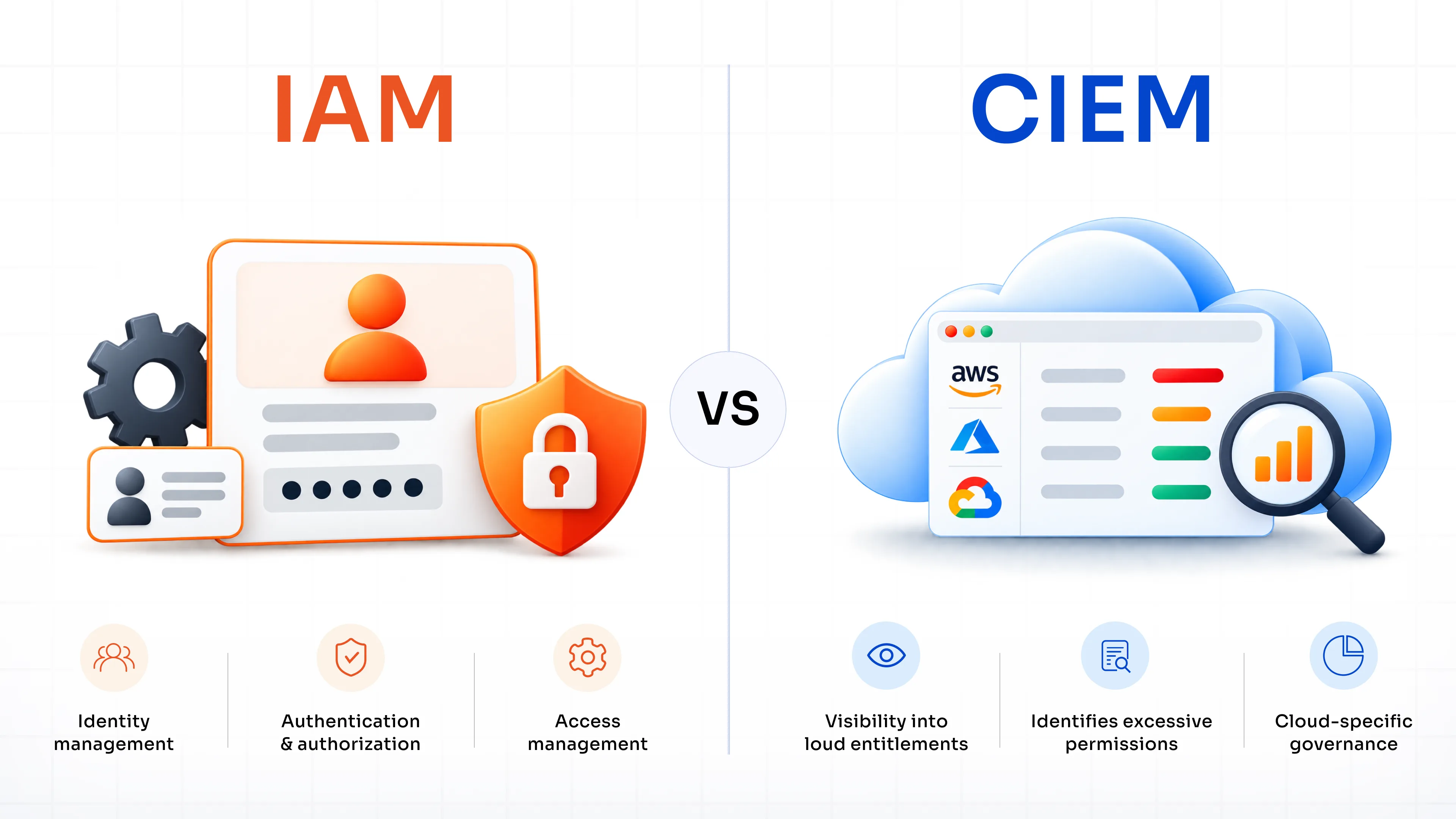
CIEM vs IAM: What's the Difference?
| IAM | CIEM |
|---|---|
| Identity and access foundation: Establishes identities and controls how they authenticate and receive access. | Cloud entitlement visibility: Maps the permissions and entitlements identities hold across cloud infrastructure. |
| Authentication and authorization: Determines whether an identity can access a resource or application based on defined policies and controls. | Effective permission analysis: Examines the permissions an identity can actually exercise, including access that may be broader than intended. |
| Identity lifecycle: Manages access as identities are created, changed, or removed throughout their lifecycle. | Permission right-sizing: Identifies excessive, unused, dormant, or unnecessary cloud permissions that can be reduced. |
| Access management: Supports capabilities such as SSO solutions, MFA, provisioning, and broader user access controls. | Cloud-specific governance: Concentrates on access to cloud resources, workloads, services, and infrastructure across environments. |
| Role-based access: Uses RBAC and other access models to determine what access should be assigned according to organizational responsibilities. | Entitlement risk analysis: Evaluates whether assigned cloud privileges create unnecessary exposure or overprivileged identities. |
| Broader identity security discipline: Provides the foundation for managing identities and access across applications, systems, and resources. | Specialized cloud capability: Extends that foundation with deeper analysis of cloud permissions and entitlement risks. |
| Primary question: Who is the identity, and what access should it receive? | Primary question: What cloud access does the identity actually have, and does it still need it? |
CIEM Best Practices
Effective best practices for cloud entitlement management are built around visibility, continuous review, and least privilege rather than simply accumulating more access controls.
1. Follow the Principle of Least Privilege
Start with the assumption that identities should receive only the permissions required for their responsibilities. Regularly evaluate whether those permissions still match current operational needs.
2. Maintain Visibility Into All Cloud Identities
Include employees, administrators, service accounts, applications, workloads, and other non-human identities in entitlement analysis. Limiting visibility to workforce identities can leave significant portions of cloud access ungoverned.
3. Remove Unused Permissions
Unused privileges represent access that exists without a demonstrated operational need. Identifying and removing these permissions reduces unnecessary exposure and helps prevent entitlement accumulation.
4. Review Entitlements Regularly
Cloud environments change continuously, so entitlement reviews should not be treated as a one-time exercise. Reassess permissions as identities, workloads, roles, and responsibilities change.
5. Use RBAC Where Appropriate
Role-based access control can provide a structured way to assign permissions according to defined responsibilities. CIEM can complement RBAC by helping organizations assess whether the permissions attached to those roles remain appropriate.
6. Monitor Privileged Identities
Privileged identities deserve particular attention because excessive permissions attached to them can create greater security consequences. Monitor their entitlements and look for access that exceeds legitimate requirements.
7. Automate Provisioning and Deprovisioning
User provisioning automation helps ensure that access is granted and removed consistently as identities move through their lifecycle. This reduces the likelihood that permissions remain attached to identities after they no longer require them.
CIEM and IAM: How Do They Work Together?
CIEM works best as part of a broader identity security architecture rather than as an isolated control. Each identity capability addresses a different part of the access lifecycle.
| Capability | Primary responsibility |
|---|---|
| IAM | Establishes and manages identities and access |
| Identity Lifecycle Management | Manages identities throughout their lifecycle |
| Provisioning | Grants and removes application access |
| RBAC | Assigns access according to defined roles |
| CIEM | Evaluates cloud permissions and entitlements |
| PAM | Protects and governs privileged access |
Think of these capabilities as connected layers rather than separate controls:
Identity → Lifecycle → Provisioning → Role → Cloud Entitlement → Privileged Access
IAM establishes the identity and its broader access framework. Identity Lifecycle Management keeps that identity aligned with changes throughout its existence, while provisioning manages the applications and resources it should receive.
RBAC can structure access around organizational roles, while CIEM evaluates the resulting cloud permissions to determine whether those entitlements are excessive, unused, or otherwise risky. PAM then adds controls around privileged access where higher levels of authority require additional protection.
Together, these capabilities allow organizations to connect identity governance with the actual permissions operating inside their cloud infrastructure. This creates a broader identity security strategy in which access can be managed from identity creation and provisioning through cloud entitlement analysis and privileged access protection.
Building a More Controlled Cloud Access Environment
Cloud infrastructure has changed the identity landscape. Access is now distributed across employees, applications, workloads, service accounts, and machines, with permissions often spanning multiple cloud environments and changing alongside infrastructure.
Cloud infrastructure entitlement management addresses the part of that challenge that traditional identity controls may not fully resolve: understanding the permissions identities actually hold within cloud infrastructure and determining whether those permissions remain necessary.
When combined with IAM, identity lifecycle management, provisioning, RBAC, and PAM, CIEM becomes part of a broader identity security strategy rather than a standalone cloud control. The result is a more continuous approach to access, one that does not stop at granting the right identity access, but keeps evaluating whether that access remains appropriate as the cloud environment evolves.
FAQs
What is the difference between CIEM and PAM?
CIEM focuses on discovering, analyzing, and governing cloud permissions and entitlements across identities and resources. PAM focuses specifically on protecting and controlling privileged access. PAM can secure high-privilege accounts, while CIEM helps determine whether cloud identities have more permissions than they actually require.
What types of identities does CIEM manage?
CIEM can provide visibility into both human and non-human identities operating in cloud environments. This includes employees and administrators, service accounts, applications, workloads, machines, and other automated identities that require permissions to access cloud resources.
What is the difference between CIEM and CSPM?
CIEM focuses primarily on identity entitlements and permissions—understanding who or what can access cloud resources and whether that access is excessive. CSPM focuses more broadly on cloud security posture, including identifying configuration risks and security misconfigurations across cloud environments.
How does CIEM reduce excessive cloud permissions?
CIEM analyzes identities, permissions, and access patterns to identify privileges that are excessive, unused, dormant, or otherwise unnecessary. Organizations can then reduce those entitlements and align permissions more closely with actual operational requirements, supporting continuous least-privilege access.
Leave a Comment