

If you’re the one who gets asked, “Who still has access to this system?” and has to check four different consoles to answer it, this is for you.
IT and security teams rarely plan their identity stack from scratch. There’s always a system that’s already there, and it keeps on building over years. A Single Sign-On (SSO) tool here, a Multi-Factor Authentication (MFA) tool there, an identity governance platform, and PAM added after a brutal audit. Each purchase solved a real problem at the time. But eventually, everything is all over the place, and a simple question of who still has access to what is difficult to answer.
Converged IAM is the fix for that accumulation. It pulls access management, identity governance, privileged access, lifecycle automation, and identity analytics into a single platform instead of five separate ones. One identity layer. One policy engine. One place to see who has access to what, and why.
Here's what that actually looks like, what it takes to get there, and where teams tend to trip on the way.
What Is Converged IAM?
Converged IAM (converged identity and access management) is an approach that brings the core identity disciplines under one platform: access management, Identity Governance and Administration (IGA), Privileged Access Management (PAM), identity lifecycle management, and identity analytics.
Rather than running each discipline as a standalone tool, purchased and managed on its own timeline, a converged IAM platform, or unified IAM platform, delivers them through a single identity security platform. Every identity, human or machine, gets managed the same way, through the same policies, visible from one single dashboard.
AI agents, service accounts, and API keys are identities now too. If your platform only governs human logins, you've already got a gap, and it's growing faster than the human side of your workforce.
Why Organizations Are Moving Toward Converged IAM
Fragmented IAM is expensive to run, and it's getting riskier to leave in place. A few challenges are pushing organizations toward converged IAM.
Identity Sprawl
The average enterprise runs dozens of identity-adjacent tools. Every new one adds a login, a policy set, and a gap between systems that nobody's watching full-time.
Identity-Based Attacks
In 2025, 22% of breaches started with stolen or compromised credentials, more than any other initial access vector, according to Verizon's DBIR. IBM's 2025 Cost of a Data Breach Report puts the average cost of a credential-based breach at $4.67 million.
Fragmented IAM makes these attacks easier. When access management, governance, and privileged accounts sit in separate systems, nobody has the full picture until it's too late.
Fragmented Identity Data
Your HR system has one version of an employee record. Your directory has another. Your PAM tool has a third. When they drift out of sync, which is to be expected once you're past 2 or 3 tools, nobody has a single source of truth for who a person actually is and what they're allowed to touch.
Compliance Pressure
NIST, PCI-DSS, DPDPDA, GDPR, and ISO 27001 all expect you to answer basic questions fast: who has access to what, when was it granted, when was it last reviewed. That's painful when the answer lives across four different consoles.
Operational Complexity
Manual provisioning. Manual deprovisioning. Access reviews done in spreadsheets. Every manual step is a place where someone gets forgotten, and forgotten accounts are exactly what attackers look for.
Cost and Vendor Management
Five vendors means five contracts, five renewal cycles, five support relationships, and five separate places where something can quietly break. Budget overruns on IAM rarely come from one bad purchase. They come from five reasonable purchases that never talked to each other.
Core Components of a Converged IAM Platform
A real converged IAM platform isn't just IGA with an AM and PAM merged. It's built from a few core disciplines working as one system.
- Identity and Access Management (AM): SSO, password management, and policy-based access to applications and resources. The front door.
- Identity Governance and Administration (IGA): Access certifications, entitlement reviews, and policy enforcement. The audit trail.
- Privileged Access Management (PAM): Controls for high-risk accounts: admins, service accounts, break-glass access. Privileged lifecycle management, from provisioning to revocation, lives here.
- Identity lifecycle management: Automated onboarding, role changes, and offboarding, usually triggered directly by HR events.
- Authentication and MFA: Multiple methods (passwords, biometrics, passkeys, hardware tokens), applied by risk level, not by default.
- Identity analytics and intelligence: AI and machine learning layered across the above to flag anomalies, unused entitlements, and identity-based threats before they become incidents. This is also where Identity Threat Detection and Response (ITDR) plugs in.
None of these components do much alone. AM without governance means you know who logged in, not whether they should have access. IGA without lifecycle automation means someone's still manually kicking off every review. The value shows up when they share one identity model and one policy engine, so a change in one place (a role update, an offboarding trigger) propagates everywhere at once instead of needing four separate updates.
How Converged IAM Works: Architecture and Lifecycle
Structurally, converged IAM sits as one layer between your identity sources and everything users touch.
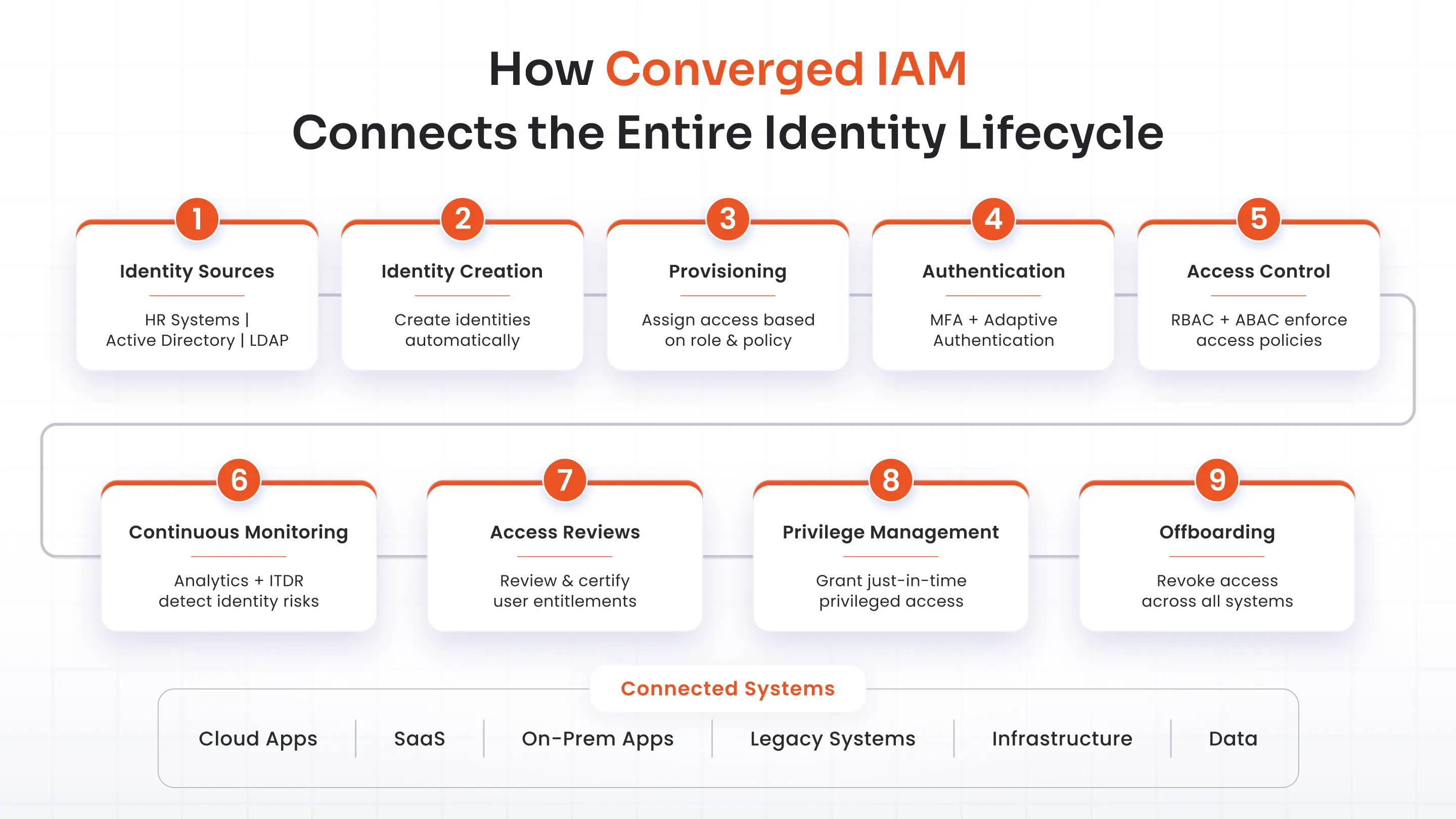
Identity sources (your HR system, directories like Active Directory or LDAP authentication) feed into that unified layer. From there, the platform applies access policies, authentication rules, and governance controls consistently, whether the resource is a cloud app, an on-prem system, or a legacy tool nobody wants to touch.
Follow a single identity through it, and the lifecycle looks like this:
- Identity created: An employee joins. The HR system triggers account creation automatically, no ticket required.
- Provisioning: Access gets granted based on role, department, and policy, not on whoever remembers to set it up.
- Authentication: MFA and adaptive authentication policies verify the identity at login, and again if the risk signal changes mid-session.
- Access policies: Role-based and attribute-based controls decide what that identity can actually touch.
- Continuous monitoring: Analytics and ITDR watch behavior in real time, not just at login.
- Access reviews: Governance runs periodic certifications so entitlements don't quietly outlive their purpose.
- Privilege management: Elevated access gets granted just-in-time, then revoked, instead of sitting active indefinitely.
- Offboarding: When someone leaves, access disappears everywhere, same day, not three weeks later when someone remembers.
That's the part traditional IAM struggles with. Not one step, but all of them staying connected to each other.
Converged IAM vs. Traditional IAM
The difference between converged IAM and traditional IAM isn't features. It's whether your identity data lives in one place or four.
Most organizations don't feel this gap until an audit, an incident, or an acquisition forces them to answer a question their siloed tools can't answer fast. "Show me everyone with access to the finance system" shouldn't take 3 days and 2 export files.
| Factors | Traditional IAM (siloed) | Converged IAM |
|---|---|---|
| Tools | Separate AM, IGA, PAM platforms | Single platform, shared identity later |
| Visibility | Fragmented across consoles | One view across all identities |
| Provisioning | Manual or partially automated | Automated, HR-triggered |
| Privileged access | Often bolted on separately | Built in as a core discipline |
| Compliance reporting | Manual aggregation across systems | Centralized audit trail |
| Vendor overhead | Multiple contracts and renewals | One vendor relationship |
| Threat detection | Siloed, reactive | Continuous, cross-identity |
Key Benefits of Converged IAM
Consolidating identity onto one platform changes more than just your vendor list. It shows up directly in security posture, audit readiness, and cost.
- Less identity and tool sprawl: Fewer platforms to patch, license, and babysit.
- Lower operational and vendor costs: One contract, one renewal cycle, fewer integration points that can break.
- Faster lifecycle management: Onboarding and offboarding happen in hours, not weeks, across every connected system at once.
- Better security visibility: One dashboard shows every identity's full access picture, human and machine.
- Stronger compliance posture: Access reviews and audit reporting come from a single source instead of a manual reconciliation project.
- Fewer manual errors: Automated provisioning and deprovisioning close the gaps where orphaned accounts usually hide.
- Better ROI: Consolidation cuts license overlap and frees your team from managing integrations between tools that were never meant to talk to each other. That's usually the number that gets budget approved, even when security is the real driver.
Common Use Cases
Here’s a list of common use cases where converged IAM shows clear benefits.
- Employee lifecycle management: HR-triggered provisioning and deprovisioning across every connected app, no manual tickets.
- Hybrid and multi-cloud identity: One policy set applied consistently whether the resource is on-prem, in AWS, or in a SaaS app.
- Privileged access governance: Admin accounts, service accounts, and break-glass access managed with the same rigor as regular user access.
- Compliance and access reviews: Certifications and audit trails ready for NIST, PCI-DSS, GDPR, or ISO 27001 without a spreadsheet marathon.
- M&A and identity consolidation: When you acquire a company, you inherit its identity mess too. Converged IAM gives you one place to fold it in.
- AI agent and non-human identity governance: Service accounts, bots, and AI agents now outnumber human identities in a lot of environments. They need lifecycle management and access reviews too, and a converged platform is where that governance actually lives instead of getting skipped.
Challenges of Implementing Converged IAM
Converged IAM deployments typically run months, not weeks. A few factors explain exactly why:
| Challenges | Why it slows things down |
|---|---|
| Existing infrastructure and legacy applications | Older systems weren't built with modern IAM protocols in mind, and migrating them takes planning. |
| Migration and data consolidation | Merging identity data from four or five systems into one means cleaning up duplicate accounts, stale entitlements, and inconsistent naming along the way. |
| Integration complexity | Every connected app, directory, and HR system needs to talk to the new platform, and that's real integration work, not a checkbox. |
| Change management | IT and security teams have workflows built around the old tools, and adjusting to new ones takes time and training. |
| Vendor and platform dependency | Consolidating onto one platform means more of your identity security rides on a single vendor relationship, worth weighing against the cost of staying fragmented. |
These are planning considerations, not reasons to stay fragmented. Budget realistic time for migration and treat it as a phased project rather than a single cutover.
Best Practices for Successful Converged IAM Deployment
A converged IAM rollout goes smoother when it follows a sequence instead of happening all at once.
- Assess your current identity environment first: You can't consolidate what you haven't mapped. Inventory every IAM-adjacent tool before you touch anything.
- Define your target architecture: Decide what unified looks like for your organization before you start migrating, not halfway through.
- Prioritize integrations by risk: Start with the systems holding your most sensitive access, not the easiest ones to connect.
- Automate lifecycle workflows early: Manual provisioning during a migration just moves the sprawl problem; it doesn't fix it.
- Standardize access policies: Role-based and attribute-based controls only work if they're consistent across every connected system.
- Migrate incrementally: Move in phases. A big-bang cutover on identity infrastructure is how outages happen.
- Measure outcomes: Track time-to-provision, access review completion rates, and orphaned account counts before and after. If the numbers don't move, something in the deployment needs a second look.
Skip the assessment step and everything downstream gets harder. Teams that jump straight to buying a platform usually end up migrating the same sprawl they started with, just under one roof instead of five.
How to Choose a Converged IAM Solution
Not every "converged" platform actually converges everything you need. Some are single tools with a few bolted-on acquisitions that don’t fully share data. Start by checking convergence: does it handle AM, IGA, PAM, lifecycle management, and analytics natively, and does governance extend to NHIs like AI agents and service accounts or just employees?
Next comes deployment. Confirm if it supports your environment (cloud, on-prem, or hybrid). Look past the marketing word ‘automated’ to see how deep the lifecycle workflows actually go vs. a handful of pre-built templates. Check if PAM is a first-class part of the platform or just an add-on module.
Finally, look at the full picture on cost and migration. Total cost of ownership should include licensing, implementation, and ongoing management.
How miniOrange Delivers Converged IAM
miniOrange's IAM platform brings access management, identity governance, privileged access, and identity analytics together under a single identity layer, covering both workforce IAM and CIAM.
It automates joiner-mover-leaver workflows straight from HR triggers, applies role-based access control consistently across cloud, on-prem, and hybrid environments, and connects to over 6,000 applications, directories, and HR systems out of the box.
Furthermore, identity threat detection sits alongside passwordless authentication and governance, not bolted on afterward. And compliance reporting for frameworks like NIST, PCI-DSS, GDPR, and ISO 27001 comes from one audit trail instead of four separate ones.
miniOrange is currently trusted by over 30,000 organizations across 150+ countries, and Gartner Peer Insights recognized it as a Strong Performer, with 89% of reviewers saying they'd recommend it for IAM.
FAQs
What is converged IAM?
It's an approach that combines access management, identity governance, privileged access management, lifecycle automation, and identity analytics into a single platform instead of separate tools.
Is converged IAM different from IAM?
Yes. IAM is the umbrella discipline. Converged IAM is a specific approach to delivering it: unified instead of siloed.
Does converged IAM include PAM?
It should. Privileged access management is a core component, not an optional add-on, in a real converged IAM platform.
What's the difference between IAM and IGA?
IAM manages authentication and access broadly. IGA is the governance layer within IAM: certifications, entitlement reviews, and policy enforcement.
Is CIAM part of converged IAM?
It can be. Some converged platforms manage workforce and customer identities (CIAM) under the same architecture; others keep them separate but connected.
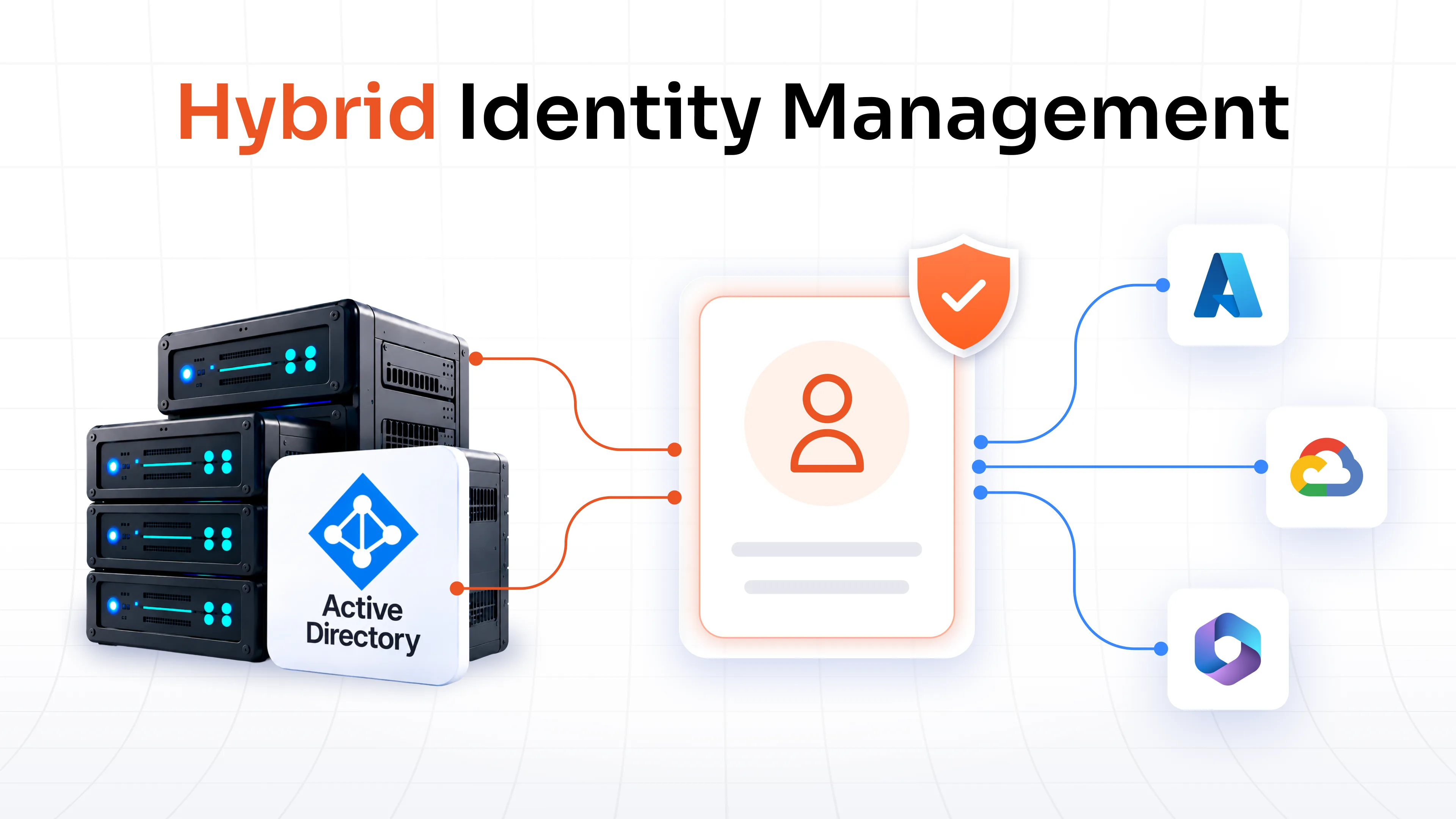
Can converged IAM support hybrid environments?
Yes. A properly built platform applies consistent policies across cloud, on-prem, and hybrid infrastructure at once.
Does converged IAM support zero trust?
Converged IAM built for zero trust security. Continuous identity verification, adaptive access, and real-time monitoring are native to converged platforms, not an extra layer.
Who should use converged IAM?
Mid-size to enterprise organizations juggling multiple IAM tools, facing compliance pressure, or dealing with identity sprawl from growth, M&A, or years of point-solution purchases. If your team can't answer "who has access to X" in under a day, that's usually the sign.
Leave a Comment