

Hybrid identity management is the practice of managing user identities and access across on-premises and cloud environments through a connected identity framework.
Most organizations today operate across both. Active Directory may still manage identities for internal applications, while cloud platforms and SaaS applications handle other parts of the business. This creates a simple challenge: how do you give users consistent access when their applications and identities exist in different environments?
Hybrid identity management addresses this by connecting these environments and giving organizations a consistent way to manage authentication, access, and user identities.
The result is a more connected identity experience for users and better visibility and control for IT and security teams.
Why Do Organizations Need Hybrid Identity Management?
Cloud adoption has changed where applications and data live, but it has not made on-premises infrastructure disappear.
A company may still depend on Active Directory, legacy applications, private databases, and internal infrastructure while adding cloud applications and services at the same time. Replacing everything at once is rarely practical, so organizations end up operating a hybrid environment for years.
The identity layer has to work the same way.
Supporting Hybrid IT Environments
Consider an employee who starts the day by signing in to an internal finance application, then moves to Microsoft 365, a SaaS application, and a cloud-hosted business service.
Those resources may live in completely different environments, but from the employee's perspective, they are all part of the same workday.
Without a connected identity strategy, IT teams may have to manage separate accounts, credentials, authentication methods, and permissions for each environment. That creates more administrative work and more opportunities for access to fall out of sync.
Hybrid identity management brings these environments together while allowing organizations to keep the infrastructure they still need.
Creating a Consistent Identity Experience
Users should not have to understand an organization's identity architecture just to access an application.
A well-designed hybrid identity environment can provide one connected identity, Single Sign-On, consistent authentication, and centralized access management across authorized resources.
This becomes even more important with hybrid work identity management. Employees may access internal applications from home, cloud applications from a corporate device, and SaaS services while traveling. Their location or the application's hosting model should not force IT to manage completely separate identity experiences.
How Does Hybrid Identity Management Work?
A typical hybrid identity environment connects an on-premises directory with a cloud identity provider through synchronization, federation, or other authentication mechanisms.
The flow can look like this:
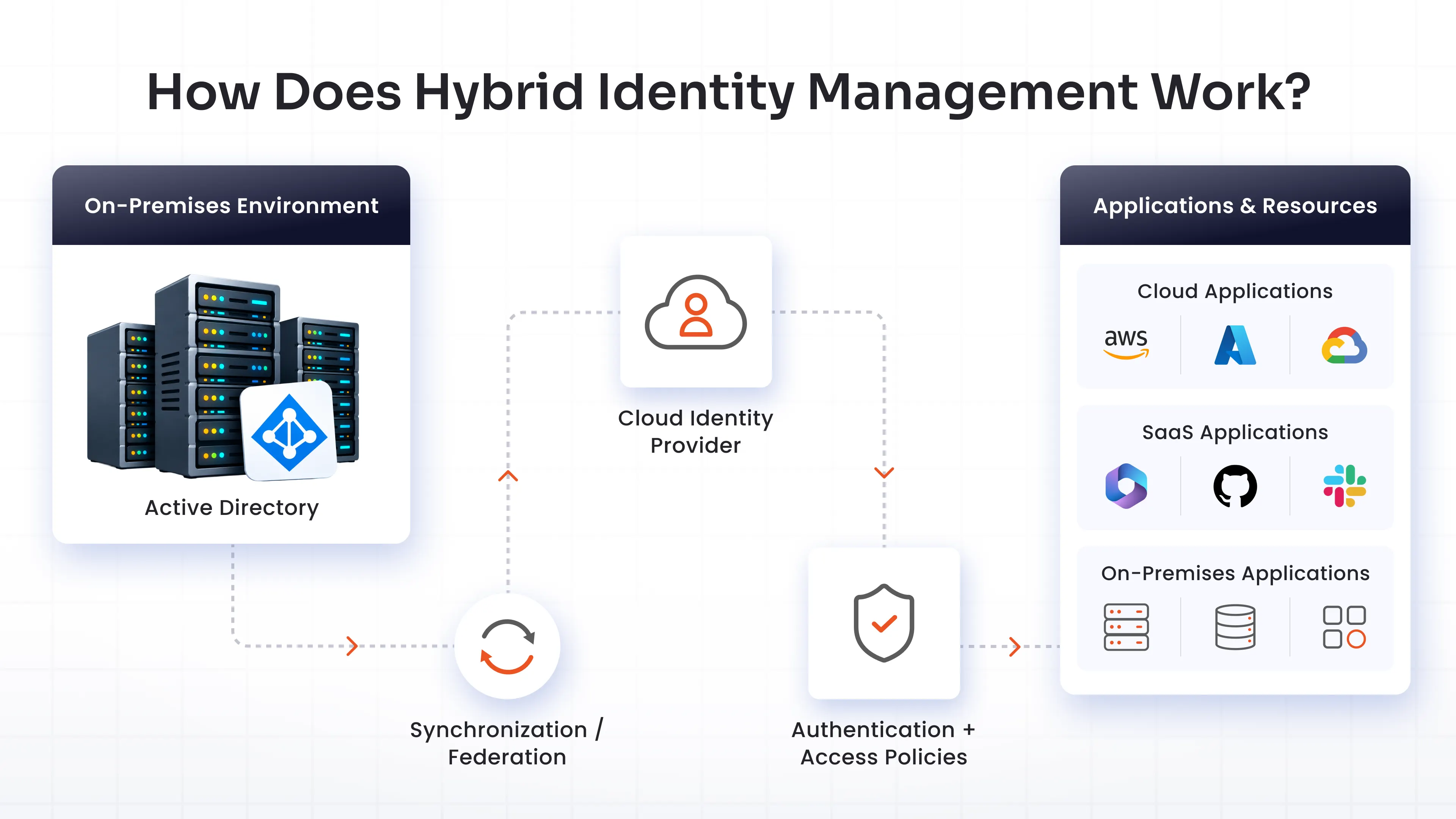
Each layer has a different job.
Identity Synchronization
Identity synchronization keeps relevant user information aligned between on-premises directories and cloud identity platforms.
For example, when a user's account information changes, the updated identity data can be reflected in the connected environment.
But synchronization alone is not enough. Having the same user information in two places does not automatically mean that the user has the right access, strong authentication, or appropriate permissions.
That is why synchronization needs to work alongside authentication, provisioning, access control, and lifecycle management.
Authentication and SSO
Authentication answers a basic question: Is this really the user they claim to be?
In a hybrid environment, authentication may involve on-premises authentication, cloud authentication, federation, password synchronization, or pass-through authentication, depending on the architecture.
SSO then makes the experience easier for users. Instead of repeatedly entering credentials as they move between applications, users can authenticate through a trusted identity layer and access the resources they are authorized to use.
Provisioning and Deprovisioning
An identity is not static. Someone joins the organization. They change teams. Their responsibilities expand. Eventually, they leave. Every one of those events can change what the person should be able to access.
Provisioning creates the accounts and access a user needs. When their role changes, access should change with it. When they leave, their access should be removed.
This is where identity lifecycle management in hybrid environments becomes important. Automating these changes helps prevent situations where an employee has moved to another department but still has access to applications from their previous role, or where a former employee's account remains active.
Key Components of Hybrid Identity Management
A hybrid identity strategy is not a single technology. It is a combination of identity and access capabilities working across environments.
Active Directory
Active Directory often remains an important identity source for users, groups, and applications running on-premises. In many organizations, it continues to sit at the center of internal authentication even as cloud adoption grows.
Cloud Identity Provider
A cloud identity provider extends identity and authentication capabilities to cloud applications, SaaS platforms, and cloud infrastructure.
The connection between the on-premises directory and cloud identity provider is what allows organizations to manage access across both environments.
Identity Synchronization
Synchronization keeps relevant identity attributes aligned between connected systems. This helps avoid maintaining completely separate versions of the same user identity.
SSO and Federation
SSO simplifies application access by reducing repeated logins. Federation allows trusted identity information to be used across different applications or environments. Together, they help create a smoother experience without giving users unnecessary credentials to manage.
MFA and Conditional Access
A password alone is not enough to protect access to critical resources.
MFA adds another layer of verification, while adaptive access can take additional context into account, such as the user's identity, device, location, or risk level.
This gives organizations more control over how access is granted, rather than simply deciding whether a username and password are correct.
Identity Lifecycle Management
Lifecycle management keeps identity and access aligned with the user's relationship with the organization. Joiners, movers, and leavers can trigger changes in accounts, groups, roles, and application access.
What Are the Benefits of Hybrid Identity Management?
The value of hybrid identity management goes beyond making different systems communicate. It gives organizations a more manageable way to control access while their IT environment spans multiple locations and technologies.
One Connected Identity
Users can work with a consistent identity across on-premises and cloud resources instead of maintaining separate identities for every environment.
Simpler Application Access
SSO can reduce repeated authentication and make it easier for users to move between the applications they are authorized to use.
Stronger Access Control
Centralized identity policies make it easier to apply consistent authentication and authorization requirements across environments.
Automated Identity Changes
Automating provisioning, role changes, and deprovisioning reduces manual work and helps keep access aligned with the user's current responsibilities.
Easier Cloud Adoption
Organizations do not have to choose between keeping existing infrastructure and adopting cloud services. Hybrid identity provides a way to connect the two while the environment continues to change.
Better Visibility and Governance
When identity and access information is managed consistently, security teams have a clearer view of who has access to what. That makes access reviews, auditing, and governance easier to manage.
What Are the Challenges of Hybrid Identity Management?
A hybrid environment solves one problem but introduces another: more connections to manage.
Identity Fragmentation
Identity information may be spread across multiple directories, applications, and identity providers. Without effective synchronization and governance, teams can lose track of which identity is authoritative.
Synchronization Failures
A synchronization issue can leave user information inconsistent between environments. That can affect provisioning, authentication, and access.
Excessive or Outdated Access
People change jobs and responsibilities faster than permissions are sometimes updated. If lifecycle processes are not automated, users can accumulate access they no longer need.
Increased Attack Surface
Connecting on-premises and cloud environments creates more relationships between systems. A compromised identity can potentially become a pathway to resources across those connected environments.
Legacy Application Limitations
Older applications may not support modern authentication methods. Bringing them into a consistent identity architecture can therefore require additional integration or compensating controls.
Administrative Complexity
IT teams may have to manage different directories, applications, authentication mechanisms, and policies. Without centralized visibility and automation, hybrid identity can become difficult to operate at scale.
How Does Hybrid Identity Support Zero Trust?
Hybrid identity management can play an important role in Zero Trust security because identity provides a common control point across different environments.
The basic idea is simple: being authenticated does not automatically mean a user should have access to everything.
Organizations can instead:
- Verify every access request using identity and contextual information.
- Use MFA based on risk when additional verification is needed.
- Enforce least privilege so users receive only the access required for their work.
- Review access continuously as identities, roles, devices, and risk conditions change.
This approach is particularly useful in hybrid environments where the same user may move between on-premises and cloud resources throughout the day.
Hybrid Identity vs. Cloud IAM
Hybrid identity and cloud IAM overlap in several areas, but they address different environments.
| Hybrid Identity Management | Cloud IAM |
|---|---|
| Manages identities across on-premises and cloud environments | Primarily manages cloud identities and resources |
| Connects existing directories with cloud identity services | Uses cloud-native identity infrastructure primarily |
| Supports legacy and modern applications | Primarily targets cloud applications and services |
| May rely on synchronization and federation | Relies mainly on cloud-native authentication |
| Fits organizations operating long-term hybrid environments | Fits organizations with primarily cloud-based environments |
For organizations still relying on hybrid Active Directory, legacy applications, or private infrastructure, hybrid identity management provides a practical way to connect those systems with modern cloud identity services.
Why Choose miniOrange for Hybrid Identity Management?
Managing hybrid identities requires more than synchronizing users between directories. Organizations need to control authentication, application access, provisioning, and identity changes across the entire user lifecycle.
miniOrange brings these capabilities together with SSO, MFA, Active Directory integration, user provisioning and deprovisioning, identity lifecycle management, role-based access, and secure authentication.
This gives organizations a way to connect existing identity infrastructure with modern applications while applying consistent identity and access controls across their hybrid environment.
FAQs
What is the difference between hybrid identity and cloud IAM?
Hybrid identity management connects on-premises and cloud identity environments, while cloud IAM primarily focuses on identities, applications, and resources within cloud environments.
What is hybrid Active Directory?
Hybrid Active Directory refers to an environment where on-premises Active Directory operates alongside cloud identity services, allowing organizations to manage identities and access across both environments.
What are the security risks of hybrid identity?
Common risks include fragmented identities, synchronization failures, excessive or outdated permissions, legacy authentication weaknesses, and additional attack paths between connected environments.
How does hybrid identity support Zero Trust?
Hybrid identity supports Zero Trust by helping organizations apply consistent authentication, MFA, least-privilege access, and access review policies across on-premises and cloud environments.
Leave a Comment