
If you’re using an Identity and Access Management (IAM) solution for safeguarding employee and customer accounts, then you must know about the IAM security risks. This is to account for the possible gaps and work on them.
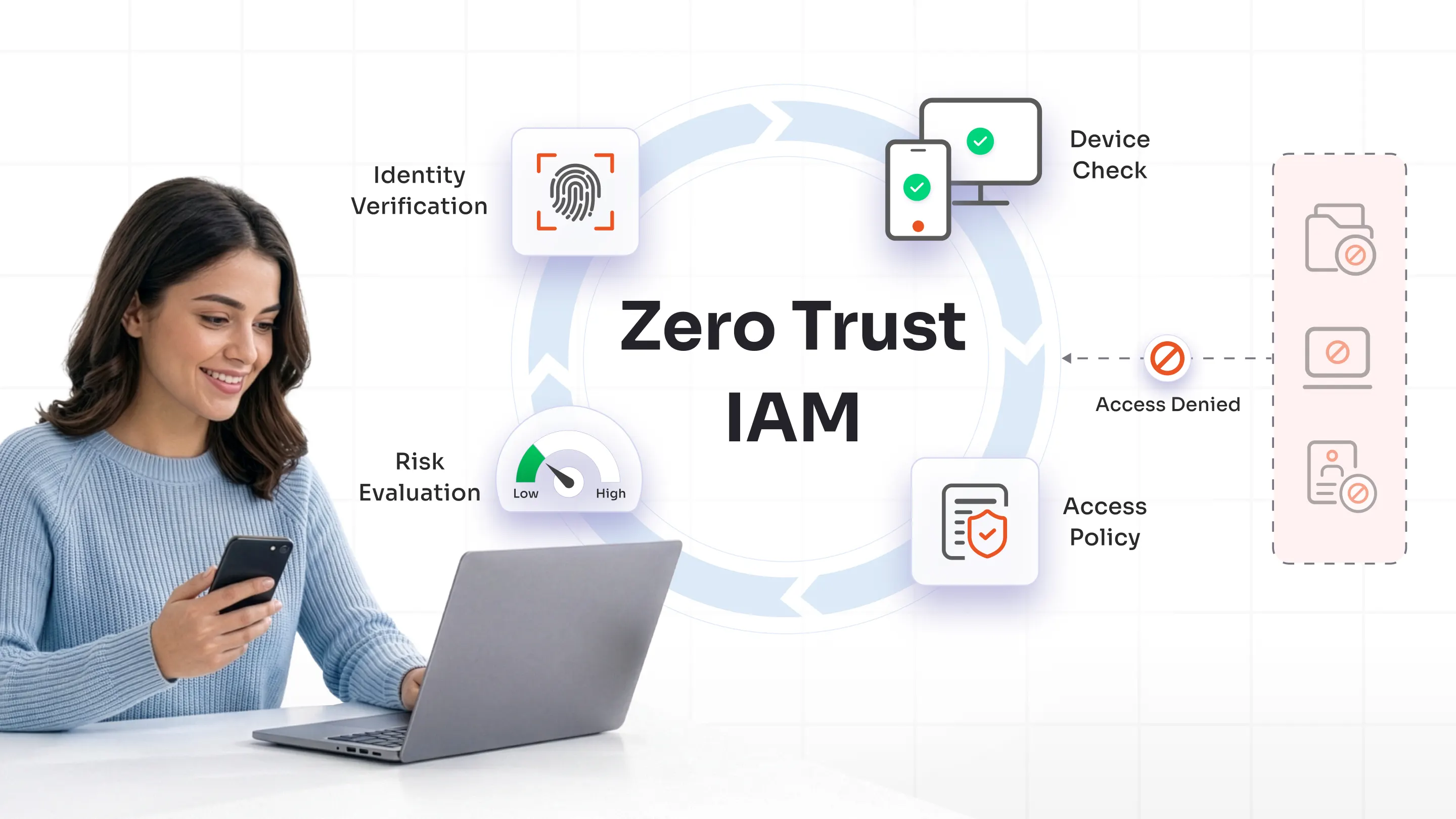
Identity security risks are no longer limited to not meeting checklists, but have shifted to a dynamic approach. A continuous, real-time, and risk-based approach is the new norm.
With the rise of machine identities and the need to secure agentic AI, IAM security risks have increased over the past couple of years. And let’s not forget about the cyberwars.
With a speedy rise in adversaries, it is paramount to understand the IAM security risks, so you can close the gaps quickly.
Below, we unpack the top IAM threats shaping 2026, the identity security risks modern enterprises face, and how forward-thinking IAM programs are evolving to tackle them.
Risk 1: Privileged Access Mismanagement
Privileged accounts are the VIPs. They hold immense power because they have access to critical data and systems. In an enterprise, usually these accounts are held by the C-suite and those working on confidential or critical projects.
If these accounts are mismanaged in ways like unmanaged access tokens, shared admin credentials, or over-provisioning service accounts, the entire infrastructure is left vulnerable. And the attackers know that if they secure privileged accounts, they practically own the network.
Solution: A modern PAM (Privileged Access Management) solution enforces the Principle of Least Privilege (PoLP) dynamically, Just-in-Time (JIT) access, user activity monitoring, and more.
Risk 2: Weak or Stagnant Authentication Controls
Gone are the days when static Multi-Factor Authentication (MFA) methods like SMS codes or passwords were the means of offering access to accounts. Today, passwords are easily phished, and codes are easily intercepted. Also, there’s a chance of losing devices through which you would normally perform MFA.
Furthermore, password reuse across apps, sites, and devices has become a common practice, leading to credential stuffing and brute force attacks. Plus, MFA fatigue is a common attack for stagnant authentication controls.
Solution: Passwordless authentication and adaptive MFA can help to secure logins. The former eliminates the use of passwords entirely, often driven by FIDO2/WebAuthn, whereas the latter steps up MFA based on risk and contextual signals like user behavior, IP, device, and location.
Risk 3: Lack of Visibility Across Multi-Cloud and SaaS
The shift towards the cloud and the use of myriad SaaS products has improved workflows and data storage, but at the same time, it has produced a major issue. The use of varied cloud and SaaS environments has led to siloed identity storage, access permissions, configurations, and policies. This situation creates blind spots for attackers to strike.
When the organizations fail to answer questions like “Who has access to what?” or “Which identities are overprivileged?”, they’re already at risk.
Solution: Cloud IAM and CIEM (Cloud Infrastructure Entitlement Management) solutions that unify access insights across environments, enabling real-time auditing and automated remediation.
Pro tip: Integrating cloud IAM monitoring with your security operations center (SOC) gives teams the context they need to detect identity-driven anomalies faster.
Risk 4: Delayed De-Provisioning and Orphan Accounts
The digital footprint of an employee remains even after they leave an organization. Accounts that are left active beyond an employee’s tenure give rise to orphaned accounts. These accounts are the prime targets of threat entities because they still have system-level access or even privileged permissions.
Solution: Automated JML (Joiner-Mover-Leaver) provisioning workflows and synchronization with the HRIS systems. This ensures that access entitlements stay synced throughout the user lifecycle.
Risk 5: Entitlement Sprawl or Privilege Creep
Entitlement sprawl, also known as privilege creep, is a situation where users accumulate permissions they no longer need, sometimes across multiple roles or departments.
Without regular access reviews, organizations lose track of who holds sensitive permissions and why. Entitlement sprawl leads to insider threats, compliance failures, operational inefficiencies, and breaches.
Solution: Operationalize regular reviews, least privilege access, and JIT access to handle entitlement sprawl and remove unnecessary access.
Risk 6: Weak Governance and Compliance Mapping
IAM governance is about setting policies that define who can access what, how, and why. Compliance mapping, on the other hand, means linking IAM controls and activities to official regulations or frameworks like HIPAA, GDPR, or SAMA, so an organization can prove it meets legal and industry security standards.
So, when an organization has “weak governance and compliance mapping,” it means:
- There are no clear rules or oversight for managing identities and access.
- Access controls might be handled inconsistently across teams or applications.
- There’s no direct connection between IAM policies and compliance requirements.
- When auditors request evidence of access reviews, permissions, or certifications, the data is scattered, outdated, or missing.
Solution: Formalize policies and approval workflows, along with regular access reviews and certifications. Also, opt for automated audit reporting that shows which identities have which entitlements. Further, clear mapping of IAM controls to compliance frameworks.
Risk 7: SAML/OAuth/OIDC Misconfigurations
SAML, OIDC, and OAuth misconfigurations are setup mistakes in the Single Sign-On (SSO) flows that allow cybercriminals to log in and gain unauthorized access.
This usually happens in how tokens, redirects, signatures, and trust relationships are configured between your IdP and apps. When SAML/OIDC/OAuth are misconfigured, attackers can easily bypass authentication, steal sessions, or impersonate users.
Solution: Validate JSON Web Tokens (JWT). Use strict redirect URIs and updated libraries to handle token validation and XML parsing.
Risk 8: MFA Bypass Threat
MFA isn’t completely bulletproof. Cybercriminals are masters at creating real-time phishing kits and Adversary-in-the-Middle (AiTM) proxies capable of intercepting MFA codes. These cybersecurity attacks make MFA bypass one of the fastest-growing IAM security risks of 2026.
Solution: Phishing-resistant MFA solutions like FIDO2, WebAuthn, and device-bound credentials significantly reduce this risk. Adaptive MFA mechanisms further elevate security levels through context-aware authentication methods.
Risk 9: Shadow IT Usage
Shadow IT continues to undermine enterprise security postures. Business teams often spin up unauthorized apps or cloud services without IT’s knowledge, creating unmanaged identities scattered across the environment.
Each of these unsanctioned identities expands the identity attack surface. Attackers can exploit weak or duplicated credentials in these systems to move laterally into sensitive core networks.
Solution: Adaptive monitoring, automated app discovery, and centralized SSO help bring shadow IT under control through real-time visibility and monitoring over all SaaS apps and cloud systems.
Risk 10: Identity Misconfigurations
Often overlooked, identity misconfigurations are the foundation of many breaches. Misaligned role policies, broken conditional access rules, or excessive default privileges can silently open doors to threat actors.
Common examples include misconfigured SCIM connectors, broad trust relationships, and unverified provisioning scripts. These issues rarely trigger alerts but can expose critical systems for months.
Solution: Continuous configuration scanning and policy-as-code frameworks are emerging as essential defenses because they help in strengthening security posture.
The Emerging Layer: Machine and Service Identities
In 2026 and beyond, machine identities such as API tokens, IoT endpoints, and service accounts outnumber human identities by a wide margin. Each represents a potential entry point.
Machine identity management involves securing certificates, enforcing rotation policies, and reducing persistent trust between services.
As AI workloads and automation scale, governance models must account for non-human identities, auditing them just as rigorously as they do for employees.
Why These Risks Matter Now?
Identity is the connective tissue of every digital business. When identity and access management fails, the entire ecosystem collapses—access controls, data protection, and compliance all rely on it being secure.
In 2026, attackers are increasingly targeting identity infrastructure because it’s highly privileged and often underprotected.
Compromising credentials is cheaper and faster than breaching hardened firewalls or Endpoint Detection and Response (EDR) systems. Yet, the consequences are far-reaching: from ransomware infiltration to full-scale cloud compromise.
Prioritizing IAM security isn’t simply an IT objective anymore; it’s a board-level mandate tied directly to business trust, resilience, and competitive advantage.
How IAM Experts Like miniOrange Address These Risks?
Leading IAM providers like miniOrange are redefining enterprise identity defense through unified visibility, automation, and adaptive trust frameworks.
- Centralized SSO and Identity Federation: Simplifies access across all apps and clouds while ensuring secure federation trust models.
- Adaptive MFA and Passwordless Authentication: Provides context-aware, phishing-resistant login protection using FIDO2 and WebAuthn.
- Privileged Access Management (PAM): Enforces least privilege through session control, just-in-time access, and continuous monitoring.
- Automated JML Provisioning (SCIM + HRIS Integrations): Streamlines onboarding and de-provisioning to eliminate orphan accounts.
- Cloud IAM + CIEM Visibility: Gives enterprises real-time insight into multi-cloud entitlements and misconfigurations.
- Compliance Evidence and Audit Reporting: Builds a traceable identity governance trail that simplifies regulatory mapping.
- Phishing-Resistant Authentication (WebAuthn + FIDO2): Stops credential phishing before it starts.
By embedding these capabilities, enterprises can drastically reduce their IAM threat exposure while enhancing user experience and regulatory posture.
To know more about these solutions, connect with our IAM security experts.
FAQs
What are the identity and access management solutions?
The top IAM solutions include Adaptive MFA, SSO, 2FA/MFA, and user lifecycle management, to name a few.
What are the best practices to counter IAM security risks?
The top three best practices to counter IAM security risks are:
- To implement a Just-in-Time (JIT) access solution
- To adopt passwordless authentication models
- To treat AI agents as privileged users
With these practices and mitigation strategies, the organizations can easily evade the security risks of IAM.

Leave a Comment