

Businesses deploy autonomous AI agents to scale their operations, query production databases, run automated troubleshooting, and even execute complex CI/CD pipelines. AI can do all of this at speeds humans simply cannot match.
For most of these tasks, AI agents need privileged access. For instance, they might need access to your cloud environments, sensitive APIs, databases, and other critical business software.
That is risky from a security perspective. But they can’t work without that access. To address this, businesses have relied on static credentials, long-lived API keys, and over-provisioned service accounts. You hardcode an API secret into an environment variable and grant the agent root or admin privileges.
However, as non-human identities outnumber human users, standing privileges can create a massive, unmanaged attack surface. If an attacker compromises an agent or executes a prompt injection, those static credentials give them full, unrestricted access to your system.
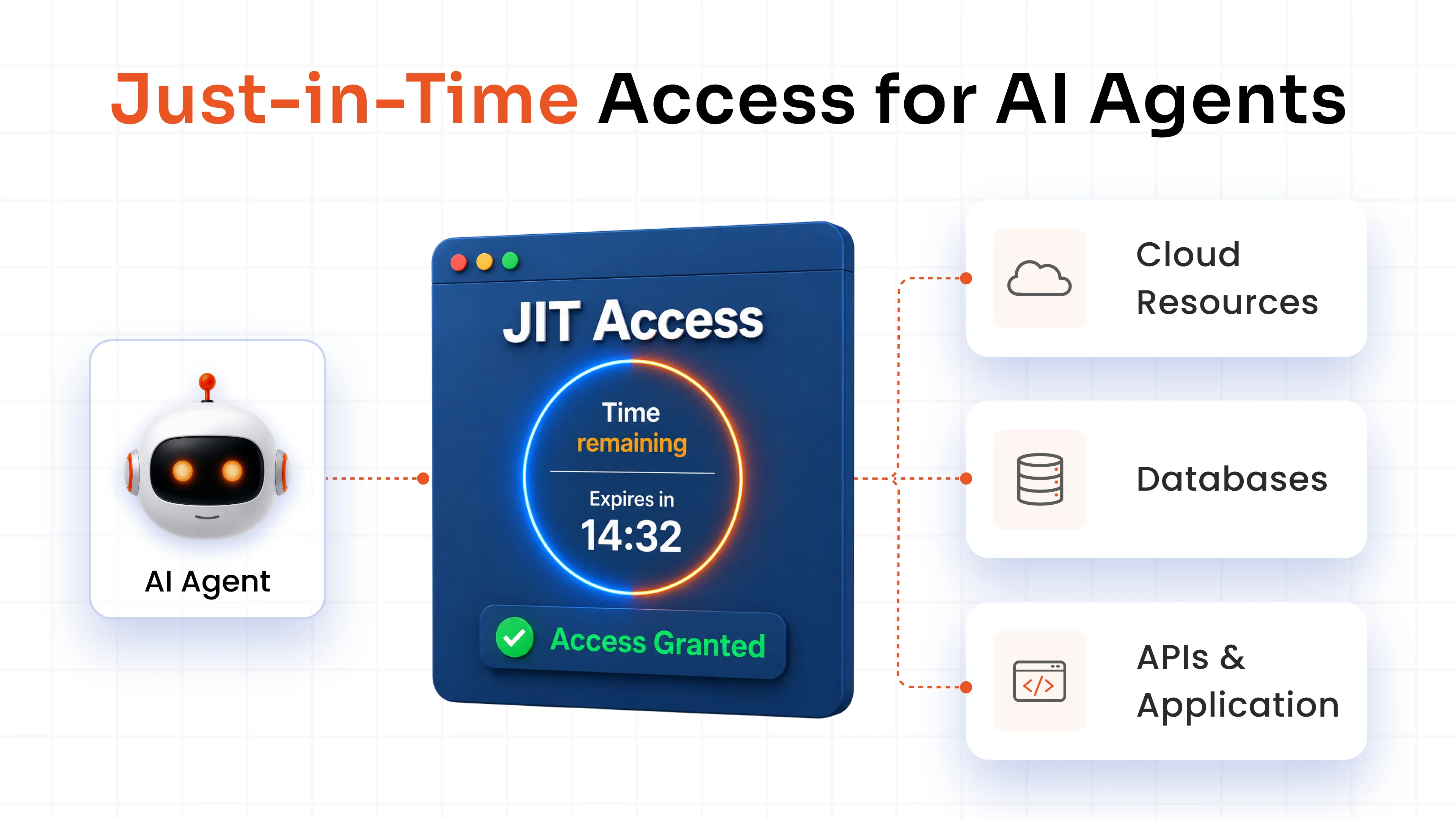
Just-in-time access for AI agents solves this fundamental problem. Instead of granting permanent privileges, a Just-in-Time (JIT) access solution provisions dynamic, ephemeral credentials only when an agent requests a task and revokes them immediately upon completion.
What Is Just-in-Time Access for AI Agents?
Just-in-time access for AI agents gives an AI agent privileged access only when it needs it and for a limited period. Instead of keeping standing credentials active, it provisions dynamic, temporary permissions that automatically expire once the agent completes its workflow.
Why Traditional Access Management Fails for AI Agents
Traditional Identity and Access Management (IAM) and legacy Privileged Access Management (PAM) tools were built for human workflows.
AI agents don’t work like humans. They act autonomously and interact with multiple systems through APIs and credentials.
For a deeper dive into this shift, read our guide on why traditional PAM is failing machine identities.
Here is why legacy access controls fail when applied to AI agents:
1. Long-Lived Static API Keys
Developers often generate long-lived API keys to let AI agents query backend systems. These keys may sit in config files, secret managers, or code repositories. Because rotating API keys can break complex workflows, teams rarely rotate them. If an attacker extracts a single key, they gain persistent access.
2. Long-Lived Secrets
Machine identities rely heavily on persistent secrets, such as OAuth tokens with long expiration windows or static database passwords. The longer a credential remains active, the larger its window of vulnerability.
3. Shared Service Accounts
Organizations often assign multiple AI agents to a single, highly privileged service account. This makes accountability harder. When an anomaly occurs, you cannot distinguish whether Agent A executed an unauthorized query or Agent B experienced a system failure.
4. Lack of Least Privilege
AI agents need agility to run varied tasks. To prevent agent workflows from breaking, engineers frequently over-provision permissions, granting full read/write access across entire data stores. This conflicts with the principle of Just Enough Access and increases the potential impact of compromised or misconfigured agents.
5. No Runtime Context
Traditional IAM checks credentials at the point of authentication, not during execution. A legacy system checks if the API key is valid, but it cannot evaluate why the agent is performing an action, what prompt triggered it, or how long the action should take. Without real-time context, legacy tools cannot stop suspicious agent behavior.
How Just-in-Time Access Works for AI Agents
Transitioning to just-in-time access for AI agents replaces permanent permissions with dynamic, workflow-driven access controls. There are no permanent credentials. The AI agent requests elevated privileges only when it needs to perform a verified operation.
Here is the step-by-step lifecycle of how JIT access operates for autonomous non-human workloads:
Step 1: Discovery or Manual Creation of API User
The first step is to establish the identity that will receive privileged access.
You discover existing machine identities across your cloud environments or manually register the AI agent within your management engine as a dedicated API user identity.
Step 2: Identity Verification and Policy Evaluation
When the AI agent initiates a workflow requiring elevated rights, it submits a request to the access management engine. The system evaluates the agent's identity, source network, task parameters, and risk level against defined security policies.
Step 3: Automated Approval Workflow
Depending on your security threshold, the request routes through pre-configured logic rules. Standard high-frequency operational tasks receive instant, policy-based automated approvals. High-risk actions, such as modifying production schemas, can trigger real-time notifications to human administrators.
Step 4: Temporary Credential Issuance
Once the request passes the required controls, the system can issue temporary credentials.
This is the core of temporary access for AI agents. Instead of leaving a privileged credential available indefinitely, you provide access for the required period. The agent can use the credential to perform its authorized task during that window.
Step 5: Runtime Monitoring and Session Recording
While the agent operates using its temporary privileges, the session monitoring engine logs every API payload, command execution, and database query in real time. This ensures complete observability into autonomous machine behavior.
Step 6: Automatic Revocation
When the AI agent completes its designated task, or the defined Time-to-Live (TTL) window expires, the system revokes the temporary access. The system terminates active tokens, restoring the environment to a posture of Zero Standing Privileges.
Security Risks of Standing Privileges for AI Agents
Leaving static credentials inside autonomous workflows makes your organization vulnerable. Implementing just-in-time access for AI agents directly mitigates these vulnerabilities:
- Credential Theft: Hardcoded API keys and static cloud secrets stored in code repositories or runtime environments can become targets for automated secret-scanning attacks.
- Lateral Movement: If an attacker compromises an AI agent with standing privileges, they can move laterally across connected cloud networks, databases, and microservices.
- Prompt Injection Attacks: Attackers can craft malicious inputs that manipulate an LLM-powered agent into executing unintended commands. If the agent holds standing administrative access, prompt injection grants the attacker admin rights.
- Agent Hijacking: Malicious actors can intercept vulnerable agent orchestration loops, hijacking active sessions to exfiltrate proprietary corporate data.
- Privilege Escalation: Over-provisioned AI agents allow malicious actors (or misconfigured agents) to escalate access levels across integrated third-party systems.
- API Abuse: Without rate limits and dynamic lifetime boundaries, a rogue or compromised agent can flood critical microservices, causing systemic denial-of-service outages.
- Audit Non-Compliance: Unmonitored machine accounts with permanent access fail key audit guidelines for SOC 2, ISO 27001, HIPAA, and PCI-DSS.
How miniOrange PAM Secures AI Agents with JIT Access
miniOrange Privileged Access Management (PAM) provides dedicated infrastructure designed to eliminate standing privileges for both human users and autonomous workloads.
Here are the key miniOrange PAM features that solve AI agent security challenges:
JIT Access
miniOrange PAM eliminates long-lived credentials by providing short-lived JIT-based credentials that auto-expire, enforcing Zero Standing Privileges.
This makes temporary access for AI agents a practical part of your privileged access strategy.
Least Privilege
You can control privileged access based on defined policies rather than giving an identity unrestricted access. This helps you apply the principle of least privilege.
Automated Approval Workflows
miniOrange PAM supports approval workflows for privileged access. This allows you to introduce an approval step before privileged access is granted where your policies require it.
Enterprise Password Vault
Centralizing privileged credentials gives you a controlled place to manage them instead of relying on scattered credentials.
For AI agent access, this becomes particularly important because non-human identities may need credentials to interact with privileged resources.
Privileged Session Monitoring
This gives you real-time visibility into privileged sessions and creates a record of activity for review. That visibility matters when you manage non-human identities because an AI agent may perform privileged actions without a human manually executing every step.
Audit-Ready Reports
miniOrange generates detailed compliance trails mapping actions directly to individual agent identities.
FAQs
Can AI agents use Just-in-Time access?
Yes. AI agents can request and use Just-in-Time access programmatically when the required APIs and integrations are available. Access platforms evaluate the agent’s request parameters, issue short-lived credentials for the task, and revoke them automatically upon task completion.
Is JIT different from PAM?
Just-in-Time (JIT) access is a core capability within modern Privileged Access Management (PAM). While legacy PAM focuses on vaulting and managing permanent credentials, JIT PAM focuses on eliminating standing access entirely by issuing credentials on demand for a limited duration.
How do AI agents authenticate securely?
AI agents authenticate using secure non-human identity standards, such as short-lived mTLS certificates, OAuth 2.0 client credentials, signed JWTs, or cloud workload identity federation. This allows the PAM system to verify the agent's identity before issuing dynamic privileges.
Does JIT improve compliance?
Yes. JIT access simplifies compliance with frameworks like SOC 2, ISO 27001, HIPAA, and PCI-DSS. By eliminating standing permissions and generating audit logs for every dynamic session, organizations prove that non-human access operates strictly under the principle of least privilege.
Is JIT suitable for CI/CD pipelines?
Yes. JIT access works seamlessly within CI/CD pipelines and DevOps workflows. Build runners and deployment agents request dynamic credentials at job startup, run the build or deployment scripts, and drop privileges the moment the job finishes.
How does JIT support non-human identities?
JIT supports non-human identities by replacing static API keys, stored secrets, and permanent service accounts with short-lived tokens. It provides machine workloads with rapid, automated access provisioning and revocation without requiring manual human oversight.

Leave a Comment