

Privileged accounts typically perform high-impact activities. You have to monitor their sessions continuously to ensure nothing goes wrong.
A Privileged Session Monitoring through PAM platform makes this possible using agent-based or agentless approaches. Both have legitimate use cases. However, the choice does affect deployment, coverage, maintenance, visibility, scalability, and operational overhead.
Choosing between agentless vs. agent-based monitoring depends on what you need to monitor and how much control you need at the endpoint.
In this guide, we compare how agent vs. agentless monitoring works in PAM, breaking down their mechanics, advantages, limitations, and key differences so you can choose the best fit for your team.
What Is Agent-Based Monitoring?
Agent-based monitoring relies on dedicated software installed directly on each target endpoint. The agent runs as a local service on the operating system. It monitors user sessions, captures host logs, and communicates directly with your central PAM platform over an encrypted network connection.
Because the software sits inside the host system, it records granular system events and enforces policies directly at the OS level.
How Agent-Based Monitoring Works
The monitoring flow follows a direct path:
- Privileged user requests access and logs into the target system.
- Target system + Agent executes the session locally while the endpoint agent captures background processes, system calls, and local command executions.
- PAM platform receives continuous host-level visibility from the agent for centralized logging and control.
Advantages of Agent-Based Monitoring
-
Deep Host-Level Visibility
The agent captures edits, events, and other activities directly from the host system. This can include intercepting local command executions, kernel calls, registry modifications, and file-system changes right at the OS layer.
This direct presence lets you capture actions taken directly on the server console or through local scripts, giving security teams an unalterable audit trail of deep host behaviors.
-
Detailed Endpoint Activity
Installing an agent lets you track exact endpoint behaviors down to specific process IDs and executable hashes. You gain full insight into users’ attempts at local privilege escalation or launch restricted administrative binaries.
Instead of merely seeing high-level session traffic, you monitor every local configuration change and catch potential threats and anomalies immediately.
-
Potentially Richer Telemetry
Because the agent has direct access to the host, it can collect endpoint-specific information that goes beyond standard endpoint traffic. It can monitor system performance metrics, local event logs, active memory usage, and background service changes.
This level of contextual data depth allows you to correlate user actions with underlying system impact and support privileged user behavior analytics
-
Host-Specific Controls
An agent can enforce policies right on the endpoint to block malicious activities before they execute. You can restrict unauthorized executable files, block malicious script executions, and revoke temporary administrator rights instantly on Windows, macOS, or Linux endpoints.
Controlling local OS capabilities directly on the device shuts down malware propagation and unauthorized software installations at the host level.
-
Monitoring During Network Outages
Host agents with local caching enabled can function even if the network connection drops. Once network connectivity recovers, the agent automatically syncs the cached audit data back to your central vault without losing log data.
Limitations of Agent-Based Monitoring
-
Requires Agent Deployment
As the name suggests, you must manually install the software on every target machine. As your environment grows, you will have to install and configure those agents across hundreds of endpoints.
-
Compatibility Requirements
The agent must support the operating system or device on which you plan to deploy it. This becomes a consideration when your infrastructure includes multiple operating systems or legacy systems.
You must constantly verify that agent releases support new OS kernel patches, legacy Linux distributions, or updated Windows builds before deploying updates.
-
Agent Maintenance/Upgrades
Updates, upgrades, troubleshooting, and lifecycle management become part of your operational workload. Your team must schedule regular update windows, test new agent versions in staging environments, and troubleshoot failed installations.
-
Operational Overhead
Managing agents across a large environment can add deployment, monitoring, troubleshooting, and change-management tasks. This continuous operational burden consumes valuable engineering resources that could otherwise focus on strategic security initiatives and automation.
-
Resource Consumption
An endpoint agent consumes local resources such as CPU and memory on the host systems, which can affect system performance. On high-throughput production servers, like busy database systems or real-time application nodes, agent overhead can slow host performance and increase latency.
-
Coverage Gaps
Network hardware like switches, routers, firewalls, cloud appliances, and proprietary OT devices simply do not support agent installation. They will be vulnerable if you rely solely on an agent-only approach.
-
Challenges With Ephemeral/Third-Party Systems
Installing an agent may not be practical when the target system belongs to a vendor, contractor, or another organization. Auto-scaling cloud servers spin up and down too quickly for traditional agent provisioning.
-
Change-Management Concerns
Every software modification made to production servers requires strict change control approvals and risk assessments from infrastructure teams. Updating host-based agents across mission-critical systems requires approvals, maintenance windows, and regression testing to prevent unexpected server downtime.
These administrative hurdles often delay security patching and slow down the rollout of critical monitoring policies.
What Is Agentless Monitoring?
Agentless monitoring observes privileged activity without installing software on your target systems. Instead, it routes connections through a centralized proxy gateway or leverages native administrative protocols like SSH, RDP, and HTTPS. The central gateway brokers the connection, injects vault credentials, and provides session isolation while recording session activity.
How Agentless Monitoring Works
With agentless monitoring, a privileged user connects to the target system through the PAM platform. The platform monitors the session and captures activity. You can monitor and manage the session from the centralized platform. Because the monitoring takes place outside the endpoint, you don’t have to modify the target system to get centralized visibility.
Advantages of Agentless Monitoring
-
No Software Installation on Target Systems
This is the biggest operational difference. You don't need to deploy a monitoring agent to every server. It also means you can get started much faster and secure privileged access across cloud, on-premises, and hybrid environments.
-
Lower Endpoint Maintenance
There’s no need to patch or update agents on every target system, which saves a lot of effort and time for your IT team. All maintenance happens centrally on the PAM platform gateway, ensuring your endpoints remain stable.
-
Easier Centralized Management
You manage the configuration and access through the PAM platform rather than maintaining software across every endpoint. This includes session policies, recording configurations, access controls, and credential injection. Any change you make takes effect immediately across all managed sessions through the central gateway.
-
Easier Onboarding of Multiple Systems
You can add new servers, cloud instances, databases, or network devices to your security perimeter with simple network configuration rather than software rollouts. You secure target assets by pointing native protocol connections (SSH, RDP, web) through your centralized PAM gateway.
This ease of onboarding means you can scale and add new systems without adding more overhead for your IT team.
-
Useful For Third-Party/Vendor Access
It can be difficult to install agents on third-party vendor machines, but you might still need to give them privileged access to your systems.
With agentless monitoring, third-party users connect through web portals or gateway proxies using standard protocols without installing software on their personal or corporate devices. You grant granular, time-bound access, inject vault credentials automatically, and record external sessions while maintaining strict isolation from host systems.
-
Reduced Agent Lifecycle Management
You don't need to maintain a separate agent lifecycle across every protected system. You avoid tracking agent software versions, renewing agent host certificates, and troubleshooting corrupted local installations.
Your operational overhead remains low because your central gateway handles scaling without increasing endpoint complexity as you grow.
Limitations of Agentless Monitoring
-
Visibility Depends on the Architecture
Agentless PAM relies on supported session protocols (RDP, SSH session monitoring, database, web) and gateway proxy design. If a proprietary application or non-standard protocol does not route cleanly through a central proxy gateway, session visibility and command indexing become limited.
Your depth of session inspection remains tied directly to the capabilities of the protocol and proxy architecture handling the connection.
-
Less Host-Level Telemetry
You may not get the same depth of system-level information that a host agent can provide.
The gateway records everything visible within the user's interactive session stream, such as terminal commands, video feeds, and keystrokes, but misses offline local events, background kernel calls, and direct console activity performed outside the proxy connection.
-
Limited Endpoint-Specific Controls
Proxy-based agentless gateways control session traffic but cannot directly alter local endpoint operating system permissions. Without an agent on the endpoint, you cannot directly block local application launches, restrict local USB drivers, or revoke offline local administrator rights on the physical machine.
-
Network/Proxy Dependency can Matter
Agentless monitoring depends on remote connectivity and the architecture used to reach the target. You need constant connectivity during sessions. If network connectivity drops or proxy gateways experience high latency, live remote sessions will suffer.
Your organization must design redundant, high-availability gateway infrastructure to prevent single points of failure from impacting privileged admin workflows.
-
Some Endpoint Controls Require an Agent
When you need to enforce controls directly on the endpoint, an agent may be necessary. Enforcing least privilege on workstations, blocking local privilege escalation, and controlling application execution on offline laptops require host-side agents.
The best approach is to combine agentless session gateways with targeted host agents to get total coverage across infrastructure and endpoints.
Agent-Based vs. Agentless Monitoring: Key Differences
When you're evaluating agentless vs. agent-based monitoring, focus on the trade-off between endpoint depth and operational simplicity.
| Factors | Agent-Based Monitoring | Agentless Monitoring |
|---|---|---|
| Deployment | Agent installation required across targeted systems | No target-side agent required. Faster deployment. |
| Initial setup | Can be complex with package installation and registration involved | Generally simpler. No installation on target required |
| Maintenance | Agents require regular updates and management | Lower endpoint maintenance and provisioning costs |
| Endpoint impact | Consumes system resources | Minimal target-side impact |
| Scalability | Growth means installing agents on more endpoint devices | Easier to onboard systems without installing software on each target |
| Third-party systems | Can be difficult when you cannot install software | Often more practical when you do not control the target system |
| Best suited for | Deep endpoint visibility and endpoint-specific controls | Broad, centralized monitoring and privileged session access |
Is Agentless or Agent-Based Security Better?
Neither approach is definitively better. Your choice depends on your infrastructure goals and operational constraints.
Choose an agent-based approach when you need:
- Detailed visibility or controls that must operate directly on the host.
- Strict local application control.
- Local privilege revocation.
Conversely, choose an agentless approach if your priorities are:
- Centralized monitoring and control.
- Zero endpoint overhead.
- Easy vendor management.
- Faster deployment across cloud, on-premises, or hybrid environments.
There’s a possibility that your particular requirements might not strictly fit into one of these categories. The right approach here is to combine both methods to cover different parts of your infrastructure.
How Does miniOrange PAM Approach Privileged Session Monitoring?
If you are looking for an agentless PAM platform that can be deployed within a week, miniOrange fulfills those requirements and goes beyond.
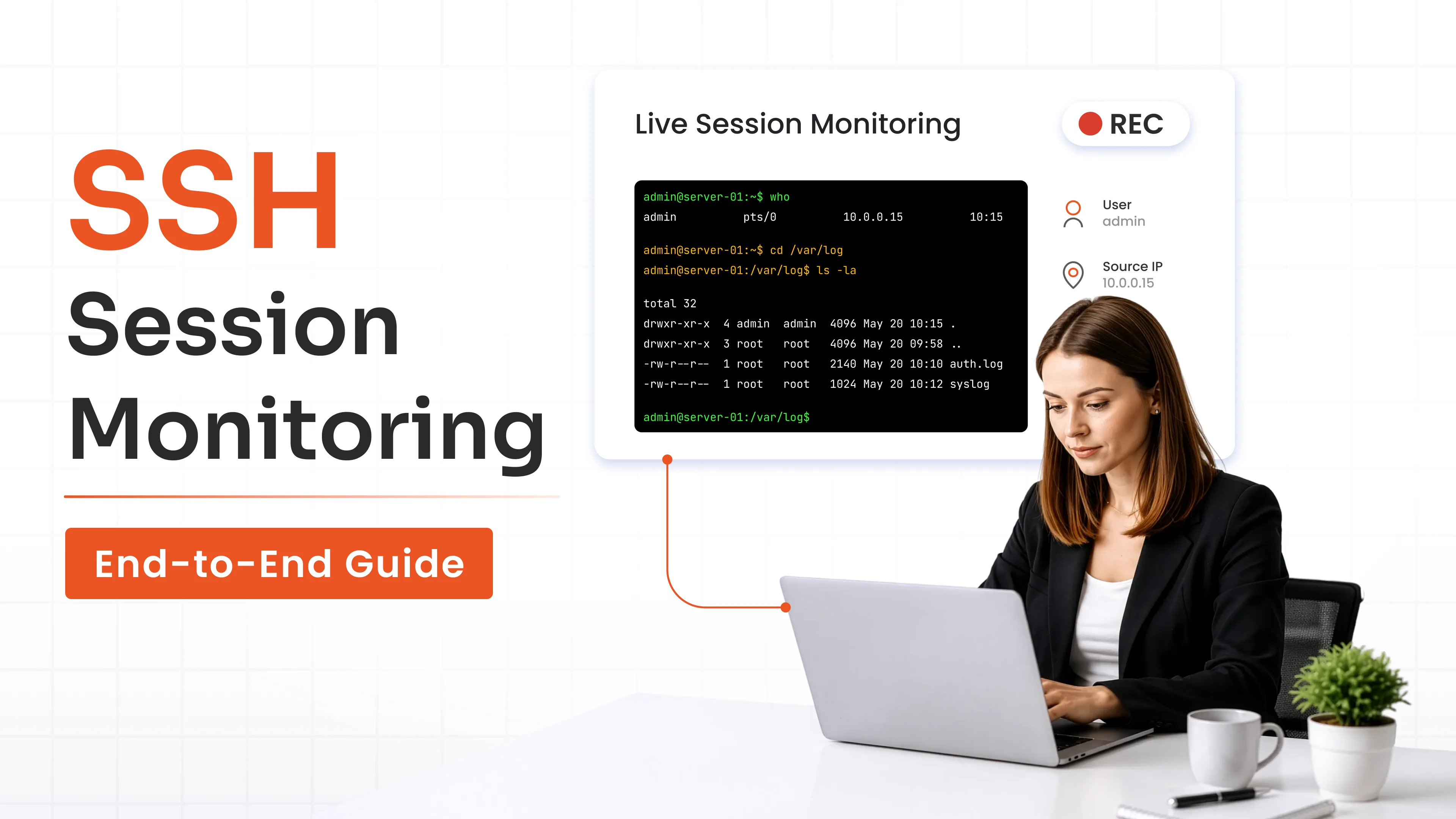
miniOrange PAM platform supports real-time agentless privileged session monitoring and recording, including visibility into privileged user activity. You can monitor privileged sessions across supported access methods such as SSH, RDP, and database connections.
This can be helpful when you're managing privileged access for vendors, contractors, or other third parties where endpoint software installation may not be practical.
But there are cases when you might need endpoint-specific privilege controls, which require agents. miniOrange PAM provides an Endpoint Privilege Management (EPM) agent that runs on managed endpoints and can detect privilege requests, apply configured policies, and support temporary privilege elevation.
Get in touch with the team, and we’ll help you choose the deployment model based on the control you actually need.
FAQs
Which companies offer agentless PAM solutions with strong monitoring features?
miniOrange offers agentless PAM for privileged session monitoring, including real-time session monitoring, recording, playback, and session controls. It lets you monitor privileged access without installing a monitoring agent on every target system.
What are the main differences between agentless and agent-based monitoring in PAM?
Agentless monitoring does not require software on target systems and simplifies deployment and maintenance. Agent-based monitoring installs software on the endpoint, enabling deeper host-level visibility and endpoint-specific controls. miniOrange PAM supports agentless privileged session monitoring and uses an agent for endpoint-specific privilege management.
What are the key advantages of agentless PAM session monitoring?
Agentless PAM session monitoring eliminates target-side agent deployment, reduces endpoint maintenance, and simplifies centralized management. With miniOrange PAM, you can monitor and record privileged sessions across supported access methods without installing a session-monitoring agent on every target.
What are the disadvantages of agent-based monitoring solutions for privileged access?
Agent-based monitoring requires you to deploy, maintain, update, and manage agents across target systems. Compatibility requirements, resource consumption, and systems where agents cannot be installed can also create operational challenges.
Does agentless PAM provide enough visibility into privileged sessions?
Yes, agentless PAM can provide strong session-level visibility when the required protocols and access methods are supported. miniOrange PAM provides real-time privileged session monitoring, recording, playback, and session controls without requiring a monitoring agent on target systems.
Leave a Comment