

Password spraying and credential stuffing are two of the most common password-based cyberattacks that are used to compromise user accounts. Yet, security teams frequently use the terms interchangeably, which is a problem because the two attacks behave very differently and call for different defenses.
Both of these attacks target the same weak point (the login page). And both can lead to full account takeover. But the technique, the pace of attack, and the source of the passwords involved are not the same.
This guide breaks down how each attack works, the key differences between them, and outlines the practical controls from MFA to adaptive MFA solutions that stop both before they result in a breach.
Why Password-Based Attacks Continue to Succeed
The numbers speak for themselves as to why password-based attacks still continue to flourish.
- In early 2024, Microsoft disclosed that the Russian state-sponsored group Midnight Blizzard had breached its corporate email systems using a password spraying attack against a legacy test account with no MFA enabled.
- By February 2024, Microsoft reported the Midnight Blizzard group had increased its password spray volume tenfold compared to January, all while deliberately limiting attempts per account to stay under the radar.
- On the credential stuffing side, Akamai tracked roughly 26 billion credential stuffing attempts per month in 2024, and 2025 volumes are tracking at or above that level.
- Verizon's 2025 Data Breach Investigations Report found that credential-based attacks, including stuffing, now account for over a fifth of all confirmed breaches, ahead of phishing as the single most common breach vector.
These numbers explain why password-based attacks remain the top way into enterprise systems, despite years of security investment elsewhere.
Billions of credentials are already circulating from prior breaches, and widespread password reuse means a breach at one unrelated website can hand attackers a working key to a completely different organization.
Automated tools do the rest, letting bots attempt thousands of logins per minute and fueling the rise of Account Takeover (ATO) as a primary attack outcome.
Attackers favor these methods over more sophisticated exploits simply because they are cheap, scalable, and don't require in-depth technical skill.
What Is a Password Spraying Attack?
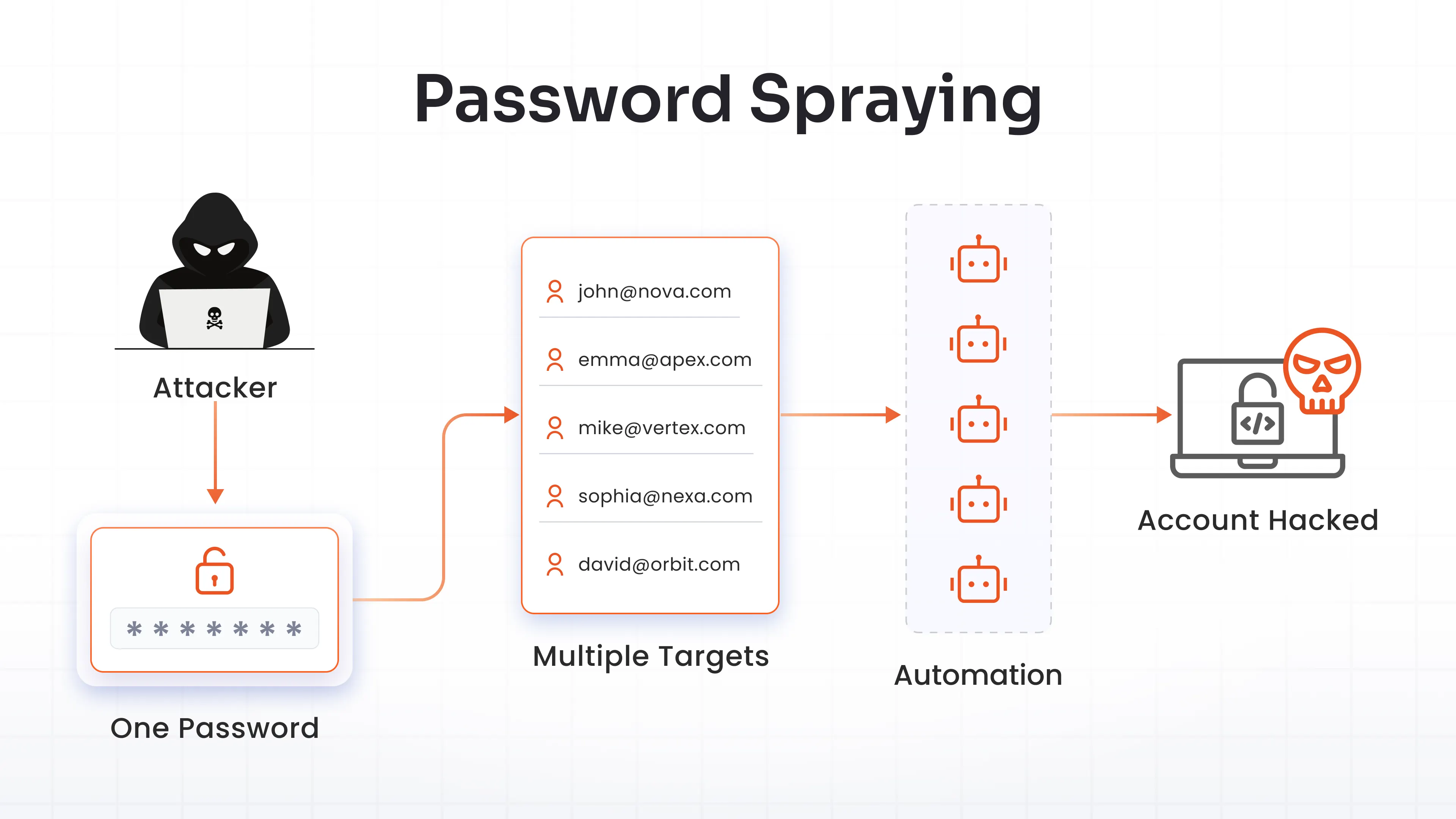
A password spraying attack uses one commonly guessed password, such as "Password123" or "Welcome1," and attempts to log in with it across many different user accounts, rather than repeatedly guessing multiple passwords against a single account.
Attackers rely on this approach because most organizations lock accounts after a set number of failed attempts. Traditional brute-force attacks, which hammer one account with many guesses, quickly trigger those lockouts.
Password spraying inverts the ratio: one password against many accounts. To stay under the radar, choose passwords based on predictable human behavior: seasonal terms, company names, default vendor passwords, or entries from common password lists.
How Does Password Spraying Work?
Here's what the attack typically looks like from start to finish:
1. Scope out the target: Attackers research the organization's domain and email naming conventions using public sources like LinkedIn or from breach data already in hand.
2. Build a username list: They compile hundreds or thousands of likely or confirmed usernames based on that pattern.
3. Pick a handful of passwords: Instead of random guessing, they choose a short list of high-probability passwords - think seasonal terms or common defaults.
4. Run automated login attempts: Bots try the chosen password against every username on the list.
5. Slow it down: Attempts are spaced out, sometimes by minutes or hours, so no single account trips a lockout.
6. Flag the hits: Any successful login gets noted for follow-up.
7. Move deeper into the network: Once inside, attackers explore, escalate privileges, or pivot toward more valuable targets.
The pacing in steps 4 and 5 is really the whole trick because no single account shows a burst of failed logins. The attack hides inside normal login noise unless an organization is watching authentication patterns across its entire user base, not just per account.
What Is Credential Stuffing?
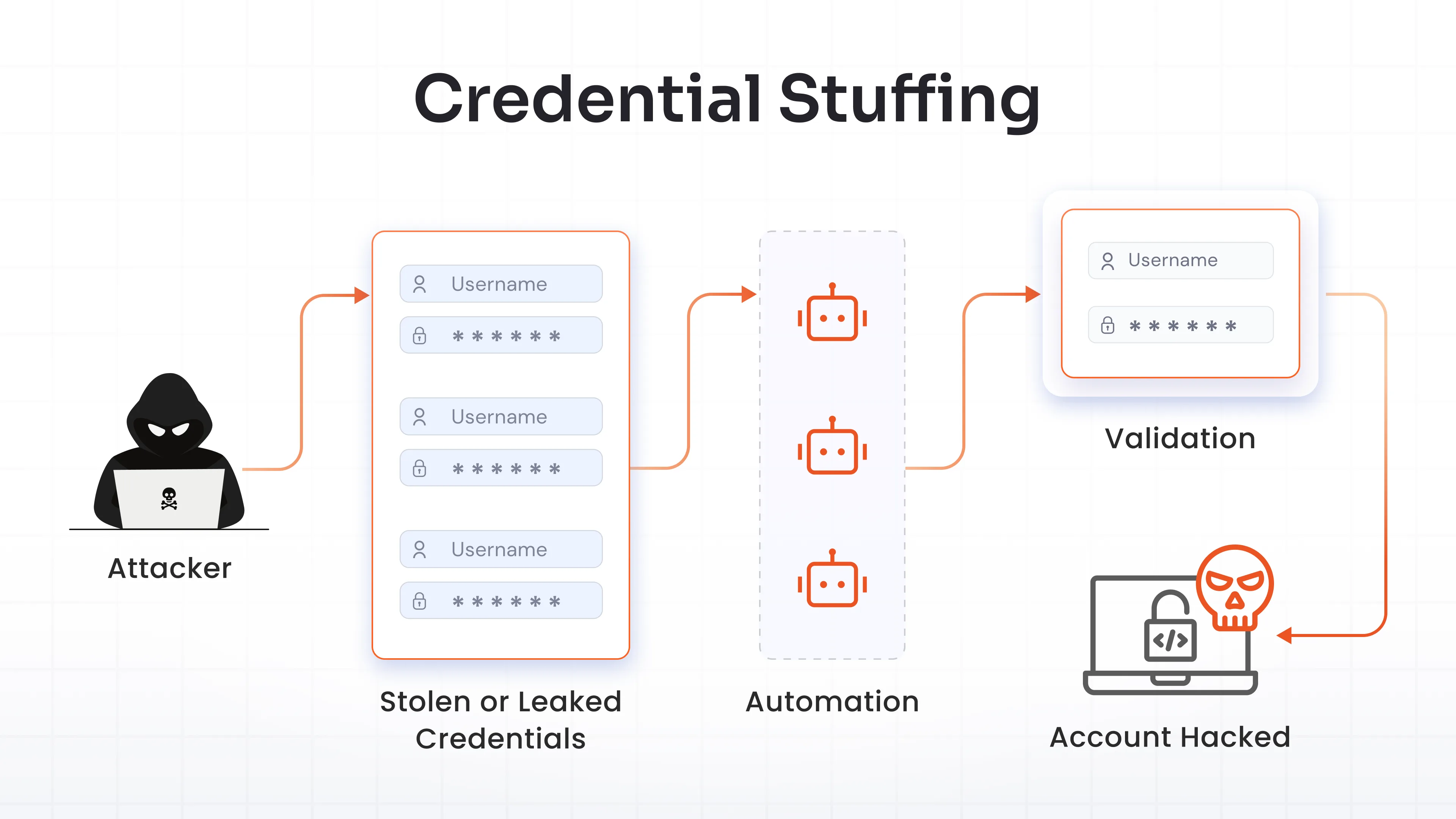
Credential stuffing uses lists of already-stolen username-password pairs, typically harvested from prior data breaches. They attempt logins across other websites and applications, betting that users have reused the same credentials elsewhere.
Unlike password spraying, which relies on guessing weak passwords, credential stuffing relies entirely on known, working credentials. These sets, sometimes containing millions of pairs, are bought, sold, and shared on dark web marketplaces.
The vulnerability being exploited is simple: password reuse. When a user's email and password leak in one breach, that same pair often works at a completely different bank, retailer, or corporate portal.
As breach volumes keep climbing and automation tools get cheaper, credential stuffing keeps getting easier to run at scale. Every new large-scale breach effectively arms the next wave of stuffing campaigns.
How Does Credential Stuffing Work?
1. Obtaining leaked credentials: Attackers acquire username-password pairs from breaches, directly or through third parties.
2. Purchasing credential dumps: Large lists are bought and sold on dark web marketplaces, sometimes priced by industry or region.
3. Credential validation: Smaller test batches confirm which credentials are still active.
4. Automated login attempts: Bots test validated pairs against the target's login page, often distributed across many IP addresses.
5. Successful account takeover: Matching credentials grants direct access, no guessing required.
6. Fraudulent activity: Attackers drain funds, steal data, or use the account to launch further attacks.
7. Credential resale: Confirmed working credentials are resold at a premium.
Automation is what makes this scalable. Millions of credential pairs can be tested against a target in a short window, and because each attempt uses a technically "correct" password for that pair, many bypass basic rate-limiting or lockout defenses.
Password Spraying vs. Credential Stuffing: Understanding the Key Differences
Both are password-based attacks aimed at account takeover, but the mechanics differ enough to require different detection and prevention strategies. Here's how they compare side by side:
| Factors | Password Spraying | Credential Stuffing |
|---|---|---|
| Password Selection | Guess a small set of commonly used, predictable passwords | Uses known credentials already confirmed to work elsewhere |
| Attack Target | Many accounts, one password | Many accounts, many specific, matched credential pairs |
| Login Attempt Pattern | Slow and deliberately spaced out | Fast and high-volume |
| Source of Credentials | Generic, guessed passwords with no link to the target's breach history | Credentials stolen from real, prior breaches, often unrelated to the target |
| Likelihood of Lockouts | Designed to avoid lockouts by limiting attempts per account | Can trigger lockouts on volume, though distributed IPs help evade this |
| Primary Goal | Find any account with a weak, guessable password | Find any account where a user reused a breached password |
Both attacks ultimately aim to compromise user accounts. Spraying exploits weak password choices, and stuffing exploits password reuse. Knowing which technique is in play helps security teams apply the right detection logic and defenses.
Why Do Attackers Choose Password Spraying or Credential Stuffing?
The choice usually comes down to what an attacker already has on hand. Password spraying is the fallback when there's no breach data specific to the target. But usernames can be guessed or scraped, and it works best against organizations with weak password policies or thin monitoring across accounts.
Credential stuffing takes over when attackers are sitting on large volumes of breached credentials and are targeting platforms: consumer apps, e-commerce sites, and SaaS products, where password reuse is likely.
Three factors tend to drive the decision:
- How structured and guessable the target's usernames are
- How much breach data is already available for that target's user base
- How fast the attacker wants results
Credential stuffing moves faster because it skips the guessing step entirely, while spraying is slower but can still succeed against organizations that have never been breached, simply by exploiting weak password habits.
Common Signs Your Organization Is Under Attack
Early detection matters! The window between initial compromise and real damage (exfiltration, fraud, lateral movement) can be short. Catching these signs early lets organizations lock down accounts and contain incidents before they escalate.
Here are the signs that you should look out for:
- Multiple failed logins spread across many accounts, rather than concentrated on one
- Login attempts from unusual or geographically inconsistent locations
- Sudden spikes in authentication traffic, especially outside business hours
- Login attempts matching known breached credential lists
- A rise in account lockouts clustered in a short window
- Unusual authentication behavior, such as logins from new devices followed by unusual activity
Business Risks of Password Spraying and Credential Stuffing
A single successful password spraying or credential stuffing attempt rarely stays contained to one account.
Once an attacker is in, the damage compounds quickly. It starts with account takeover and often escalates into data breaches that expose customer or corporate information. This is followed by financial fraud through unauthorized transactions and privilege escalation that turns one low-level login into access over sensitive systems.
The downstream costs are significant. Organizations face compliance violations under frameworks like GDPR, HIPAA, or PCI-DSS when account takeover leads to unauthorized data access. This goes hand-in-hand with the reputational damage that follows a publicized breach: customer trust, once lost, is expensive to rebuild.
There's also the operational hit: business disruption from emergency lockdowns and forced password resets, plus the direct incident response costs of investigation, forensics, and remediation.
For regulated industries like healthcare, BFSI, and government, these costs are compounded further by mandatory breach disclosure timelines and potential regulatory penalties. This means the financial and reputational fallout from a single compromised account can extend well beyond IT.
How to Prevent Password Spraying and Credential Stuffing Attacks
Defend against automated login attacks by combining multi-factor authentication with strict access controls and real-time behavioral monitoring. By eliminating single-factor vulnerabilities and blocking brute-force attempts, you significantly reduce the risk of unauthorized account takeovers. Let’s look at the other preventive measures:
- Enforce strong password policies: Longer, more complex passwords shrink the pool of guessable passwords vulnerable to spraying.
- Eliminate password reuse: Unique passwords per service directly undermine credential stuffing.
- Enable Multi-Factor Authentication (MFA): Even a guessed or stolen password can't complete login without a second verified factor, making MFA one of the most effective controls against both attacks.
- Adopt Passwordless Authentication where possible: Removes the password attack surface entirely.
- Use Adaptive Authentication: Adjusts requirements based on context (location, device, behavior) to catch anomalies a static policy would miss.
- Implement Risk-Based Authentication (RBA): Scores each login for risk, applying step-up verification only when needed.
- Deploy CAPTCHA and bot protection: Slows or blocks the scripted attempts that both attacks depend on.
- Configure rate limiting: Restricts attempts per IP or time window, disrupting high-volume automation.
- Enable smart account lockout policies: Tuned to detect patterns across the user base, not just per account, to catch spraying.
- Monitor for breached credentials: Cross-referencing credentials against breach databases flags stuffing risk before it's exploited.
- Continuously monitor login behavior: Real-time analysis flags both slow spraying and high-volume stuffing.
- Educate employees on credential security: Reduce weak password choices and password reuse at the source.
Building a Modern Identity Security Strategy Against Password-Based Attacks
Relying on passwords alone is no longer sufficient. A modern identity security strategy layers multiple controls so a compromised password is never enough on its own to grant access.
- Identity and Access Management (IAM) provides the foundation, centralizing authentication and access
- Multi-factor authentication ensures that a valid password alone isn't enough
- Passwordless authentication solution removes the password attack surface for supported applications
- Single Sign-On (SSO) solution reduces the number of credentials users manage, cutting down on reuse
- Risk-based and continuous authentication add ongoing verification based on context and session behavior, rather than trusting a single point-in-time login
- Privileged Access Management (PAM) software protects sensitive systems even if a standard account is compromised
- Identity threat detection ties it all together by monitoring authentication activity for spraying and stuffing patterns as they happen
Together, these controls reflect a core principle of modern identity security: passwords are necessary but insufficient on their own, and every login should be verified with context, not just credentials.
How miniOrange Helps Prevent Password Spraying and Credential Stuffing
miniOrange helps security teams strengthen authentication without breaking user experience. MFA and Adaptive MFA block stolen-password access while adjusting to real-time risk signals.
Passwordless Authentication and SSO cut password-related attack surface and sprawl, and Risk-Based Authentication triggers extra verification only when needed.
Centralized policies and real-time monitoring give teams full visibility into spraying and stuffing attacks all from one IAM platform covering cloud and on-premises apps.
FAQs
What is the difference between brute forcing and password spraying?
Brute-forcing tests many passwords against one account, often triggering lockouts quickly. Password spraying inverts this, testing one password across many accounts to stay under lockout thresholds.
What makes password spraying hard to detect?
Spaced-out, low-volume attempts per account mean no single account shows an obvious spike — detection requires monitoring patterns across the whole user base.
What is the best defense against credential stuffing?
Multi-Factor Authentication, since it blocks access even when an attacker has a valid, matching username and password.
Which attack is more dangerous, credential stuffing or password spraying?
Both carry serious risk, but credential stuffing often has a higher success rate at scale since it uses confirmed, working credentials rather than guesses.
Can Multi-Factor Authentication (MFA) stop password spraying and credential stuffing attacks?
Yes, MFA requires a second verification factor beyond the password, so a guessed or stolen password alone can't complete authentication.
What should I do if my credentials have been exposed in a data breach?
Change the exposed password immediately, update it wherever it was reused, enable MFA, and monitor for unusual account activity in the days following.


Leave a Comment