
A single telecom login is one of the most dangerous keys in existence. Behind it sit subscriber identities, billing systems, and the network backbone every other industry depends on.
In April 2025, SK Telecom admitted attackers had stolen authentication records tied to its USIM cards, affecting 27 million subscribers, with malware present for years before discovery. Weeks earlier, the FBI warned of a campaign using AI-generated voice and text to trick targets into handing over account access. Attackers aren't breaching firewalls; they're logging in, and passwords keep failing.
Verizon's 2025 DBIR found the human element behind 60% of breaches, with stolen credentials the top entry method at 22%. MFA closes that gap: 99.9% of compromised accounts don't use it.
Why Do Telecommunications Companies Need MFA?
A telecom provider isn't defending one perimeter. It's defending network operations centers, customer-facing portals, OSS/BSS platforms, remote engineers, cloud workloads, 5G core infrastructure, and a long tail of third-party vendors, all at once. Every one of those is an access point, and every access point protected by a password alone is a liability.
The problem is that passwords fail predictably. They get phished, reused, leaked, and sold. Once a valid credential lands in the wrong hands, an attacker can walk through the front door as a legitimate user, and no firewall will stop them. Supply-chain exposure compounds it, with third-party involvement in breaches doubling year over year to roughly 30% of all cases in the 2025 DBIR.
MFA closes that gap. By requiring a second (or third) factor beyond the password, it blocks credential theft, phishing, and account takeover even when the password itself is compromised. That protection matters most for the highest-risk surfaces in telecom: remote administrative access to network equipment, 5G and cloud infrastructure, and privileged accounts that can reconfigure the network itself.
Common Security Challenges MFA Helps Address in Telecommunications
Telecom threats aren't abstract. Here's what carriers are up against, and where MFA changes the math.
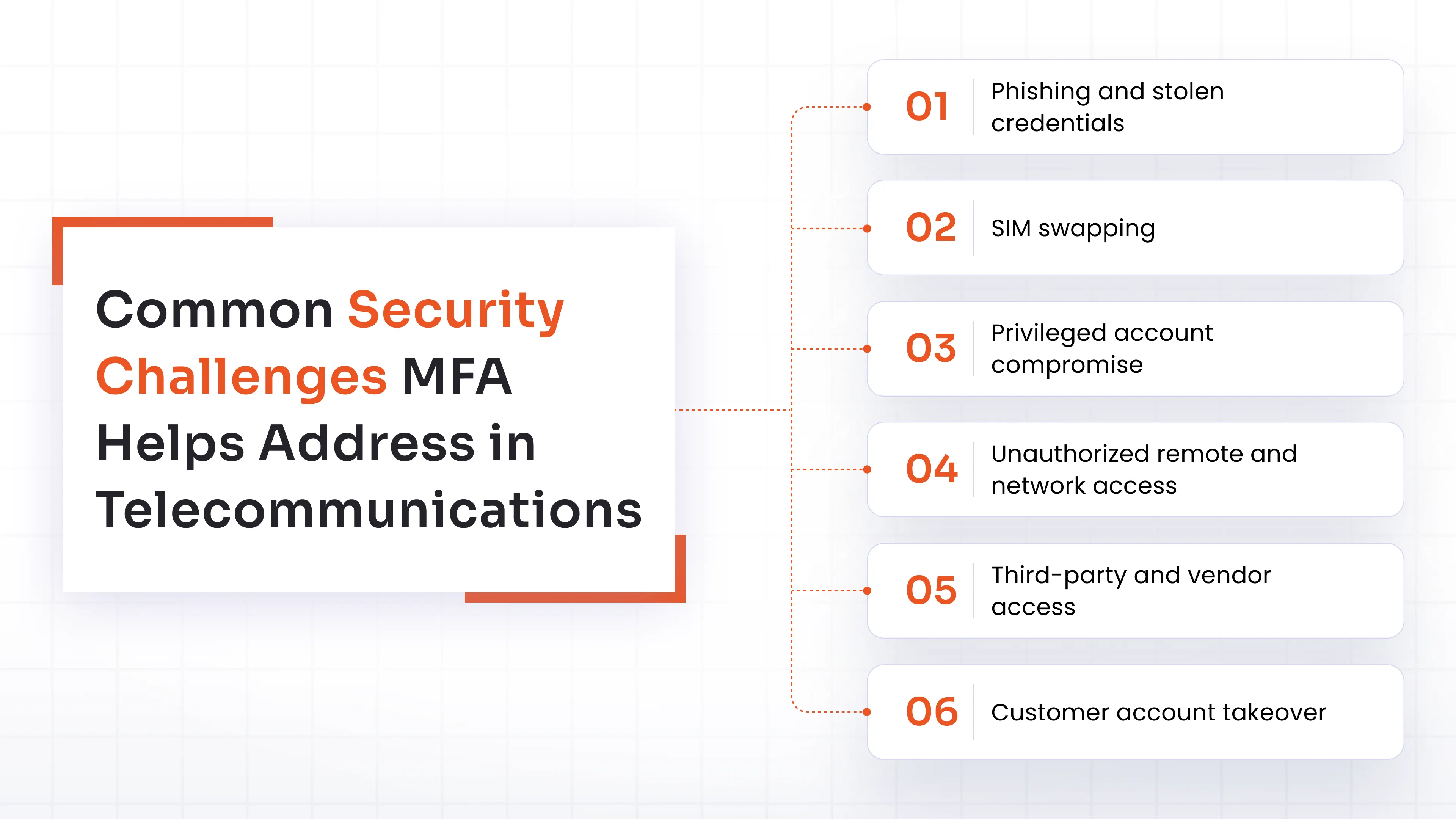
1. Phishing and stolen credentials
Attackers use a phishing attack to trick employees into handing over login credentials, or simply buy leaked ones. MFA blocks the reused password by demanding a second factor the attacker doesn't have.
2. SIM swapping
A well-known telecom-specific attack is SIM swapping, where a fraudster ports a victim’s phone number to a SIM card they control, allowing them to intercept SMS codes and potentially take over accounts. The lesson here is important: MFA helps, but which MFA method you choose matters enormously (more on that below).
3. Privileged account compromise
Network admins hold the keys to the kingdom. MFA on privileged access ensures a stolen admin password alone can't reconfigure your core.
4. Unauthorized remote and network access
Engineers connect to sensitive infrastructure from everywhere. MFA on VPN and network devices verifies that a remote session is really your engineer.
5. Third-party and vendor access
Supply chain attacks and vendor compromises are major entry points for attackers. MFA on vendor accounts helps limit the blast radius if a compromised partner's credentials are used to gain unauthorized access.
6. Customer account takeover
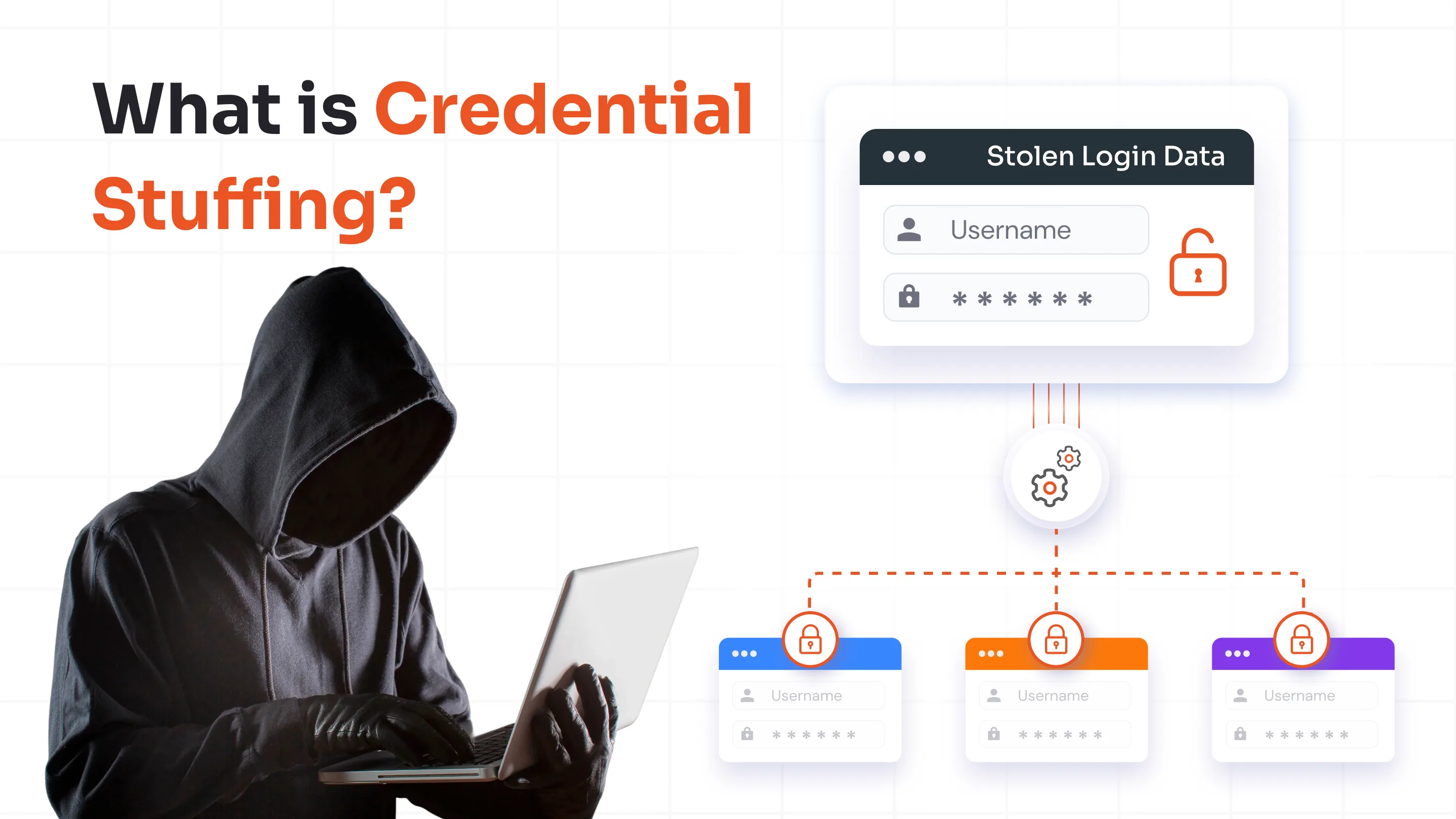
Subscriber portals are constant targets for credential stuffing. MFA on customer logins stops attackers from cashing in on breached password lists.
Where Can Telecommunications Companies Use MFA?
MFA isn't a single toggle. It's a layer you apply across every access point in your environment.
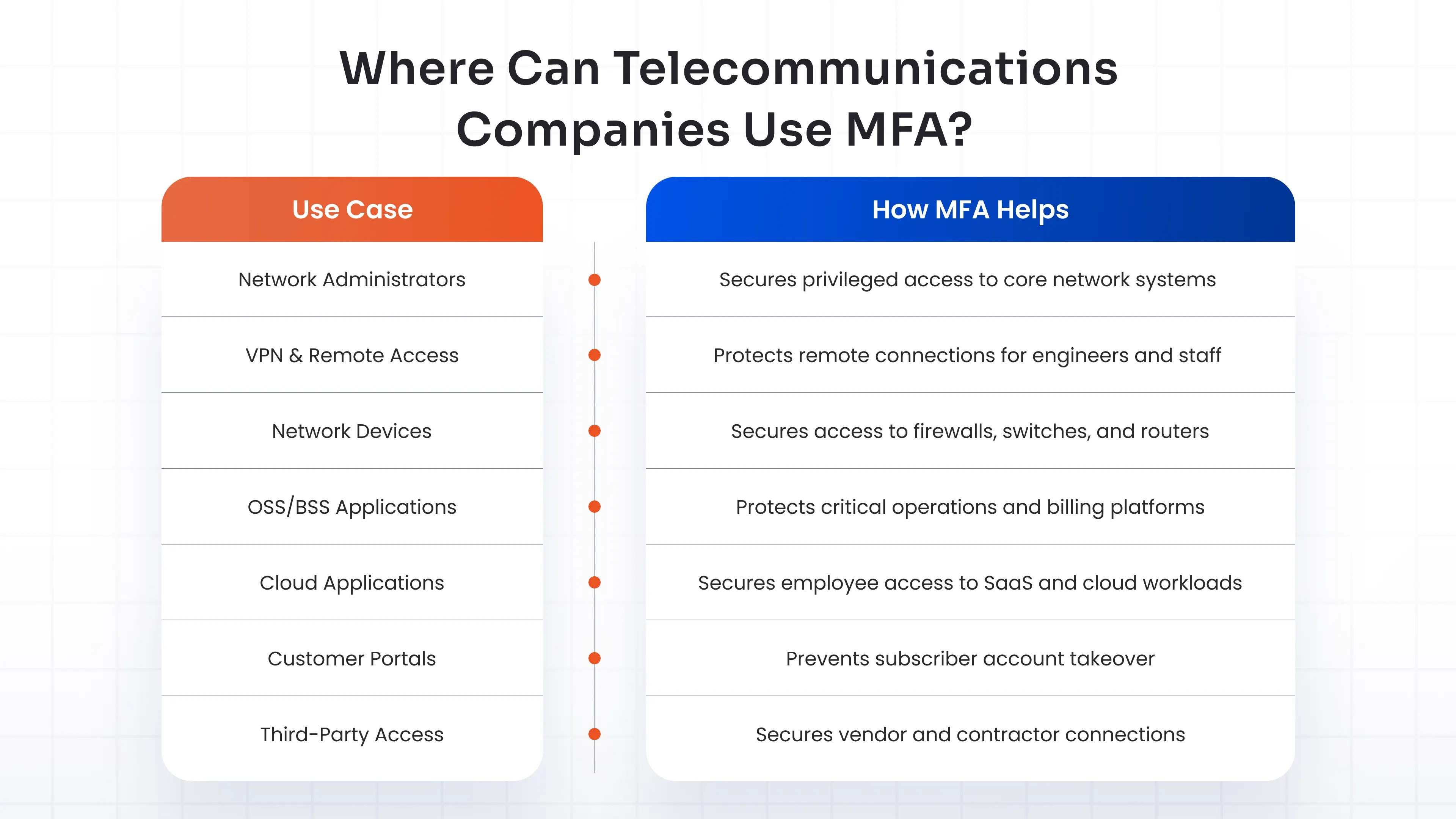
miniOrange extends MFA across all of these through VPN MFA and RADIUS/TACACS+ integrations that cover network devices, so you're not stitching together separate tools for each surface.
Which MFA Methods Are Best for Telecommunications?
Not every login carries the same risk, so not every login needs the same factor. A customer checking their bill and a network administrator reconfiguring the 5G core sit at opposite ends of the risk spectrum. The right approach matches MFA methods to the user type, the sensitivity of the access, and how phishing-resistant the method needs to be.
1. Authenticator Apps and OTP
Time-based one-time passwords (TOTP) generated by an authenticator app are a solid baseline for everyday employee logins, billing-team access, and internal tools that don't touch the network core.
They work offline, are easy to roll out at scale, and stop basic credential-stuffing attempts cold. They're not phishing-resistant on their own, so they're best reserved for lower-risk, high-volume access rather than administrative or network-facing systems.
2. Push Notifications
Push-based authentication sends an approval prompt straight to a registered device, no code to type. For a workforce logging in dozens of times a day across OSS/BSS platforms and internal apps, push is the fastest option that still beats a password alone.
Pair it with adaptive policies so repeated approval requests (a sign of MFA fatigue attacks) get flagged rather than rubber-stamped.
3. FIDO2 and Passkeys
FIDO2 and passkeys sit at the phishing-resistant end of the spectrum, and they're the direction telecom security is heading. Instead of a code or link an attacker can intercept or spoof, FIDO2 binds a cryptographic key to the legitimate login page, so a fake portal or missed call simply can't complete authentication.
That matters in telecom specifically, given how often social engineering and AI-generated voice phishing are used to target carrier employees. FIDO2 and passkeys are a strong fit for network administrators, OSS/BSS access, and any account that can touch the core.
4. Security Keys and Hardware Tokens
Physical security keys extend the same phishing-resistant protection to environments where a phone isn't practical, shared operations centers, secure facilities, or admins managing multiple privileged accounts. A hardware token costs a fraction of what a single compromised admin credential can expose across a network.
5. Biometrics
Fingerprint and facial recognition support biometric authentication for passwordless employee access and, increasingly, customer-facing apps. They remove password-reset overhead and pair well with device-based FIDO2 flows, though they still depend on the underlying device's security.
6. SMS and Email OTP
SMS and email codes are familiar and easy to deploy, which is why they're common in customer-facing portals and legacy systems. But they carry real weaknesses that matter more in telecom than almost any other industry: SIM swapping lets an attacker port a victim's number and intercept the code directly, and SMS-based prompts remain a favorite target for phishing and vishing.
Given that telecom providers are themselves the infrastructure SIM swapping exploits, SMS/email OTP should be treated as a fallback for legacy or genuinely low-risk logins, never as the method protecting administrative, network, or privileged access.
7. Smart Cards and CAC Authentication
Smart cards authentication and CAC (Common Access Card) authentication suit high-assurance environments, defense-adjacent operations, or facilities where staff already carry a credential for physical access. The certificate is bound to the card, so there's nothing to phish and nothing an attacker can intercept remotely.
A sound telecom strategy uses convenient methods like OTP and push for broad workforce and customer access, and reserves FIDO2, security keys, and Certificate-based authentication, the genuinely phishing-resistant options, for network administrators, privileged accounts, and anything touching the core.
Explore the full range of options on the miniOrange MFA Methods page to map methods to your user groups.
Best Practices for Implementing MFA in Telecommunications
Rolling out MFA well is as much about strategy as technology. A few principles that consistently pay off:
1. Start with privileged and network administrator accounts: These are the highest-value targets, so protect them first with your strongest factors.
2. Use phishing-resistant MFA for high-risk access: For core network, For core network, OSS/BSS, and admin logins, a phishing-resistant MFA solution like FIDO2 and security keys shuts down the phishing and vishing tactics that defeat SMS codes.
3. Secure VPN and remote access: Every remote session into your infrastructure should require MFA, no exceptions.
4. Implement adaptive, risk-based authentication: Step up verification only when risk signals warrant it. Adaptive MFA solution reads IP, device, location, and behavior so trusted logins stay frictionless while anomalies get challenged.
5. Integrate MFA with your existing stack: Choose a multi-factor authentication (MFA) software that ties into your IAM, SSO, RADIUS, and network infrastructure rather than bolting on a silo.
6. Provide secure recovery options: Backup methods keep legitimate users from being locked out without opening a soft entry point for attackers.
7. Monitor authentication activity: Audit logs and real-time monitoring turn your MFA layer into a detection tool, not just a gate.
Why Choose miniOrange MFA for Telecommunications?
miniOrange is built for the kind of mixed, high-stakes environment telecom carriers run. A few reasons it fits:
- 15+ MFA methods in a single platform, so you can standardize on one tool and tailor factors by role and risk
- FIDO2, passkeys, and security keys for phishing-resistant, high-assurance access
- Push notifications and authenticator apps for smooth, everyday workforce authentication
- Biometrics authentication and hardware tokens for passwordless and high-security scenarios
- Adaptive MFA solution that triggers Allow, Challenge, or Deny based on live risk signals
- VPN MFA, Windows MFA, Linux MFA, and network MFA across the full access surface
- RADIUS and TACACS+ integrations to secure firewalls, switches, and routers with no separate proxy module needed
- Cloud, on-premise, and hybrid deployment to match however your environment is built
- Centralized authentication and policy management for consistent control across every access point
Conclusion
Telecom carriers face a threat landscape where a single stolen password can expose tens of millions of subscribers, as SK Telecom's 2025 breach made painfully clear. Passwords alone can't carry that weight anymore. MFA, applied across network administrators, VPNs, network devices, applications, customer portals, and vendor access, and built on phishing-resistant methods for your highest-risk logins, is the practical, proven layer that stops credential theft before it becomes a breach.
Ready to secure every access point on your network? Book a demo with the miniOrange team today.
FAQs
What is MFA for telecommunications?
It's a security layer requiring telecom users to verify identity with two or more factors beyond a password, protecting networks, applications, staff, and customer accounts from unauthorized access.
Is SMS-based MFA secure for telecommunications companies?
It's better than passwords alone, but SMS is vulnerable to SIM swapping and phishing. For admin and network-critical access, use phishing-resistant methods like FIDO2 or security keys instead.
How can telecom companies secure remote network administrators with MFA?
Apply MFA to VPN and privileged accounts using strong, phishing-resistant factors, integrate it with RADIUS and network infrastructure, and add adaptive policies that challenge high-risk logins.
Which MFA method is best for telecom companies?
It depends on risk. Use FIDO2, passkeys, or security keys for privileged and administrative access, and authenticator apps or push notifications for broader workforce logins.
About the Author

Content Writer
Pallavi Narang is a content writer with more than 4 years of experience. She specializes in driving brand awareness and lead generation through compelling storytelling and strategic marketing campaigns. With a background in SaaS, cybersecurity, and data analytics, Pallavi excels in translating complex concepts into engaging narratives. Outside of work, she is either learning new languages or reading.
Leave a Comment