

The way user accounts are provisioned has a direct impact on security, compliance, and operational efficiency. Two of the most common approaches, SCIM provisioning and Just-in-Time (JIT) provisioning, both automate user onboarding but follow fundamentally different models.
One continuously manages the user lifecycle across connected applications, while the other creates accounts only when users authenticate through Single Sign-On (SSO) authentication. Choosing the right approach depends on your organization's security requirements, identity architecture, and lifecycle management goals.
This guide compares SCIM vs. JIT provisioning to help you understand the differences and select the right provisioning strategy.
What is SCIM Provisioning?
Managing user identities across multiple applications becomes increasingly complex as organizations grow. Creating accounts manually, updating user information across systems, and removing access during offboarding can quickly become time-consuming and error-prone.
SCIM Provisioning Definition
System for Cross-domain Identity Management (SCIM) is an open standard designed to automate the exchange of user identity information between identity providers (IdPs) and service providers. Using standardized REST APIs, SCIM enables organizations to automatically provision, update, and deprovision user accounts across connected applications without manual intervention.
Rather than managing identities separately in every application, administrators define users and their access in a central identity provider, such as Microsoft Entra ID, Okta, or JumpCloud. SCIM then synchronizes those identities with integrated applications, ensuring user information remains accurate and consistent throughout the identity lifecycle.
How SCIM Provisioning Works
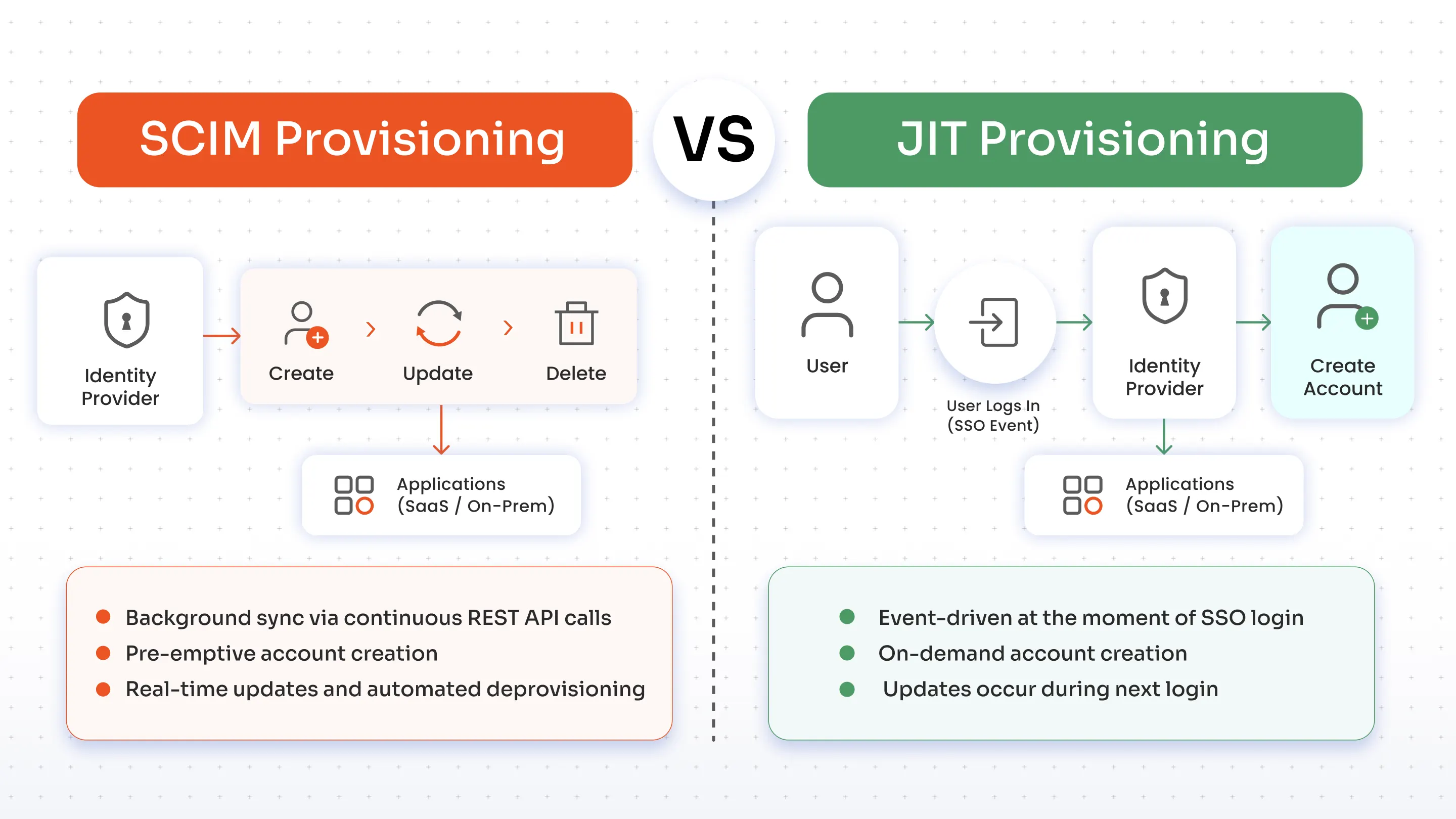
SCIM provisioning begins with an authoritative identity source, typically an HR system or an identity provider. Whenever a user joins the organization, changes roles, or leaves the company, the identity provider detects the change and communicates it to connected applications using SCIM APIs.
For example, when a new employee is hired, the identity provider creates the user's identity, assigns the appropriate groups or applications, and automatically provisions accounts across every integrated system. If the employee moves to a different department, SCIM synchronizes updated attributes and access permissions. When the employee leaves the organization, SCIM automatically disables or removes access, reducing the risk of orphaned accounts and improving security.
Core Capabilities of SCIM Provisioning
SCIM supports the complete user lifecycle by automating key identity management tasks, including:
- User provisioning: Automatically creates user accounts before users access an application.
- Profile synchronization: Keeps user attributes, such as names, email addresses, departments, and job titles, consistent across connected applications.
- Group and role management: Updates permissions when users change teams, responsibilities, or access requirements.
- Automated deprovisioning: Removes or disables accounts during offboarding to help maintain security and compliance.
What is JIT Provisioning?
Not every application requires user accounts to exist before employees attempt to access them. In many cases, creating accounts only when users first sign in is faster, reduces administrative effort, and avoids maintaining unused accounts.
JIT Provisioning Definition
Just-in-Time (JIT) provisioning is an authentication-driven approach that automatically creates a user account the first time someone successfully signs in through Single Sign-On (SSO). Instead of continuously synchronizing identities, JIT relies on identity attributes contained in SAML assertions or OpenID Connect (OIDC) tokens to generate accounts when access is requested.
By creating accounts only when users need them, JIT provisioning streamlines onboarding without requiring administrators to provision every user in advance.
How JIT Provisioning Works
When a user selects the organization's SSO login option, the identity provider authenticates the request and sends identity information, such as the user's name, email address, department, or group memberships, to the target application.
If an account does not already exist, the application automatically creates one using the received attributes and immediately grants access. On subsequent logins, some applications can refresh selected profile information, although synchronization occurs only during authentication rather than continuously in the background.
Key Characteristics of JIT Provisioning
JIT provisioning is designed around on-demand account creation and typically includes the following characteristics:
- Authentication-driven provisioning: User accounts are created during the first successful SSO login.
- On-demand access: Accounts exist only when users actually access an application.
- Identity attribute mapping: User profile information is populated from SAML assertions or OIDC claims.
- Simplified administration: Eliminates the need to pre-provision users before granting application access.
- Login-based synchronization: User information can be refreshed during authentication, depending on application support.
SCIM vs. JIT Provisioning: Key Differences
While both SCIM and JIT automate user provisioning, they solve different identity management challenges. SCIM focuses on managing the complete user lifecycle through continuous synchronization, whereas JIT is designed to create user accounts when users authenticate through Single Sign-On (SSO).
| Feature | SCIM Provisioning | JIT Provisioning |
|---|---|---|
| Provisioning Trigger | Changes in the identity provider automatically trigger provisioning events. | The first successful SSO login triggers account creation. |
| Account Creation | Accounts are created before users access an application. | Accounts are created only when users first sign in. |
| User Profile Updates | User attributes remain synchronized whenever changes occur. | User information is updated only during authentication, depending on application support. |
| Deprovisioning | Automatically disables or removes accounts when users leave the organization. | Does not provide automated offboarding. |
| Identity Lifecycle Management | Supports onboarding, updates, role changes, and offboarding. | Primarily focuses on first-time account creation. |
| Authentication Dependency | Can work independently of SSO, although often deployed together. | Requires SSO to provision users during authentication. |
| Implementation | Requires SCIM-compatible APIs on both the identity provider and the application. | Simpler to implement when SSO is already configured. |
| Best Fit | Large enterprises, regulated industries, and organizations managing many SaaS applications. | Internal applications, occasional users, contractors, and rapid deployments. |
When Should You Choose SCIM or JIT?
Choosing between SCIM and JIT depends less on which technology is "better" and more on how your organization manages identities, access, and user lifecycle events. Many organizations even use both approaches together, but understanding where each delivers the most value helps determine the right strategy.
Choose SCIM Provisioning If
SCIM is the better choice when identity lifecycle management is a business requirement rather than simply creating user accounts.
Consider SCIM if your organization:
- Manages a large workforce across multiple SaaS and enterprise applications.
- Needs automated onboarding, profile synchronization, role changes, and offboarding.
- Must meet compliance requirements such as SOC 2, ISO 27001, HIPAA, or GDPR where timely access removal is critical.
- Wants to eliminate orphaned accounts and reduce manual administrative effort.
- Uses a centralized identity provider to govern user access across the organization.
Choose JIT Provisioning If
JIT is well suited for organizations that want to simplify user onboarding without implementing continuous identity synchronization.
Consider JIT if your organization:
- Already uses SAML or OpenID Connect (OIDC) based Single Sign-On.
- Wants users to receive application access only when they first log in.
- Is deploying new internal applications quickly with minimal provisioning overhead.
- Provides occasional access to contractors, vendors, or external collaborators.
- Wants to avoid maintaining unused accounts for users who may never access an application.
Can SCIM and JIT Be Used Together?
Yes. In fact, many modern identity architectures combine both approaches. JIT provisioning can create user accounts during the first SSO login, while SCIM manages ongoing profile updates, role changes, and automated deprovisioning throughout the user's lifecycle.
This combination allows organizations to deliver seamless onboarding while maintaining centralized identity governance, stronger security, and automated lifecycle management across their application ecosystem.
Choosing the Right Provisioning Strategy
When comparing SCIM vs. JIT provisioning, there isn't a one-size-fits-all answer. JIT provisioning is ideal for quickly creating user accounts during the SSO login process, making it a practical choice for simple deployments and occasional access.
SCIM provisioning, on the other hand, provides complete identity lifecycle management by automating user creation, updates, and deprovisioning across connected applications. For organizations focused on security, compliance, and efficient user lifecycle management, SCIM offers the long-term advantage. Many enterprises also combine SCIM, JIT, and SSO to deliver seamless user experiences while maintaining centralized identity governance.
FAQs
Can SCIM and JIT provisioning be used together?
Yes. Many organizations use both together as part of their identity management strategy. JIT provisioning creates a user account during the first SSO login, while SCIM manages ongoing lifecycle events such as profile updates, role changes, and account deprovisioning. This combination provides both seamless onboarding and automated user lifecycle management.
Does JIT provisioning support user deprovisioning?
No. JIT provisioning is designed to create user accounts during authentication and may update certain attributes when users log in again. However, it does not automatically disable or delete accounts when employees leave the organization. Automated offboarding typically requires SCIM provisioning or another identity lifecycle management solution.
Does SCIM provisioning require Single Sign-On (SSO)?
No. SCIM provisioning and SSO serve different purposes. SCIM automates user lifecycle management between an identity provider and applications, while SSO authenticates users and grants access. Although they are commonly deployed together, SCIM can operate independently of SSO if supported by the connected applications.
Why is SCIM considered more secure than JIT provisioning?
SCIM improves security by continuously synchronizing user identities and automatically removing access when users leave the organization or their roles change. This reduces the risk of orphaned accounts and excessive permissions. JIT provisioning does not provide automated offboarding, so inactive accounts may remain unless managed separately.
Which provisioning method is better for enterprise environments?
For most enterprises, SCIM provisioning is the preferred choice because it supports automated onboarding, profile updates, role synchronization, and deprovisioning across multiple applications. JIT provisioning is better suited for organizations that need a simple way to create accounts during first-time SSO logins or for applications with occasional user access.
What is the main difference between SCIM and JIT provisioning?
The biggest difference is when and how user accounts are created and managed. SCIM uses continuous API-based synchronization to automate the entire user lifecycle, including onboarding and offboarding. JIT provisioning creates accounts only when users successfully authenticate through SSO, making it focused on first-time access rather than ongoing identity management.
Leave a Comment