
Most organizations deploy access management tools and believe they have identity security covered. They do not. What they have is a way to let users in, but no systematic way to ask whether those users should still have that access at all.
Access governance and access management are related but distinct disciplines. Confusing them is one of the most common reasons enterprises fail compliance audits, accumulate excessive permissions over time, and struggle to explain who has access to what when auditors ask.
This guide clarifies the difference, explains when you need each, and shows how both work together to form a complete identity security strategy.
What Is Access Governance?
Access Governance is the discipline of defining, reviewing, and certifying who should have access to which resources, and proving that those decisions are appropriate and documented. It operates at the policy and compliance layer, not the authentication layer.
Objectives of Access Governance
The core goal is answering the question: Should this user have this access? Governance ensures access aligns with job function, is reviewed periodically, and can be demonstrated to auditors as intentional and appropriate.
How Access Governance Works
Governance runs continuously and on a review schedule. It monitors access entitlements across systems, flags anomalies (users with access that no longer matches their role), and triggers access reviews and certifications where managers or system owners confirm whether existing access remains appropriate.
Key Features of Access Governance
- Access Reviews: Periodic campaigns that prompt managers to confirm or revoke existing access
- Access Certifications: Formal sign-off that access is appropriate and compliant
- Role Governance: Defining which roles map to which entitlements, with documented justification
- Segregation of Duties (SoD): Preventing one user from holding conflicting permissions that could enable fraud
- Compliance Reporting: Producing the audit evidence regulators require
- Identity Risk Management: Scoring identities by risk level based on access patterns and anomalies
What Is Access Management?
Access Management is the operational discipline of authenticating users and enforcing access policies at the point of login. It answers the question: Can this user authenticate right now?
Objectives of Access Management
The goal is secure, seamless access: verifying identity at login, enforcing the right access level, and managing sessions across applications. It runs in real time, every time a user signs in.
How Access Management Works
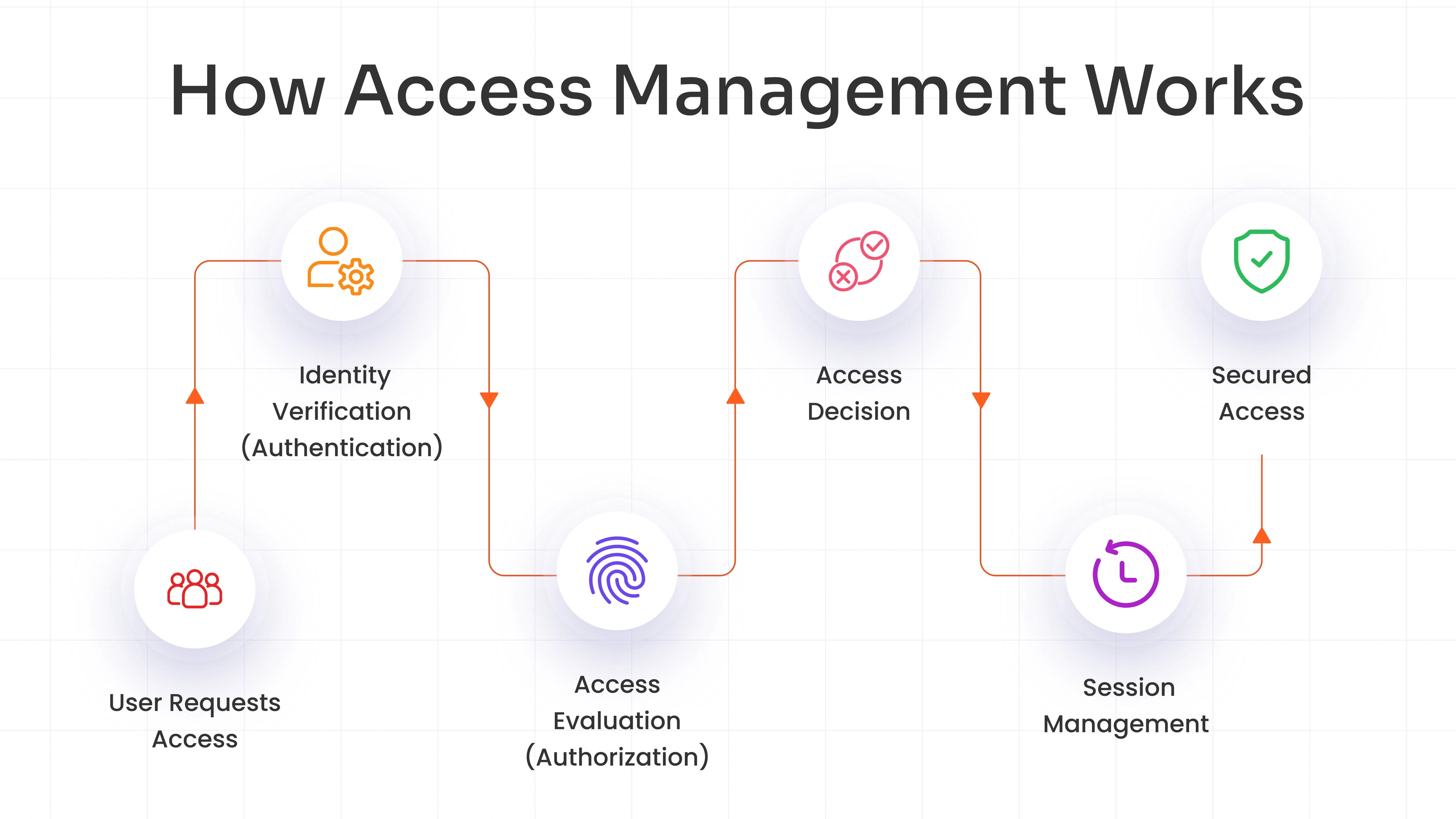
When a user attempts to access a resource, the access management layer verifies their identity (authentication), determines what they are permitted to do (authorization), and manages the session. Single Sign-On (SSO) and Multi-Factor Authentication (MFA) are the most visible components.
Key Features of Access Management
- Authentication: Verifying identity before granting access
- Authorization: Determining what an authenticated user can do
- Single Sign-On (SSO): One login, access to all connected applications
- Multi-Factor Authentication (MFA): Layering a second factor on top of passwords
- Session Management: Controlling session duration and termination
- Adaptive Access Controls: Adjusting authentication requirements based on risk signals
Access Governance vs. Access Management: Key Differences
Governance vs. Control
Access management controls the door — it lets authenticated users in. Access governance decides who should be allowed through that door and validates that those decisions remain correct over time.
Continuous Oversight vs. Real-Time Access
Access management operates at login time. Access governance operates continuously: running reviews, detecting drift between current access and appropriate access, and triggering remediation.
Compliance vs. Authentication
Authentication is the core output of access management. Compliance evidence — audit logs, certification records, and SoD reports — are the core output of access governance. Organizations subject to SOX, HIPAA, or GDPR need both.
Strategic vs. Operational Security
Access management is operational: it handles every login event across the workforce. Access governance is strategic: it sets the policy framework that determines what access should exist in the first place.
Risk Reduction vs. Access Enablement
Management enables access efficiently. Governance reduces risk by ensuring that access does not accumulate beyond what is needed, preventing the privilege creep that is one of the most common sources of insider threat and audit failure.
Why Access Governance and Access Management Are Not the Same
Access Management Answers: "Can This User Log In?"
When an employee opens Salesforce, access management verifies their credentials, enforces MFA if required, and grants a session. It does not ask whether this person's Salesforce role is still appropriate to their current job.
Access Governance Answers: "Should This User Have Access at All?"
Governance asks the harder question. It reviews entitlements across the estate, identifies users whose access no longer matches their role, and initiates certification or revocation workflows.
Real-World Example
A finance employee moves from Accounts Payable to the Finance Analytics team.
- Access Management's Role: They can still log in with their existing credentials. Their session is valid.
- Access Governance's Role: It flags that the employee still has Accounts Payable system permissions — a role that is no longer appropriate and creates a Segregation of Duties conflict with their new analytics access. A review is triggered, the old entitlements are revoked, and the change is documented for audit.
Without governance, access management would continue authenticating that employee into systems they should no longer access — indefinitely.
Access Governance vs. Access Management Architecture
Where Does Access Management Fit?
Access management operates at the login, authentication, and authorization layers — the front door of every application. SSO, MFA, and adaptive controls all live here.
Where Does Access Governance Fit?
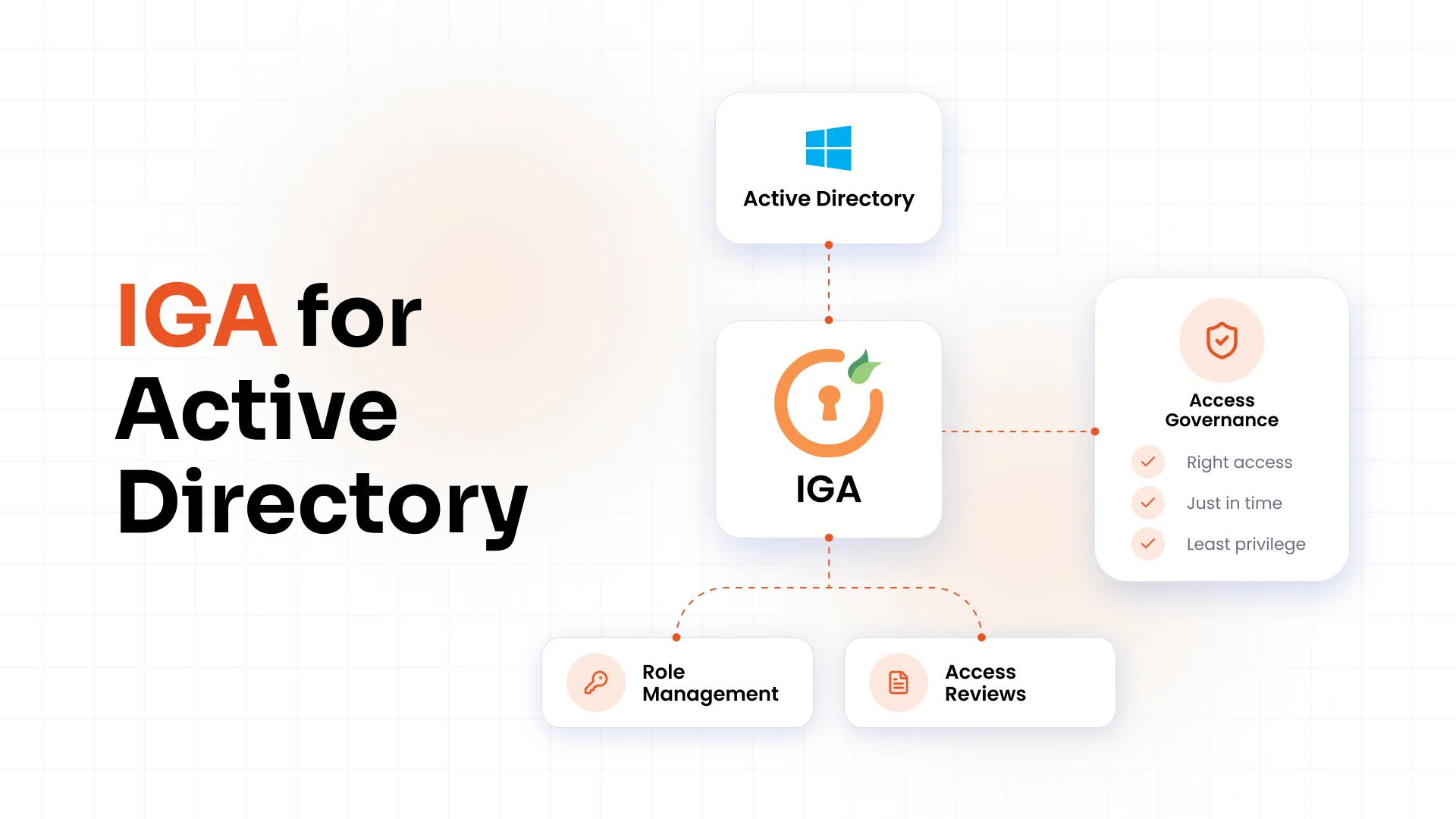
Governance operates at the policy, lifecycle, compliance, and review layers — above and behind the authentication layer. Identity Governance and Administration (IGA) platforms manage this tier.
How Both Work Together
- Governance defines what access a role should have
- Provisioning assigns that access to the user
- Access Management authenticates the user at login
- Governance reviews access periodically, confirming it remains appropriate
- Lifecycle Management revokes access when the user's role changes or they depart
Access Governance vs. Access Management Use Cases
- New Employee Onboarding: Access Management enables the first login; Governance ensures only role-appropriate entitlements are provisioned via Identity Lifecycle Management.
- Role Changes (Mover Events): Management updates session access; Governance detects and remediates residual permissions from the previous role.
- Employee Offboarding: Management disables login; Governance certifies all entitlements are revoked and documents the action for audit.
- Privileged Access Management (PAM): Management vaults and controls privileged credentials; Governance reviews whether those privileges remain justified.
- Regulatory Compliance Audits: Access Management provides authentication logs; Governance provides access certification records, SoD reports, and entitlement history.
- Third-Party Access: Management authenticates vendors; Governance ensures vendor access is time-limited, scoped, and reviewed on a schedule.
Access Governance vs. Access Management for Compliance
| Compliance Requirement | Governance | Management |
|---|---|---|
| Access Reviews | ✓ | ✗ |
| Access Certification | ✓ | ✗ |
| MFA Enforcement | ✗ | ✓ |
| Audit Reporting | ✓ | Partial |
| Least Privilege | ✓ | Partial |
| SoD Controls | ✓ | ✗ |
- SOX: Requires separation of duties, access certification for financial systems, and documented access reviews — all governance functions.
- HIPAA: Requires role-based access to PHI, audit trails, and periodic access reviews — governance provides the review infrastructure; management enforces the access controls.
- ISO 27001: Mandates access control policies, user provisioning procedures, and regular access reviews — split between governance (reviews) and management (enforcement).
- PCI DSS: Requires MFA for cardholder data environments (management) and access reviews for all system components (governance).
Common Challenges Organizations Face
Organizations often struggle with cultural resistance and siloed communication, which stall adoption and alignment across departments. Additionally, a lack of clear strategy and insufficient training frequently leads to inefficient resource allocation and project roadblocks.
Let's look at the complete list of challenges one by one:
- Excessive Access Rights: Without governance, users accumulate permissions over years of role changes — never having anything removed.
- Orphaned Accounts: Departed employees whose accounts were never fully deprovisioned.
- Manual Access Reviews: Spreadsheet-based reviews that are slow, error-prone, and incomplete.
- Authentication Gaps: No MFA, weak passwords, or no SSO — all access management failures.
- Compliance Failures: No certification records, no SoD enforcement, no audit trail.
- Identity Sprawl: Identities fragmented across dozens of disconnected systems.
Why Modern Enterprises Need Both
Governance without management means you have a policy framework with no enforcement at the door.
Management without governance means you authenticate users efficiently but have no way to prove their access was appropriate or to detect when it drifts beyond what they need.
Together, they create a complete identity security strategy:
- Governance defines and approves what access exists
- Provisioning assigns it
- Management authenticates the user at every login
- Governance reviews it periodically and keeps it aligned with current roles
Zero Trust Security principles tie both together — never trust, always verify, always govern.
How miniOrange Combines Access Governance and Access Management
miniOrange unifies these layers by pairing real-time access controls (like SSO, Adaptive MFA, and session monitoring) with continuous lifecycle governance (such as automated SCIM provisioning and AI-assisted access reviews).
This ensures that while users gain seamless, day-to-day access, their permissions are constantly audited and restricted to the principle of least privilege.
FAQs
What is the difference between access governance and access management?
Access Management controls how users authenticate and what they can access at login time. Access Governance determines whether users should have access in the first place.
Is access governance part of IAM?
Yes. Access governance is a component of Identity and Access Management (IAM), but it operates at a higher layer than access management. IGA platforms are the enterprise-grade implementation of access governance.
Can access management work without access governance?
Technically, yes. Access management handles authentication regardless of whether governance is in place. But without governance, access accumulates unchecked, compliance audits become impossible to pass, and the risk of excessive or inappropriate access grows continuously.
Why are access reviews important?
Access reviews catch entitlement drift: cases where users have retained access from previous roles, projects, or departments. Regular reviews are required by SOX, HIPAA, ISO 27001, and PCI DSS and are one of the most effective controls for reducing insider risk.
What is access certification?
Access certification is the formal process by which a manager or system owner confirms that a user's current access entitlements are appropriate and should be maintained. Certifications create the audit evidence that regulators require to demonstrate that access was intentionally granted and periodically validated.
Which is more important: governance or management?
Neither is optional for enterprise security. Management without governance creates unchecked access accumulation. Governance without management leaves authentication gaps. The combination is what produces a defensible, compliant identity security posture.
How do access governance and PAM differ?
Privileged Access Management (PAM) focuses specifically on securing high-risk privileged accounts: vaulting credentials, recording sessions, and enforcing just-in-time access. Access Governance covers the full identity estate, including privileged accounts, and adds the review and certification layer that ensures privileged access is regularly validated and appropriate.
About the Author

Content Writer
With a background in Journalism and extensive experience in SaaS and cybersecurity content writing, Chaitali Avadhani has contributed to creating various forms of impactful content pieces across multiple verticals. At miniOrange, her role is to craft SEO-friendly and lead-generating content around Identity and Access Management (IAM) products and cybersecurity as a whole.
Leave a Comment