
Identity has become the new security perimeter. With over 80% of breaches involving compromised credentials, how organizations manage and govern identities is now the defining factor in both security posture and regulatory compliance.
The stakes have risen sharply. Cloud adoption, remote workforces, AI-driven automation, and expanding third-party ecosystems have multiplied the volume of identities organizations must manage, and the consequences of mismanaged access have never been more severe.
Regulatory frameworks like SOX, HIPAA, GDPR, NIS2, and India's DPDP Act now demand demonstrable, continuous oversight of who has access to what and why.
Yet the IGA vs. IAM distinction remains one of the most misunderstood concepts in identity security. Both disciplines address identity, but they answer fundamentally different questions.
An IAM solution gets users in securely. An Identity Governance and Administration (IGA) platform ensures they should be there at all. This guide explains the IGA vs. IAM difference, where each fits in the modern enterprise, and why both layers are essential to a complete identity security posture.
IGA vs. IAM: What's the Difference? (Quick Answer)
Ideally, IAM controls access; IGA governs whether that access remains appropriate over time. However, there are several other differences, let's look at them.
| Element | IAM | IGA |
|---|---|---|
| Core job | Manages and controls access | Governs and validates access |
| Focus | Authentication and authorization | Compliance, risk, and governance |
| Key question | How does a user get access? | Should the user have access? |
IGA vs. IAM: Comprehensive Comparison
| Capability | IAM | IGA |
|---|---|---|
| Authentication | ✓ | - |
| Single Sign-On (SSO) | ✓ | - |
| Multi-Factor Authentication (MFA) | ✓ | - |
| Authorization | ✓ | - |
| User Provisioning | ✓ | ✓ |
| User Deprovisioning | ✓ | ✓ |
| Access Requests | ✓ | ✓ |
| Identity Lifecycle Management | Basic | Advanced |
| Access Reviews | - | ✓ |
| Access Certifications | - | ✓ |
| Entitlement Management | Limited | ✓ |
| Segregation of Duties (SoD) | - | ✓ |
| Role Mining | - | ✓ |
| Identity Risk Analysis | - | ✓ |
| Compliance Reporting | Limited | ✓ |
| Audit Readiness | Partial | ✓ |
| Toxic Access Detection | - | ✓ |
| Continuous Access Governance | - | ✓ |
Why Are IAM and IGA Often Confused?
Both disciplines are about managing digital identities. Both involve provisioning, user data, and access control. And historically, identity governance and administration evolved from traditional identity access management as organizations realized that provisioning access was only half the problem, governing it over time was the other half.
They overlap enough to cause confusion but diverge sharply in purpose. An IAM solution is operational; it runs every time a user logs in.
An IGA platform is continuous and strategic; it runs in the background, validating that every access entitlement across your estate is still appropriate, policy-compliant, and risk-free.
Modern enterprises need both layers working together.
What Is Identity and Access Management (IAM)?
Identity and Access Management is the set of technologies and processes that control how users are identified, authenticated, and authorized to access systems and data. It is the operational backbone of identity security.
Core functions:
- Identity Management: Creating, updating, and deprovisioning user accounts across directories and applications
- Authentication: Verifying who a user is through passwords, Multi-Factor Authentication (MFA), biometrics, or passwordless methods
- Authorization: Determining what an authenticated user can do, governed by RBAC (Role-Based Access Control) or ABAC (Attribute-Based Access Control)
- Single Sign-On (SSO): One login, access to all connected applications
- User Provisioning and Deprovisioning: Creating accounts on hire, removing them on departure
Key benefits: Secure and seamless access, reduced IT burden, centralized identity control, and improved user experience.
An IAM solution answers the operational questions: How does this user log in? What are they authorized to do right now?
What Is Identity Governance and Administration (IGA)?
Identity Governance and Administration is the discipline that governs who should have access, validates that access over time, and produces the compliance evidence organizations need to satisfy regulators.
Core functions:
- Identity Lifecycle Management: End-to-end automation of the joiners-movers-leavers process: provisioning, updating, and revoking access based on HR events
- Access Request and Approval Workflows: Structured request processes with policy-driven approvals, replacing ad-hoc access requests
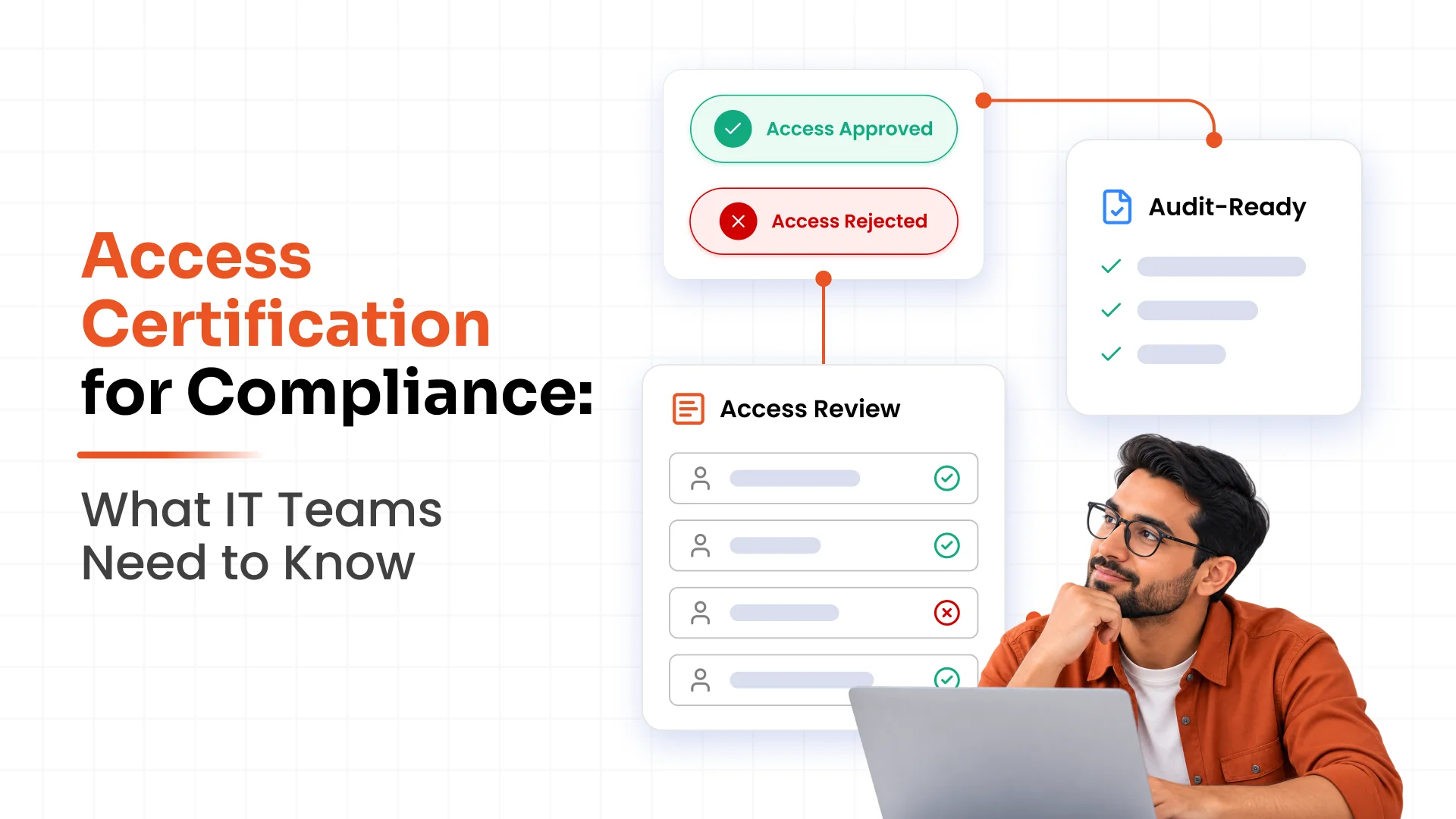
- Access Reviews and Certifications: Periodic campaigns where managers confirm whether existing access is still appropriate
- Entitlement Management: Visibility into exactly what permissions every identity holds, across all systems
- Segregation of Duties (SoD): Detecting and preventing conflicting access combinations that could enable fraud
- Identity Risk Management: Scoring identities by risk level based on entitlements, behavior, and policy violations
- Compliance Reporting: Generating the audit evidence that SOX, HIPAA, ISO 27001, and GDPR require
Key benefits: Reduced identity risk, better entitlement visibility, stronger compliance posture, and improved governance at scale.
An IGA solution answers the strategic questions: Why does this user have access? Is it still appropriate? Does it create risk?
IAM vs. IGA: Understanding the "How" vs. "Why" of Access
The clearest way to understand the IGA vs. IAM distinction is through the questions each discipline answers.
An IAM solution answers:
- How is access granted?
- How is identity verified at login?
- How are permissions assigned to a role?
An IGA solution answers:
- Why does this user have this access?
- Is access still required for their current role?
- Does the access create a compliance or fraud risk?
- Has it been reviewed and certified recently?
The access governance workflow that connects them:
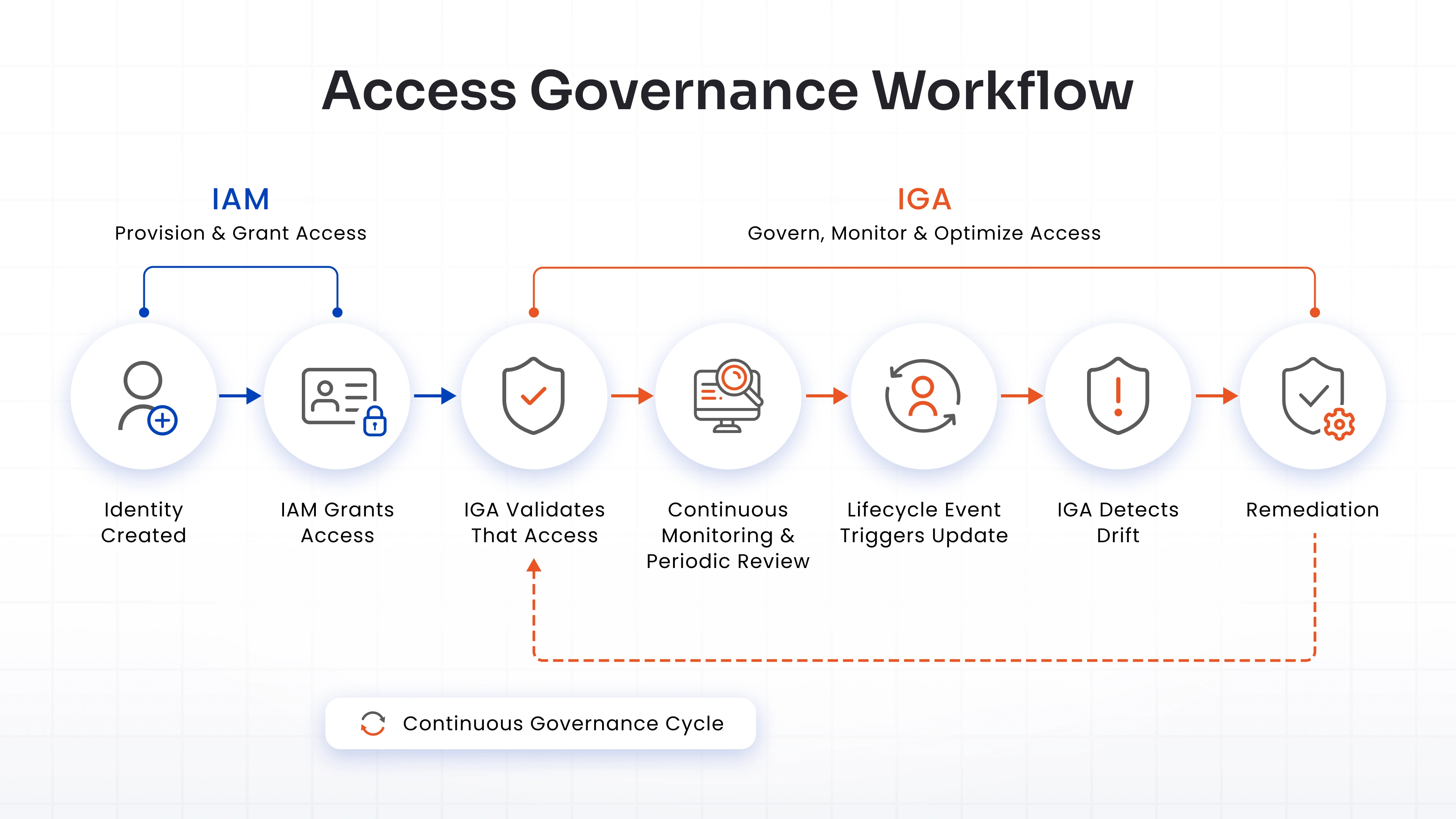
Without an identity governance solution, the workflow stops after "IAM grants access" - and access accumulates silently for years.
Why IAM Alone Is No Longer Enough
Identity access management was designed for a simpler era: fewer applications, fewer users, and regulatory requirements that could be satisfied with basic access logs. That world no longer exists.
Here's why an IAM solution alone can't keep pace:
- Privilege Creep: Employees accumulate excessive access through promotions, department moves, and project assignments, gaining new entitlements without ever losing old ones.
- Cloud and SaaS Complexity: The explosion of cloud and SaaS environments multiplies the number of systems where access must be governed, far beyond what traditional IAM tools were built to track.
- Unscalable Manual Reviews: Spreadsheet-based access reviews do not scale across thousands of users and hundreds of applications.
- Rising Regulatory Requirements: SOX, HIPAA, GDPR, and PCI DSS now mandate access certifications and SoD controls that standard identity access management tools were not built to produce.
- Non-Human Identity Sprawl: Service accounts, AI agents, and bots have expanded the attack surface beyond what traditional identity management covers.
- Insider Threats: Legitimate access that is never revoked becomes a silent liability, exploited by insiders or compromised by external attackers.
An IAM solution keeps the door secure. An IGA platform ensures the right people are behind it.
Identity Risks That Drive IGA Adoption
Industry Data Point: According to the Identity Defined Security Alliance (IDSA), 84% of organizations have experienced an identity-related security incident, with privilege creep and orphaned accounts among the most cited contributors.
- Privilege Creep: The gradual accumulation of access rights as users change roles, join projects, and receive one-off permission grants. These accesses are not systematically revoked. Over time, users end up with far more access than their current job requires.
- Toxic Access Combinations: Certain entitlement combinations create fraud risk - a user who can both create and approve purchase orders, for example. An identity governance solution detects these toxic combinations before they become audit findings or fraud incidents.
- SoD Violations: When one user controls both sides of a financial or operational process, separation of duties is broken. IGA software enforces SoD policies at provisioning time and detects existing violations across the estate.
- Orphaned Accounts: Active credentials for employees who have left the organization and never fully deprovisioned, and are available for exploitation. An identity governance and administration platform tracks the full lifecycle and flags accounts that survive offboarding.
- Dormant and Shadow Access: Accounts that have not been used in months and access that was granted informally without proper workflow are both invisible to standard IAM tools without an access governance layer on top.
- Third-Party and Non-Human Identity Risks: Vendor accounts, contractor access, service accounts, and AI agent tokens that persist beyond their useful life with no review schedule attached.
How IGA Complements IAM
An identity governance solution does not replace an IAM solution, it extends it with the governance layer that identity access management cannot provide on its own.
- Continuous access governance monitors the full entitlement estate, not just active sessions
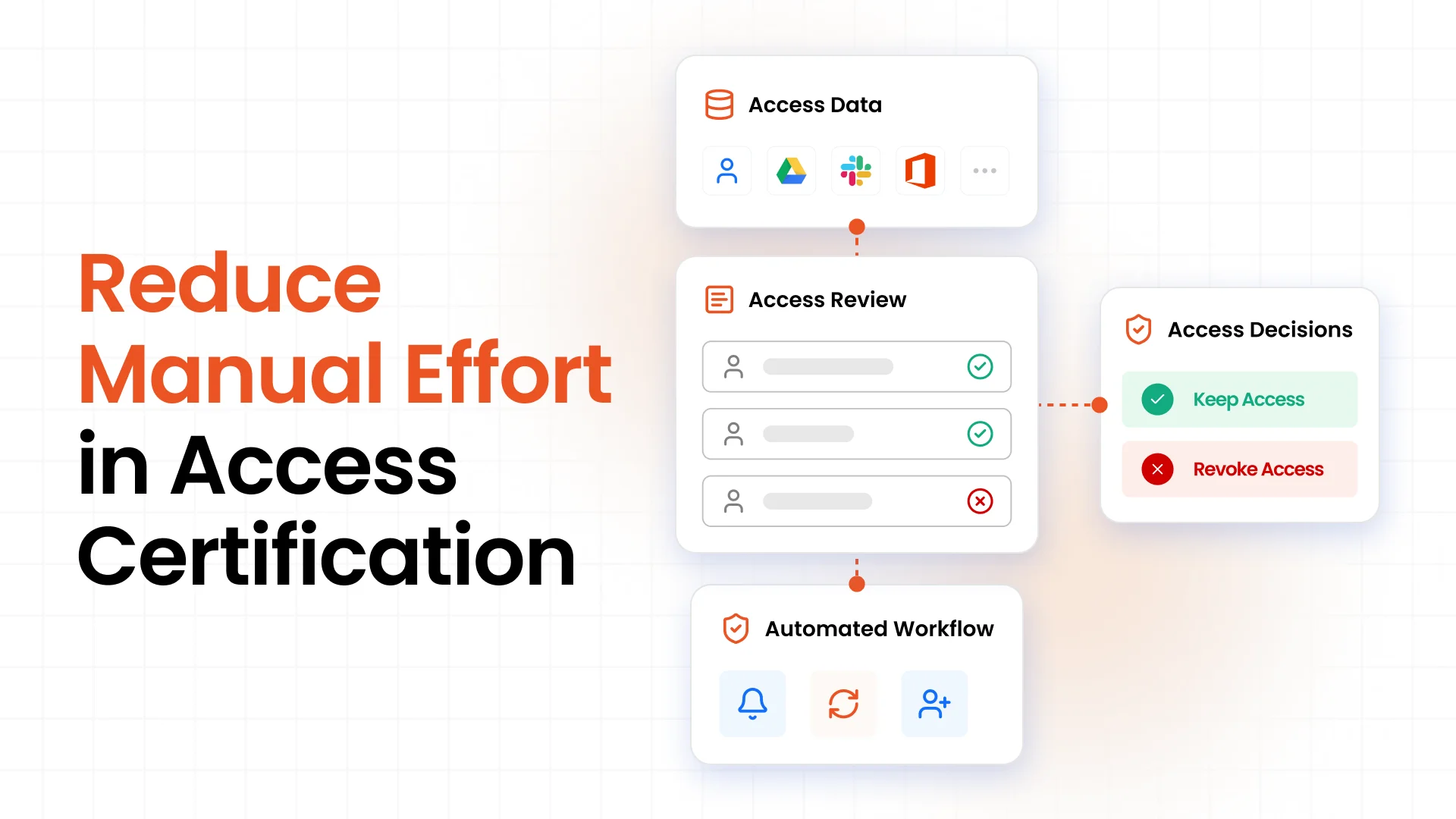
- Automated access reviews replace error-prone manual spreadsheet processes
- Risk-based access decisions feed back into IAM policy, restricting access before it becomes a problem
- Entitlement visibility gives security and compliance teams a complete picture of who can access what
- Compliance automation generates audit-ready reports without manual data assembly
- Lifecycle governance ensures the joiners-movers-leavers process produces clean, accurate access at every transition
IAM and IGA Working Together: Real-World Identity Lifecycle
Employee Onboarding
- IAM: Creates account, assigns role, and grants access to required systems
- IGA: Validates the request against policy, confirms role-appropriate entitlements, and schedules the first access review
Employee Role Change (Mover)
- IAM: Updates permissions for the new role
- IGA: Detects residual access from the previous role, removes unnecessary entitlements, and checks for new SoD conflicts created by the combination
Employee Offboarding
- IAM: Disables accounts and revokes active sessions
- IGA: Verifies complete access removal across all systems (including disconnected apps), generates audit records, and prevents orphaned accounts from persisting
This lifecycle loop: IAM provisioning, IGA governing, IAM enforcing, and IGA reviewing is what a complete identity security posture looks like in practice.
IAM vs. IGA vs. PAM vs. CIEM
As organizations mature, they often add Privileged Access Management (PAM) and Cloud Infrastructure Entitlement Management (CIEM) alongside their IAM and identity governance solutions.
Here is how all four relate:
| Capability | IAM | IGA | PAM | CIEM |
|---|---|---|---|---|
| Authentication | ✓ | - | - | - |
| Access Governance | - | ✓ | - | - |
| Access Reviews | - | ✓ | - | - |
| Privileged Account Security | - | - | ✓ | - |
| Session Monitoring | - | - | ✓ | - |
| Cloud Entitlement Governance | - | - | - | ✓ |
| Least Privilege Enforcement | Limited | ✓ | ✓ | ✓ |
| Compliance Reporting | Limited | ✓ | ✓ | Limited |
| Identity Risk Management | Limited | ✓ | Limited | Limited |
PAM focuses on securing high-privilege accounts - admin credentials, service accounts, and any identity with elevated system access.
CIEM governs permissions in cloud infrastructure environments (AWS, Azure, GCP), where entitlements are often overly broad and difficult to audit.
IGA platform provides the access governance layer that ties all three together.
When Does Your Organization Need an IGA Solution?
You likely need an identity governance and administration platform if any of the following apply:
- Audit preparation takes weeks because access data is scattered across systems
- Access reviews are still done in spreadsheets or skipped entirely
- Users clearly have more access than their current role requires
- SoD violations are hard to detect or prove that they have been addressed
- You manage thousands of identities across cloud and on-premises systems
- Compliance requirements (SOX, HIPAA, GDPR, PCI DSS) are increasing
- Incidents trace back to orphaned accounts or excessive entitlements
Key Features to Look for in an IGA Solution
Here's what to look for when evaluating IGA software for your organization:
- Automated identity lifecycle management
- Structured access request and approval workflows
- Access certification campaigns with configurable review schedules
- Role management and role mining
- Entitlement management across cloud and on-premises
- SoD controls with policy enforcement
- Toxic access detection
- Identity risk analytics
- Compliance reporting with audit-ready output
- AI-powered access recommendations
- Continuous access governance
To know more about IGA features, talk with our experts.
Popular Industry Use Cases of IGA
Some of the popular industries that can and should leverage IGA are:
- Healthcare: HIPAA-mandated access reviews and governance for patient data access across clinical systems.
- Financial Services: SOX SoD controls to prevent fraud; access certifications for financial system entitlements.
- Manufacturing: Contractor and vendor access governance: time-limited, scoped, and reviewed on schedule.
- Government: Access certifications and audit readiness for regulatory bodies and internal auditors.
- SaaS and Technology: Managing workforce identities at scale, plus governance for service accounts and AI agents.
Why Enterprises Choose miniOrange IGA
miniOrange delivers a unified identity governance platform that combines automated access reviews and certifications, entitlement and role management, SoD enforcement, identity risk scoring, compliance reporting, and seamless integration with existing IAM infrastructure - across cloud, hybrid, and on-premises environments.
FAQs
What is the difference between IGA and IAM?
An IAM solution manages how users authenticate and access systems. An identity governance and administration platform governs whether that access is appropriate, compliant, and risk-free. The IGA vs. IAM split is operational vs. strategic: IAM runs at login; IGA runs continuously in the background and on review cycles.
Is IGA part of IAM?
Identity governance and administration is a more advanced layer that builds on identity access management. While an IAM solution covers authentication, authorization, and provisioning, an IGA platform adds governance, compliance, risk management, and certification capabilities that standard IAM tools do not provide.
What comes first, IAM or IGA?
An IAM solution comes first. You need a working authentication and provisioning foundation before layering access governance on top. Most organizations implement SSO and MFA, then add an identity governance solution once user populations and compliance requirements grow complex enough to demand it.
Can IAM work without IGA?
Technically yes, but access will accumulate unchecked, compliance audits become difficult to pass, and identity risk grows invisibly over time. An IAM solution without identity governance is common in early-stage deployments; it becomes a liability as organizations scale.
Does IGA replace IAM?
No, they are complementary. An identity governance solution adds the governance and compliance layer; an IAM solution handles the operational access layer. You need both for a complete identity security posture.
Why is IGA important for compliance?
SOX, HIPAA, GDPR, and PCI DSS all require access reviews, access certifications, SoD controls, and audit trails that demonstrate access was intentionally granted and periodically validated. An identity governance platform produces this evidence automatically; manual processes cannot scale to meet these requirements reliably.
What is the difference between IGA and PAM?
PAM focuses specifically on securing privileged accounts, admin credentials, service accounts, and elevated-access identities through vaulting, session recording, and just-in-time access. An IGA platform governs the full identity estate and adds the review and certification layer that PAM does not provide.
What is the difference between IGA and CIEM?
CIEM manages permissions in cloud infrastructure environments, focusing on cloud-specific entitlements that are often excessively broad. An identity governance and administration platform provides broader access governance across the full identity estate, on-premises and in the cloud, including access reviews and compliance reporting.
How does IGA help prevent privilege creep?
An identity governance solution detects when users accumulate entitlements across role changes and project assignments, automatically flagging access that no longer matches current job function and triggering review or revocation workflows before excessive access becomes an audit finding or an attack vector.
How does IGA support Zero Trust?
Zero Trust requires continuous verification that access is appropriate and least-privilege and not a one-time check at provisioning. An identity governance solution provides the continuous access governance layer that validates entitlements are still appropriate, detects drift, and feeds risk signals back into access policy enforcement.
What industries benefit most from IGA?
Financial services (SOX SoD), healthcare (HIPAA access governance), government (audit readiness), manufacturing (contractor governance), and any large enterprise managing thousands of identities across cloud and on-premise environments.
About the Author

Content Writer
With a background in Journalism and extensive experience in SaaS and cybersecurity content writing, Chaitali Avadhani has contributed to creating various forms of impactful content pieces across multiple verticals. At miniOrange, her role is to craft SEO-friendly and lead-generating content around Identity and Access Management (IAM) products and cybersecurity as a whole.
Leave a Comment