
Passwords are no longer the only weakness in digital identity. Passkeys and FIDO2 reduce reliance on reusable credentials, but attackers can still target account recovery, steal active sessions, or exploit permissions granted to automated systems. Therefore, the next phase of passwordless authentication must address these gaps without making everyday access unnecessarily complicated.
In May 2026, the FIDO Alliance reported five billion passkeys in active use worldwide, while 68% of surveyed organizations were deploying, piloting, or rolling them out for employee authentication. The passwordless authentication trends for 2027 will therefore focus on credential governance, session integrity, delegated authority, and stronger identity verification, not simply replacing passwords with another login method.
Top 10 Passwordless Authentication Trends for 2027
1. Account Recovery Becomes a Critical Security Control
Passwordless authentication removes the need for a traditional password, but users can still lose devices, replace security keys, or lose access to their authenticators. Attackers may exploit these situations by impersonating users, manipulating support teams, or abusing weak recovery methods.
In 2027, organizations will need to assess recovery with the same care as primary authentication. Important controls include identity re-verification, independent approval for high-risk accounts, alerts when authenticators are replaced, and audit trails for recovery decisions.
NIST SP 800-63-4 addresses identity proofing, enrollment, authentication, and authenticator management. Its guidance also covers risks involving manipulated media during remote identity verification. The objective is to restore legitimate access without creating an easier route for account takeover. A strong primary credential offers limited protection if a weaker fallback can bypass it.
2. AI Agents Receive Their Own Identities and Permissions
AI agents can retrieve records, invoke APIs, update systems, and complete workflows on behalf of employees. Authenticating the employee who initiates a task does not establish that every action taken by the agent is authorized. The FIDO Alliance announced an Agentic Authentication Technical Working Group in April 2026 to develop standards for trusted interactions with AI agents and delegated actions.
Enterprise systems will need to distinguish the human requester from the software identity executing the task. Each agent should have identifiable credentials, narrowly scoped permissions, defined lifetimes, and a revocation path. Logs should connect the original request to the agent's actions. This is one of the most significant latest passwordless authentication trends because it expands identity security from human sign-in to software acting under delegated authority.
3. Session Security Takes Center Stage
A strong login does not guarantee a secure session. Applications often rely on cookies or access tokens to maintain access after authentication. If an attacker steals a usable token, they may be able to reuse it without repeating the original sign-in. NIST finalized IR 8587 in September 2026, providing guidance on protecting identity tokens and assertions against theft, forgery, and misuse.
Relevant safeguards include device-bound sessions where supported, proof-of-possession mechanisms, limited token lifetimes, and effective revocation. These mechanisms serve different purposes, so enterprises should assess them against their application architecture rather than assume one control solves every session risk.
Passwordless login security will increasingly depend on what happens after authentication. Organizations must protect the session as carefully as the credential that created it.
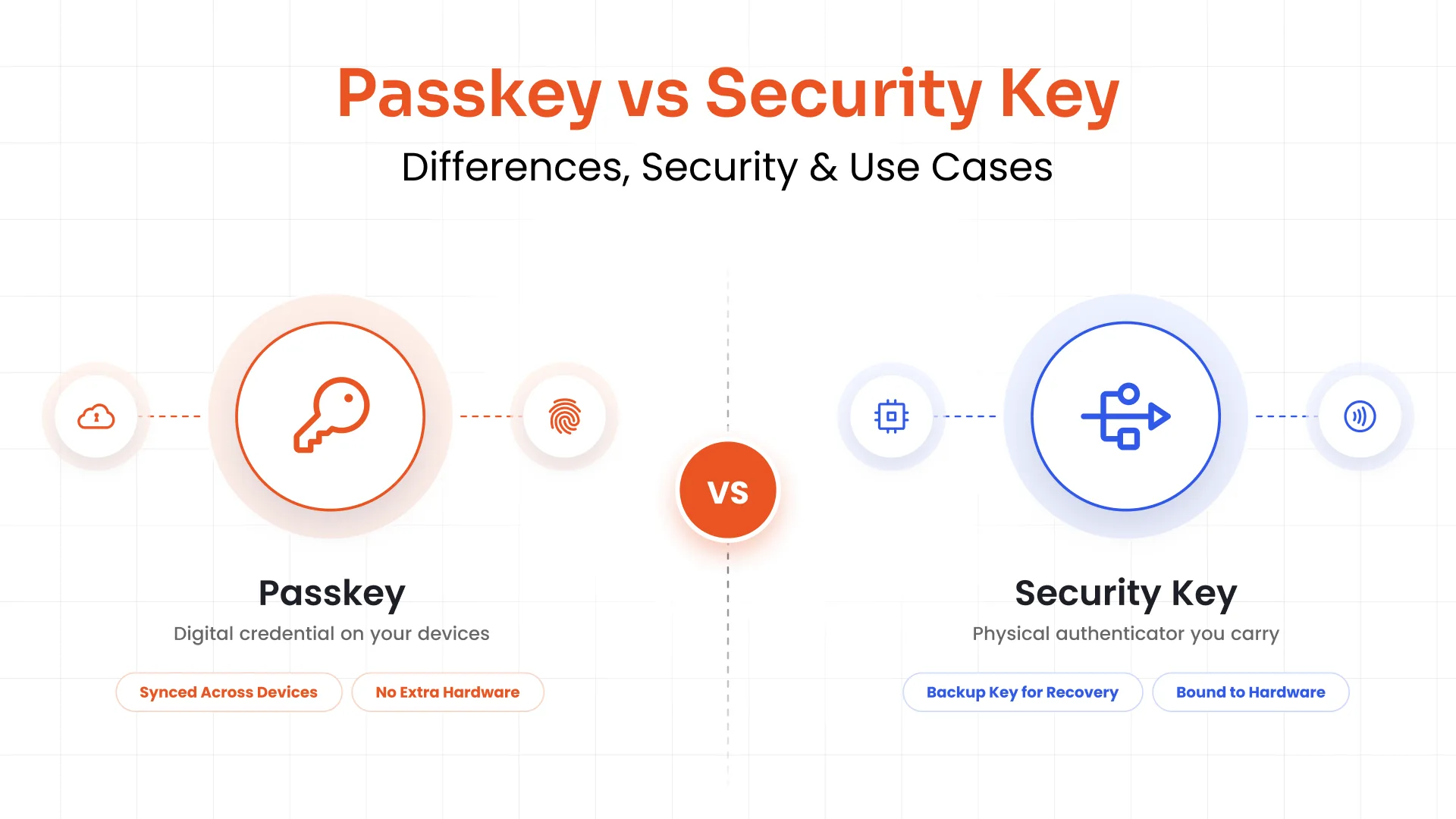
4. Synced and Device-Bound Passkeys Serve Different Risk Levels
Passkeys can be synchronized across supported devices through a credential provider or kept bound to a particular authenticator. These approaches offer different balances of convenience, portability, and administrative control.
| Consideration | Synced Passkeys | Device-Bound Passkeys |
|---|---|---|
| Access | Available across supported devices | Tied to the enrolled authenticator or device |
| Recovery | Can simplify access from a replacement device | May require a separate replacement process |
| Governance | Depends partly on synchronization and account protections | Offers tighter control over credential location |
| Typical Fit | General workforce and consumer services | Privileged access and higher-assurance environments |
Neither type is automatically secure or insecure. Device-bound credentials can use platform authenticators or physical security keys, while synced passkeys rely on the protections provided by their synchronization ecosystem.
Enterprises may permit synced passkeys for standard access while requiring device-bound credentials for selected administrator accounts. The identity system must be able to identify credential types and enforce the appropriate policies.
5. Continuous Authentication Responds to Changing Risk
Traditional authentication verifies a user at sign-in. Continuous authentication reassesses relevant signals during a session, including device posture, access context, unusual session changes, and the sensitivity of a requested action.
Behavioral biometrics can contribute signals based on typing rhythm, touch dynamics, or mouse movement. These patterns are probabilistic, however, and can change during legitimate work. An anomaly should inform a risk decision rather than automatically establish that an account is compromised.
Depending on the risk, a system might allow access to continue, request step-up authentication, restrict a sensitive operation, or terminate the session. Organizations must also define how behavioral data is collected, retained, and used to protect employee privacy. The future of passwordless authentication will depend partly on making these decisions proportionate: stronger verification when risk increases, without repeatedly challenging users during routine work.
6. Deepfake-Resistant Identity Proofing Becomes More Important
Voice cloning and synthetic video can make attackers appear to be employees or executives during remote verification. This creates risks during onboarding, identity verification, and high-risk requests where a person's face or voice is used as evidence of identity.
NIST's Digital Identity Guidelines, SP 800-63-4, address forged media and digital injection attacks in remote identity proofing. Organizations will need layered verification, including trusted identity documents where appropriate, checks for manipulated media, secure capture processes, and independent review for high-risk cases. Liveness detection can help identify some spoofing attempts, but it is not a guarantee against every synthetic-media attack.
It is also important to separate identity proofing from authentication. Identity proofing establishes confidence in who someone is; a passkey later demonstrates control of an enrolled credential. In the future of passwordless login, trustworthy enrollment and recovery will matter as much as the strength of the credential itself.
7. Digital Identity Wallets Enable Verifiable Credentials
Digital identity wallets allow users to hold and present verifiable information, such as identity attributes, qualifications, or digital documents. Instead of collecting every detail through forms, an organization can verify a credential issued by a trusted authority.
The European Commission expects EU Member States to make digital identity wallets available by the end of 2026, creating a significant policy driver for wallet-based identity services. Enterprises can use them for employee onboarding, professional qualification checks, partner verification, and selected customer identity workflows.
Decentralized identifiers and verifiable credentials can support these processes. Zero-knowledge proofs may also allow users to prove a claim without revealing all the underlying information, but this depends on the credential format and proof system. Not every wallet supports these capabilities.
Wallets complement rather than automatically replace passkeys. A wallet can present a verified claim; a passkey can authenticate control of a credential. Authorization still determines what the verified identity can access.
8. Post-Quantum Readiness Enters Identity Planning
Passkeys rely on public-key cryptography, so their long-term security depends on the algorithms used and whether those algorithms can be upgraded. A sufficiently capable quantum computer could threaten some widely used cryptographic systems, but this does not mean current passkeys will suddenly become unsafe in 2027.
NIST has published post-quantum cryptography standards, including ML-KEM for key establishment and ML-DSA and SLH-DSA for digital signatures. Its migration guidance emphasizes cryptographic inventories, risk management, and interoperability testing.
For identity infrastructure, preparation means identifying cryptographic dependencies across authentication services, certificates, applications, and connected systems. Enterprises should ask vendors how cryptographic components can be upgraded and how changes will affect interoperability.
The practical passwordless authentication future requires crypto-agility: the ability to replace cryptographic components without redesigning the entire identity environment.
9. Shared and Frontline Devices Get Purpose-Built Login Experiences
Hospitals, warehouses, factories, and retail environments often rely on workstations and tablets used by multiple employees. A standard login designed for an individual laptop may not suit these settings, where employees need fast access and reliable user switching.
Possible approaches include FIDO2 security keys, smart cards, and supported badge-based authentication. The right choice depends on the underlying protocol and security requirements.
A successful implementation must prevent the next employee from inheriting the previous user's session. Fast user switching, automatic session locking, reliable sign-out, and restrictions on shared endpoints are essential.
Organizations should also plan for lost authenticators and network outages without introducing insecure bypasses. Proximity alone does not guarantee phishing resistance, so convenience features must be evaluated alongside credential protection and session isolation.
10. Compliance and Procurement: Focus on Demonstrable Security
A product's support for passkeys or MFA does not, by itself, prove that an organization meets its security obligations. Requirements depend on the applicable framework, assurance level, sector, and use case.
NIST SP 800-63-4 defines requirements for digital identity proofing and authentication, while CISA recommends prioritizing phishing-resistant MFA solutions. FIDO-based authentication is one approach designed to prevent conventional phishing from capturing reusable authentication secrets.
Enterprise buyers should evaluate whether a solution supports the required authentication methods, enforces policies for privileged users, manages credential enrollment and revocation, integrates with existing applications, and provides useful audit evidence.
For enterprise passwordless authentication, the decision should connect technical capabilities to measurable controls and applicable compliance requirements, rather than treating a feature checklist as proof of security.
Which Passwordless Authentication Methods Will Matter Most?
The right method depends on the environment, assurance requirements, and applications involved. These passwordless authentication methods serve different purposes:
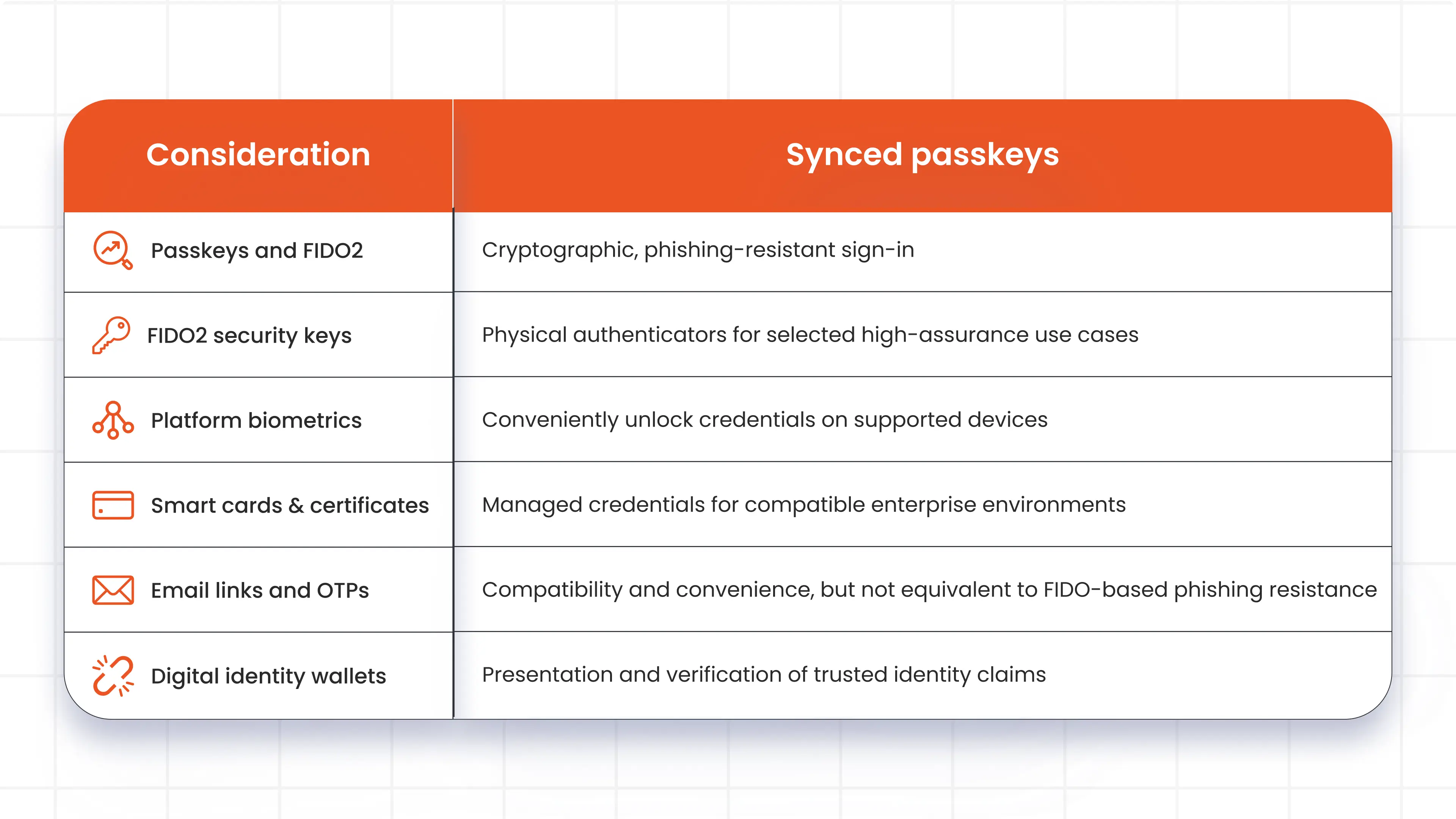
There is no single method suitable for every user or application. The passwordless login trends that matter most to an organization will depend on authenticator security, recovery, application compatibility, and policy enforcement.
What Should Organizations Evaluate Before Implementation?
A practical passwordless authentication adoption plan begins with the applications and users that carry the greatest risk. Organizations should identify password-dependent systems, prioritize privileged access, test compatibility, and define recovery procedures before expanding deployment.
Before rollout, evaluate these key areas:
- Application compatibility: Identify legacy systems, VPNs, and business applications that may require additional integration.
- Authenticator selection: Match passkeys, FIDO2 security keys, and biometric authentication to user needs and security requirements.
- Account recovery: Establish secure recovery procedures for lost devices, replaced authenticators, and locked-out users.
- User accessibility: Account for different devices, employee needs, and shared workstation environments.
- Fallback controls: Review temporary alternatives to ensure they do not create weaker routes into protected accounts.
- Deployment priorities: Start with privileged accounts and high-risk applications before expanding to the wider workforce.
The wider passwordless adoption process should also include user education, pilot testing, and clear procedures for handling authentication failures. Passwordless access is a migration program, not simply a switch that removes passwords overnight.
How miniOrange Supports Passwordless Authentication
miniOrange supports passwordless login through passkeys, FIDO2/WebAuthn, and biometric authentication, alongside additional authentication methods for different access requirements. Its IAM capabilities include Single Sign-On (SSO) and Adaptive MFA solution, with cloud, on-premises, and hybrid deployment options.
Organizations can assess these capabilities against their application landscape, user requirements, and authentication policies. Requirements such as agent-specific authorization, advanced session binding, and post-quantum migration should be validated separately against the features needed for the intended environment.
Explore the miniOrange MFA Solution to assess how passwordless login can fit into your identity and access management strategy.
The Next Phase of Login Security
The future of passwordless authentication will be shaped by how effectively organizations manage trust across the identity lifecycle. Credentials, recovery processes, active sessions, and delegated permissions each need appropriate controls.
The latest passwordless authentication trends point toward a more complete approach to identity security, where authentication establishes confidence and additional safeguards preserve it throughout access.
For organizations planning the passwordless authentication future, the priority is clear: select the right authenticators, protect the processes around them, and ensure every identity has only the authority it needs.
FAQs
What are the key passwordless authentication trends for 2027?
The key passwordless authentication trends for 2027 include passkey adoption, stronger account recovery, AI agent identity management, session security, digital identity wallets, and post-quantum cryptography readiness.
What is the future of passwordless authentication?
The future of passwordless authentication will focus on securing the entire identity lifecycle, including enrollment, recovery, active sessions, and delegated access. Organizations will increasingly combine phishing-resistant credentials with risk-based access controls.
What are the most common passwordless authentication methods?
Common passwordless authentication methods include passkeys, FIDO2 security keys, platform biometrics, smart cards, and certificate-based authentication. The right choice depends on security requirements, device compatibility, and user needs.
How can enterprises improve passwordless authentication adoption?
Organizations can improve passwordless authentication adoption by prioritizing high-risk accounts, testing application compatibility, simplifying enrollment, and establishing secure recovery procedures. Pilot deployments and adoption metrics can help identify barriers before a wider rollout.
How does passwordless login improve security?
Passwordless login using passkeys and FIDO2 can reduce phishing risks, password reuse, and credential theft. However, passwordless login security also depends on session protection, recovery controls, device security, and appropriate access policies.
What should enterprises look for in a passwordless authentication solution?
For enterprise passwordless authentication, evaluate supported authenticators, application integrations, centralized policy enforcement, account recovery, audit logs, scalability, and deployment options. Verify that the solution meets your organization's specific security and compliance requirements.
About the Author

Content Writer
Minal is an experienced B2B content writer. She has written over 250 articles across industries like UI/UX, real estate, automotive, digital marketing, SaaS, AI & ML, and cybersecurity. She brings her interest in cybersecurity to life by creating clear, engaging content tailored for technical, non-technical, and creative pieces. Her aim is to simplify complex topics, highlight product value, and connect with both technical and non-technical audiences.
Leave a Comment