

Every login creates a moment of trust. The problem is that moment rarely lasts, yet most security systems assume it does.
Traditional authentication verifies identity once, at the point of login, and then steps back. From that moment until logout, the session is treated as trustworthy. No re-checks. No re-verification. That assumption is increasingly dangerous.
Modern threat actors do not always break in. They walk in. Through stolen credentials, hijacked session tokens, or compromised devices, attackers exploit the window that opens once initial authentication is complete. Insider threats, AI-powered attacks, and credential theft have made static, login-only verification a significant security gap.
Continuous authentication addresses this directly. It evaluates user identity and trust throughout an active session, continuously and in real time, rather than treating the login as a one-time checkpoint. As organizations move toward Zero Trust Architecture, continuous authentication has become a foundational control, not an optional enhancement.
What Is Continuous Authentication?
Think of continuous authentication as an intelligent security mechanism that keeps verifying a user's identity even after they have successfully logged in.
Traditional authentication grants access based on a single login event and assumes the user's identity remains trustworthy until they log out. A continuous authentication system, on the other hand, removes that assumption by continuously verifying the user's identity throughout the session. It does this by analyzing behavioral patterns, device attributes, contextual signals, and real-time risk indicators throughout the session, often without interrupting the user experience.
If the system detects suspicious behavior or an elevated level of risk, it can automatically trigger additional verification, restrict access to sensitive resources, or terminate the session. This continuous trust evaluation significantly reduces the risk of attackers exploiting stolen credentials or hijacked sessions after the initial login.
In simple terms, continuous authentication shifts identity verification from a one-time event to an ongoing process that adapts as the session unfolds.
How Continuous Authentication Works
Rather than relying on one security checkpoint, continuous authentication solutions evaluate trust throughout the user session.
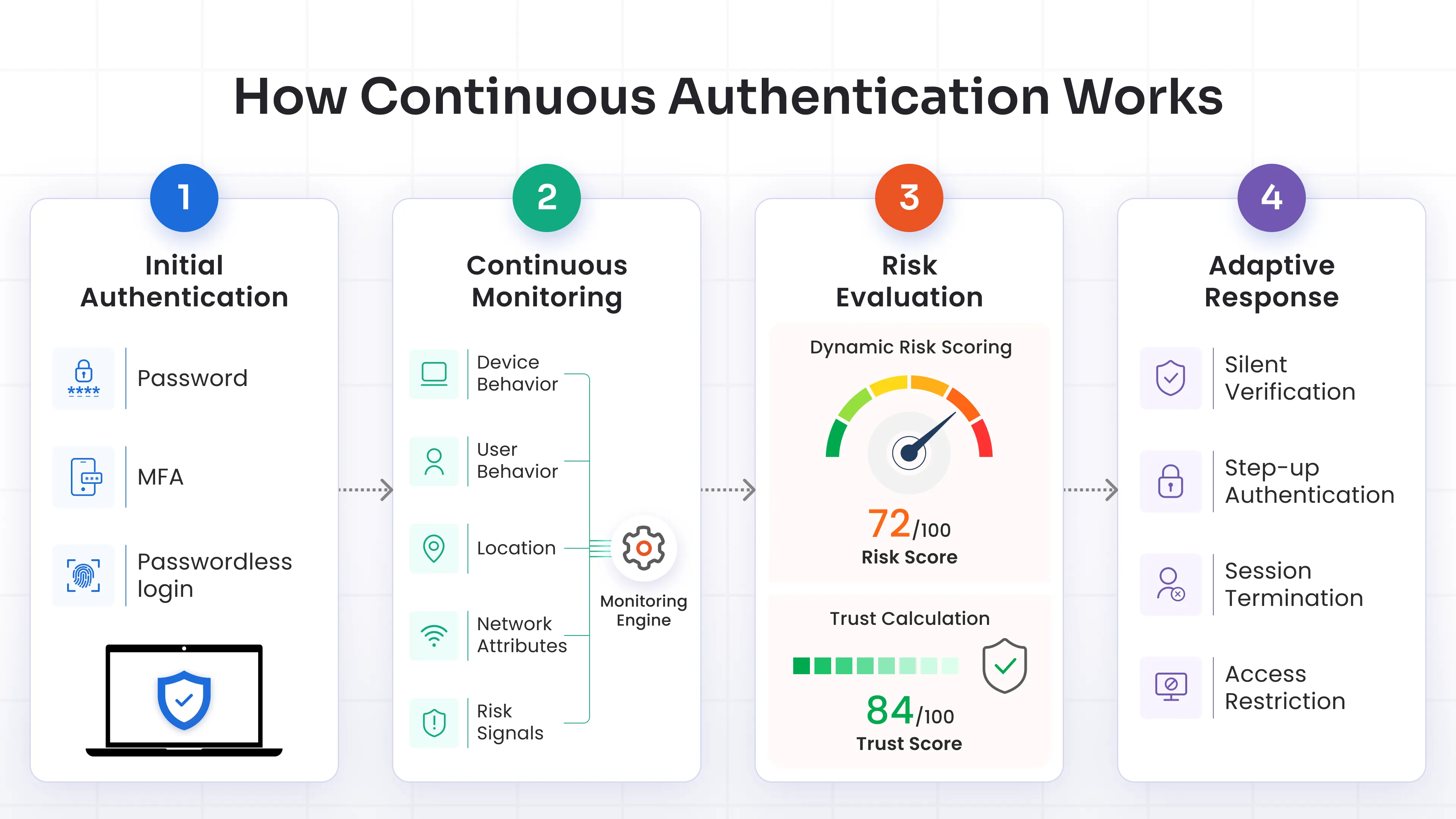
The process typically involves four stages:
Step 1: Initial Authentication
The session begins with standard identity verification: a password, multi-factor authentication (MFA), or a passwordless continuous authentication method such as biometrics or a passkey.
Step 2: Continuous Monitoring
Once the session is active, the system begins monitoring a range of signals:
- Device behavior and fingerprint
- User behavior and interaction patterns
- Location and network attributes
- Time of access
- Application navigation patterns
Many organizations strengthen continuous authentication using behavioral biometrics by analyzing typing speed, mouse movements, touchscreen interactions, and navigation habits to establish a unique behavioral profile.
Step 3: Risk Evaluation
The collected signals feed into a dynamic risk scoring engine. Each signal contributes to a real-time trust calculation. A sudden location change, an unfamiliar device, or abnormal typing behavior can all raise the risk score.
Step 4: Adaptive Response
Based on the risk score, the system responds proportionally:
- Low risk: Session continues uninterrupted
- Elevated risk: Step-up authentication is triggered (e.g., an MFA prompt)
- High risk: Session is terminated or access is restricted
Why Traditional Authentication Is No Longer Enough
Static authentication models were designed for a time when users worked primarily within trusted corporate networks. Today's hybrid workplaces, cloud applications, and AI-powered threats have fundamentally changed the security landscape.
Once attackers obtain valid credentials or steal an active session token, traditional authentication often has no mechanism to verify whether the current user is still legitimate.
Common security gaps include:
- Session hijacking: Attackers intercept and reuse a valid session token without needing credentials
- Credential stuffing: Compromised username-password pairs, tested at scale, can result in unauthorized access that looks perfectly legitimate
- Token theft: OAuth tokens or session cookies stolen post-login bypass authentication entirely
- Insider threats: A legitimate user with valid credentials can misuse access in ways a one-time login check will never catch
- Account takeover: Once inside, an attacker can operate freely for the entire session duration
Consider This Scenario:
An employee logs into a cloud-based HR application using MFA from their company laptop. The login is successful, and they begin working as usual, leaving their session active.
Sometime later, an attacker steals the employee's authenticated session cookie through malware or a compromised network request and uses it to access the same application.
Because the attacker is using a valid session, they never need to enter the employee's password or complete MFA. From the application's perspective, the session appears legitimate, allowing the attacker to move through sensitive resources without triggering traditional login-based security controls.
This is where continuous authentication makes a difference. Rather than trusting the session indefinitely, it continuously validates the user's identity by monitoring behavioral patterns, device posture, contextual signals, and real-time risk indicators. If those signals no longer match the expected user, the system can immediately respond before sensitive data is exposed.
Continuous Authentication and Zero Trust
Understanding the Zero Trust Principle
The core principle of Zero Trust is simple:
Never trust. Always verify.
Rather than assuming users remain trustworthy after logging in, Zero Trust continuously validates identities, devices, applications, and access requests throughout every interaction.
Why Continuous Authentication Is Critical for Zero Trust
Continuous authentication is a core enabler of Zero Trust, and one of the mechanisms that makes it operationally possible. Here is how it maps to Zero Trust requirements:
| Zero Trust Requirement | Continuous Authentication Benefit |
|---|---|
| Verify continuously | Ongoing identity validation throughout the session |
| Least privilege | Dynamic access control based on real-time risk |
| Risk-based decisions | Real-time risk scoring at every session stage |
| Session protection | Detects suspicious activity post-login |
Key Components of Continuous Authentication
Behavioral Biometrics
Continuous authentication using behavioral biometrics analyzes patterns that are unique to each user and difficult to replicate, including:
- Typing rhythm and keystroke dynamics
- Mouse movement speed and patterns
- Touchscreen pressure and gesture habits
- Application navigation sequences
Continuous behavioral authentication using these signals operates entirely in the background and does not require any action from the user, making it a low-friction but high-signal verification method.
Device Intelligence
Device-level signals provide an additional verification layer:
- Device fingerprinting and hardware identifiers
- Browser profiling and version data
- Device trust assessment (managed vs. unmanaged, patched vs. unpatched)
Contextual Signals
Context matters as much as behavior. The system evaluates:
- IP reputation and geolocation
- Time of access relative to normal usage patterns
- Network behavior (VPN usage, unusual proxies, new access points)
AI and Machine Learning
AI continuous authentication systems use machine learning to build individual behavioral baselines and detect deviations that rule-based systems would miss. Core capabilities include:
- Anomaly detection across behavioral and contextual signals
- Behavioral modeling that improves accuracy over time
- Adaptive risk assessment that adjusts thresholds per user profile
Types of Continuous Authentication Methods
Continuous Biometric Authentication
Continuous biometric authentication extends biometric verification beyond the initial login. Methods include:
- Passive facial recognition during active sessions
- Voice pattern analysis during calls or interactions
- Fingerprint re-verification at sensitive access points
Continuous Multi-Factor Authentication
Unlike traditional MFA that occurs only during login, continuous multi factor authentication triggers additional verification when risk increases. This includes:
- Dynamic MFA triggers based on risk score thresholds
- Risk-based MFA that activates only when behavioral or contextual signals shift
- Adaptive authentication that chooses the least disruptive verification method for a given risk level
Risk-Based Continuous Authentication
Continuous risk-based authentication uses a scoring engine to evaluate risk continuously and apply policies accordingly:
- A baseline risk score is established at login
- The score adjusts in real time as signals change
- Policy enforcement responds proportionally to score changes, from silent re-verification to full session termination
Benefits of Continuous Authentication
Implementing continuous authentication delivers security and usability benefits across the organization.
- Detects compromised sessions in real time.
- Reduces the impact of credential theft and account takeover.
- Improves user experience through adaptive verification instead of repeated MFA prompts.
- Accelerates threat detection using behavioral and contextual analysis.
- Supports regulatory compliance by continuously validating user identity.
- Strengthens protection against insider threats and unauthorized privilege misuse.
Continuous Authentication Use Cases
Workforce Identity Security:
Employees accessing sensitive internal systems are monitored throughout their sessions, with verification extending well beyond the initial login.
Privileged Access Management (PAM):
Privileged sessions carry elevated risk. Continuous verification ensures that even authorized administrators are monitored for anomalous behavior.
Remote Workforce Security:
Distributed workforces introduce variable network environments and devices. Continuous monitoring catches risk signals that a VPN alone cannot address.
Financial Services:
High-value transactions and sensitive customer data require session-level assurance that login credentials alone cannot provide.
Healthcare:
HIPAA-regulated environments require tight access control over patient data. Continuous authentication supports both compliance and data protection.
Government Agencies:
Sensitive systems require persistent identity assurance across the full session lifecycle.
AI Agents and Autonomous Systems:
As AI agents operate across systems, verifying the identity of non-human actors continuously and detecting abnormal agent behavior is an emerging and critical use case.
Continuous Authentication vs Traditional Authentication
| Feature | Traditional Authentication | Continuous Authentication |
|---|---|---|
| Verification Frequency | Once at login | Continuous throughout session |
| Risk Detection | Limited to login stage | Real-time |
| Session Security | Weak post-login | Strong throughout |
| User Experience | Interruptive MFA | Adaptive, context-aware |
| Zero Trust Alignment | Partial | Full |
Continuous Authentication vs Adaptive Authentication
Although the terms are often used interchangeably, they are not identical.
| Factor | Adaptive Authentication | Continuous Authentication |
|---|---|---|
| Timing | Primarily during login | Entire user session |
| Monitoring | Event-driven | Continuous |
| Risk Assessment | Periodic | Real-time and ongoing |
Adaptive authentication makes smarter login decisions. Continuous authentication extends that intelligence across the full session. The two approaches are complementary, and the strongest implementations combine both.
Challenges of Implementing Continuous Authentication
- Privacy concerns: Collecting behavioral and biometric data requires clear policies, user consent frameworks, and compliance with regulations like GDPR and DPDP Act
- Behavioral data accuracy: Behavioral baselines take time to establish; new users or changed behaviors can affect accuracy early in deployment
- False positives: Overly sensitive thresholds can disrupt legitimate users with step-up prompts or session terminations
- Integration complexity: Connecting continuous authentication signals with existing IAM, PAM, and endpoint systems requires careful architecture planning
- User acceptance: Employees may be cautious about behavioral monitoring; clear communication about what is collected and why is essential
How AI Is Transforming Continuous Authentication
Advances in AI-based continuous authentication are making identity verification more intelligent and proactive.
AI enables organizations to:
- Build behavioral profiles for every user.
- Detect subtle anomalies that traditional rule-based systems may miss.
- Improve Identity Threat Detection and Response (ITDR).
- Automate risk-based security decisions with minimal user disruption.
As AI-powered attacks become more sophisticated, AI-driven authentication is becoming equally important for defending enterprise identities.
Best Practices for Deploying Continuous Authentication
1. Start with risk-based policies: Define what constitutes an elevated risk signal before configuring adaptive responses
2. Combine with MFA: Use continuous authentication to determine when MFA should trigger, not as a replacement for it.
3. Integrate with IAM and PAM: Continuous risk signals should feed into access control policies across both workforce and privileged identity systems.
4. Monitor behavioral signals consistently: Behavioral baselines only work if signal collection is reliable and consistently applied.
5. Align with Zero Trust strategy: Continuous authentication should be a deliberate part of the broader Zero Trust roadmap, not a standalone tool.
6. Continuously tune risk models: As user behavior evolves and threat patterns change, risk thresholds need regular review and refinement.
How miniOrange Enables Continuous Authentication
Continuous authentication is not just about adding more checks at login. It is about keeping trust under review throughout the session. miniOrange helps organizations strengthen identity security through capabilities that support modern continuous authentication initiatives, combining risk signals, adaptive policies, and identity controls that respond as user behavior changes.
Continuous Risk Evaluation:
Real-time risk scoring across behavioral, contextual, and device signals throughout every active session
Adaptive MFA:
Adaptive MFA challenges are triggered dynamically based on risk score changes, reducing friction for low-risk sessions while enforcing verification when it matters
Behavioral Risk Detection:
Behavioral anomalies are detected against individualized user baselines, enabling accurate threat identification without excessive false positives
Device Trust Assessment:
Every session is evaluated against device posture, health, and trust level, going beyond user credentials alone
Zero Trust Access Controls:
Access decisions are enforced dynamically, aligned with zero trust continuous authentication principles
PAM and Identity Governance Integration:
Continuous verification extends into privileged access sessions and integrates with miniOrange's IGA capabilities for a complete identity security posture
FAQs
Is continuous authentication part of Zero Trust?
Yes. Continuous authentication is a core mechanism of Zero Trust architecture, enabling organizations to meet the "never trust, always verify" requirement beyond the login stage and throughout every session.
How is continuous authentication different from MFA?
MFA adds verification factors at login. Continuous authentication applies risk evaluation and verification throughout the session. The two work best together, with continuous authentication determining when and whether additional MFA challenges should be triggered.
Can AI improve continuous authentication?
Yes. AI-based continuous authentication enables accurate behavioral baselines at scale, predictive threat detection, and autonomous session-level decisions that respond to threats in real time.
Is continuous authentication suitable for remote workforces?
Yes. Remote environments introduce variable devices, networks, and locations that make session-level monitoring especially valuable. Continuous authentication catches risk signals that perimeter-based controls cannot.
What industries benefit most from continuous authentication?
Financial services, healthcare, government, and any sector handling sensitive data or privileged access see the highest return from continuous authentication. It is also increasingly important for organizations deploying AI agents and autonomous systems that require non-human identity verification.
Leave a Comment