

AI systems no longer sit quietly inside a sandbox. They call APIs, retrieve files, orchestrate multi-step workflows, spin up sub-agents, and interact with enterprise tools, often without a human in the loop. Every one of those interactions is an access event. And every access event requires a secure, verifiable identity.
The question is no longer whether your AI systems need authentication. It is what kind of authentication can actually keep up with the way AI agents operate. Traditional session-based logins and static API keys were designed for human users sitting at browsers. Autonomous AI agents are a fundamentally different class of actor. They demand a fundamentally different approach to identity verification.
JWT authentication for AI systems, built on the JSON Web Token standard, has emerged as one of the most practical and scalable answers to this challenge. This guide explains what JWTs are, why they matter for AI, how they work in practice, and what you need to get them right.
What Is JWT Authentication?
JWT (JSON Web Token) is an open standard (RFC 7519) for securely transmitting identity and authorization information between parties as a compact, self-contained, cryptographically signed token.
A JWT is composed of three Base64URL-encoded parts separated by dots:
- Header: specifies the token type and signing algorithm (e.g., RS256, HS256)
- Payload: contains claims: who the subject is (sub), who issued the token (iss), when it expires (exp), and what it is allowed to do (custom claims/scopes)
- Signature: a cryptographic hash that proves the token has not been tampered with
Because the signature is verified on every request without a database lookup, JWTs enable stateless authentication. This is a critical property for distributed and AI-driven environments.
JWTs are widely used for API authentication, machine-to-machine (M2M) communication, cloud-native applications, microservices, and increasingly for AI agents and autonomous systems.
Why AI Systems Need JWT Authentication
AI systems are not passive. Modern AI agents actively:
- Call external APIs and SaaS tools
- Retrieve documents from enterprise data stores
- Trigger database queries, webhook events, or code executions
- Delegate tasks to sub-agents in multi-agent pipelines
- Operate continuously without human oversight
This means AI systems accumulate access footprints that rival or exceed those of human users. Yet most organizations still treat AI agents as second-class identities. They assign shared service account credentials, long-lived API keys, or no authentication governance at all.
That is a significant and growing security risk. The key challenges AI systems face around authentication include:
Non-Human Identities
AI agents are non-human identities and machine identities, not user identities. They don't log in; they execute. Authentication frameworks must accommodate this without defaulting to insecure workarounds like embedded credentials in code.
Distributed AI Workflows
A single AI orchestration task may span multiple services, cloud environments, and external APIs. Each hop requires its own access decision, and that decision must be consistent, auditable, and enforceable.
API-Centric Architectures
Virtually every AI platform, whether it is an LLM-based copilot, an agentic automation, or an AI data pipeline, communicates through APIs. Securing those API calls is not optional; it is baseline hygiene.
Autonomous Decision-Making
AI agents act on their own. There is no human re-entering a password or clicking "approve" between steps. The authentication mechanism must be self-contained and enforceable at the token level. It cannot depend on human confirmation.
JWT authentication addresses all of these challenges through token-based identity verification that is stateless, scoped, short-lived, and cryptographically verifiable.
How JWT Authentication Works in AI Systems
Understanding the mechanics matters because getting any step wrong creates exploitable gaps.
1. Authentication Request
The AI agent, or the platform running it, initiates an authentication request to an authorization server. In OAuth 2.0 flows, this typically uses the Client Credentials Grant, designed specifically for machine-to-machine authentication where no user interaction is present.
2. JWT Token Issued
The authorization server validates the agent's credentials (client ID and secret, or an assertion) and returns a signed JWT. The token includes claims that define the agent's identity, permitted scopes, issuer, and expiration time. Signing is performed with a private key; verifiers use the corresponding public key.
3. AI Agent Accesses APIs
The AI system includes the JWT in the Authorization header of every API request, using the Bearer token scheme:
Authorization: Bearer
4. Resource Server Validates the Token
The receiving service, whether an API, a database gateway, or an MCP server, validates the JWT locally without contacting the authorization server. Validation checks include:
- Signature verification against the public key
- Token expiration (exp claim)
- Issuer (iss) and audience (aud) claim matching
- Permitted scopes and custom claims
5. Access Granted or Denied
Based on token claims and configured policies, access is either granted or denied. No session state, no round-trip to an authentication server. Just cryptographic verification.
JWT Authentication Use Cases in AI Systems
AI Agent Authentication
Autonomous AI agents, whether they are copilots, automation bots, or retrieval pipelines, need persistent, scoped identities. JWTs let each agent carry a verifiable identity that specifies exactly which resources and actions it is authorized to use.
AI API Security
AI platforms expose APIs that other systems, including internal tools, third-party integrations, and other AI agents, constantly call. JWT-based access control ensures only authenticated, authorized callers can invoke those endpoints.
MCP Server Authentication
As the Model Context Protocol (MCP) becomes a standard interface between AI agents and enterprise tools, securing MCP server communication with JWTs becomes critical. JWTs allow AI systems to authenticate against MCP endpoints with verifiable, scoped tokens rather than hard-coded credentials.
Multi-Agent Communication
In agentic pipelines, orchestrator agents spawn sub-agents and delegate tasks. Each sub-agent must authenticate independently and operate within its own permission boundary. This prevents a compromised sub-agent from inheriting the full authority of its parent.
SaaS AI Integrations
AI integrations connecting to SaaS platforms (CRMs, ERPs, HR systems) require secure, auditable API access. JWTs provide a consistent authentication mechanism across heterogeneous cloud environments.
Enterprise AI Copilots and Internal Automation
Internal AI assistants accessing HR systems, financial data, or code repositories must be subject to the same access governance as human users. JWT-based authentication ensures these systems authenticate with least-privilege scopes and verifiable identities.
JWT Token Structure: What's Inside Matters
For AI system authentication, the claims inside the JWT payload are where access policy lives. Organizations should configure custom claims that reflect the AI agent's role and context, not just its identity. Relevant claims for AI authentication include:
- sub: the agent's unique identifier
- scope: permitted API actions (e.g., read:documents, write:tasks)
- agent_type: whether this is an orchestrator, sub-agent, or tool-use agent
- workflow_id: binding the token to a specific task or execution context
- iat / exp: issued-at and expiration timestamps
The IETF draft on Agentic JWT (draft-goswami-agentic-jwt-00, December 2025) formalizes several of these concepts, introducing agent checksums based on an agent's system prompt, tools, and configuration.
These checksums create a cryptographic identity tied to what the agent actually is, not just a credential it holds. This approach directly addresses the intent-execution separation problem: the risk that an AI agent, once authenticated, deviates from the authorized scope of work the user intended.
Benefits of JWT Authentication for AI Systems
- Stateless Authentication: No session store required. Each token is self-validating, which eliminates a major scalability bottleneck in distributed AI architectures.
- Scalability: JWTs work seamlessly across microservices, multi-cloud deployments, and agentic pipelines without shared state dependencies.
- Secure API Access: Short-lived, scoped tokens replace long-lived API keys, significantly reducing the blast radius of a credential compromise.
- Faster Authorization: Token validation happens locally at the resource server, with no latency from authentication server round-trips on every API call.
- Cross-Platform Compatibility: JWTs are an open standard supported across virtually every cloud platform, framework, and language.
- Reduced Credential Exposure: AI agents never handle raw passwords. Token-based flows minimize credential surface area at every layer.
- Auditability: Every API call carries a verifiable token identity, making it possible to build complete audit logs of what each AI agent accessed and when.
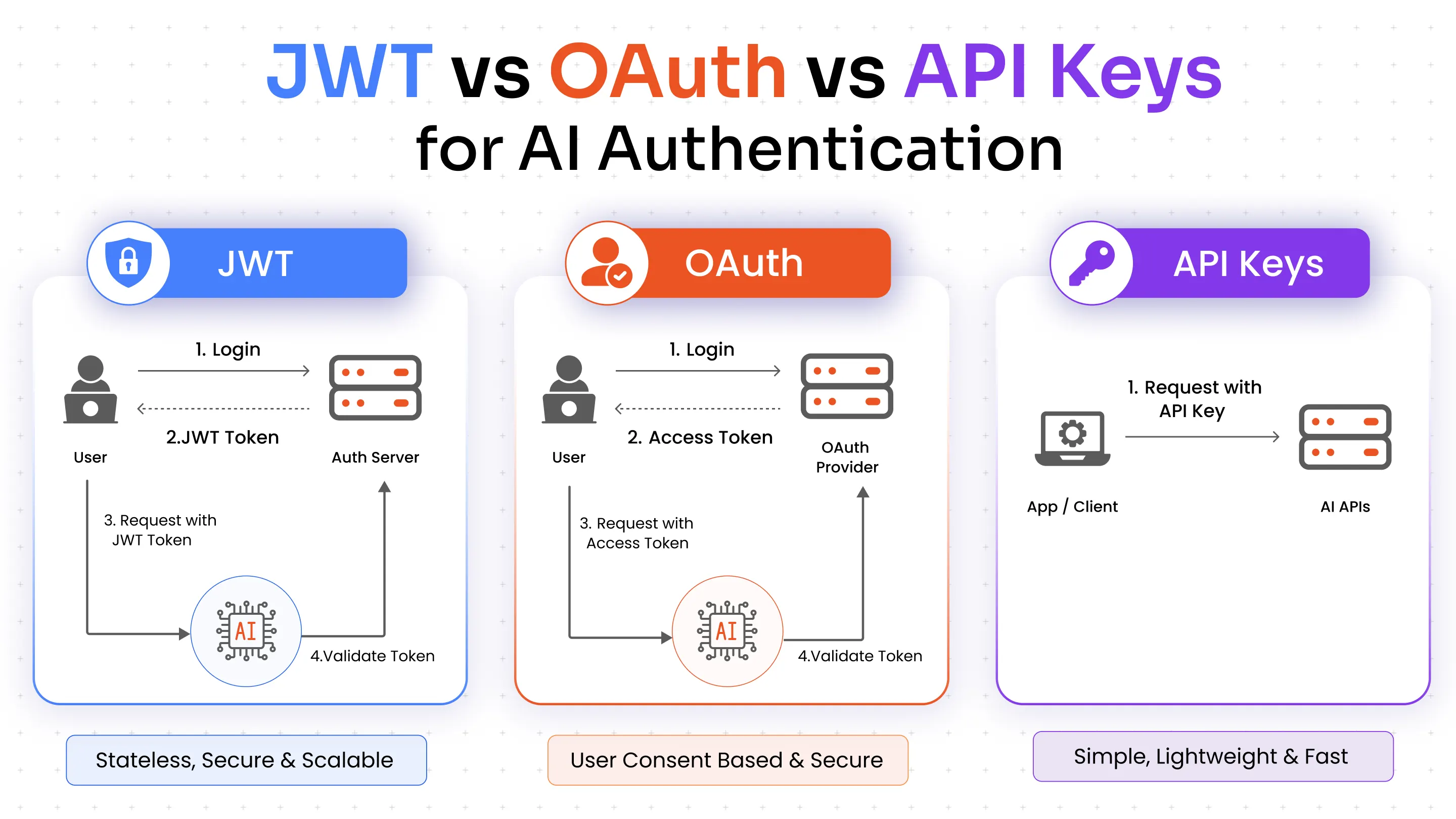
JWT vs. OAuth vs. API Keys for AI Authentication
| Feature | JWT | OAuth 2.0 | API Keys |
|---|---|---|---|
| Identity Verification | Yes | Yes | Limited |
| Stateless | Yes | Partial | Yes |
| Granular Access Scopes | Moderate | Strong | Weak |
| Expiration Support | Yes | Yes | Rarely |
| AI Agent Support | Strong | Strong | Weak |
| Token Revocation | Requires blocklist | Built-in (refresh) | Manual |
| Security Level | High | High | Low |
| Auditability | High | High | Low |
The practical answer for AI systems is not JWT or OAuth. It is both together. JWTs are the token format; OAuth 2.0 (particularly the Client Credentials flow) is the framework that governs how those tokens are issued, scoped, and refreshed.
API keys have a role in low-risk, internal machine communication, but should never be the primary mechanism for AI systems accessing sensitive enterprise resources.
Common JWT Security Risks in AI Environments
Understanding what can go wrong is just as important as knowing how JWTs work.
Token Theft and Replay Attacks
A stolen JWT can be replayed by an attacker until it expires. For AI systems with long-running workflows, this risk multiplies.
Overly Broad Scopes
Assigning AI agents wide permissions "just in case" violates least privilege and creates privilege escalation paths if an agent is compromised.
Long-Lived Tokens
JWTs without short expiry windows become persistent attack vectors. Unlike sessions, they cannot be invalidated without a blocklist.
Algorithm Confusion
Using weak or misconfigured signing algorithms (e.g., none or HS256 with weak secrets) undermines the cryptographic guarantee that makes JWTs trustworthy.
Missing Claim Validation
Failing to verify iss, aud, or exp claims allows forged or expired tokens to succeed.
Best Practices for Securing JWT Authentication in AI Systems
1. Use short-lived JWTs: Set expiration windows of 5–15 minutes for AI API calls. Use token refresh flows to maintain continuity without extending exposure.
2. Implement token rotation: Regularly rotate signing keys and refresh tokens to limit the impact of key compromise.
3. Apply least-privilege scopes: Define narrow, task-specific scopes for each AI agent. An agent retrieving documents should not have write access to databases.
4. Use asymmetric signing algorithms: RS256 or ES256 (RSA or ECDSA) are preferred over HS256 for AI authentication. The private key signs; the public key verifies with no shared secret.
5. Validate all claims: Always verify exp, iss, aud, and custom claims on every request. Never skip claim validation for performance reasons.
6. Monitor AI API activity: Instrument every token-authenticated API call. Anomalous patterns such as unusual access hours, unexpected data volumes, or unknown endpoints should trigger automated alerts.
7. Combine JWT with Zero Trust controls: JWT authentication answers "who is this?" Zero Trust frameworks answer "should this be allowed right now?" Use both. Implement continuous verification at every service boundary.
8. Encrypt sensitive claims: Use JWE (JSON Web Encryption) for tokens carrying sensitive agent context or business data in their payload.
9. Maintain a token blocklist for revocation: Since JWTs are stateless, revocation requires a blocklist or short expiry enforcement. For AI systems with elevated privileges, maintain a server-side blocklist.
10. Centralize token governance: Manage all AI agent token issuance, rotation, and revocation through a centralized identity platform. Ad-hoc credential management is how shadow AI access proliferates.
The Future of JWT Authentication for AI Agents
The authentication challenges of today's agentic AI systems are genuinely new. Frameworks built for human users, such as session cookies, password-based MFA, and manual access reviews, were not designed for entities that execute thousands of API calls per hour, spawn their own sub-identities, and make authorization decisions autonomously.
The industry is actively evolving in response. Key developments shaping the future of JWT authentication for AI include:
- Agentic JWT Standards: The IETF draft on Agentic JWT introduces cryptographic agent checksums, workflow-aware token binding, and a new OAuth 2.0 grant type (agent_checksum) specifically for AI agents. This moves agent identity from "what credential does this agent hold?" to "what is this agent, cryptographically?"
- Contextual and Dynamic Authorization: Future AI authentication won't just validate identity at access time. It will evaluate real-time context: what workflow step is the agent executing? Is this action consistent with the user's declared intent?
- Continuous Authentication: Rather than a one-time token issuance, AI systems will move toward continuous identity verification. Agent identity and permissions will be re-validated at each significant decision point in a workflow.
- Non-Human Identity (NHI) Governance: As the volume of AI agents grows, organizations will need dedicated governance platforms for managing machine identities. These platforms will track what each agent can access, when, and under what conditions.
Final Words
AI systems are already operating as autonomous participants in enterprise environments. They are accessing APIs, querying data, triggering workflows, and delegating tasks across multi-agent pipelines. Authenticating these systems with the rigor applied to human identities is not optional; it is a fundamental requirement for responsible AI deployment.
JWT authentication provides a scalable, standards-based foundation for AI identity security. Short-lived, cryptographically signed, and claims-rich, JWTs allow AI agents to authenticate without shared secrets, operate across distributed environments, and carry verifiable proof of their permitted scope with every request.
But JWTs alone are not enough. Effective AI system authentication requires combining token-based access with Zero Trust policy enforcement, least-privilege scoping, continuous monitoring, and centralized identity governance. Organizations that build these controls now will be far better positioned as agentic AI deployments scale. Regulatory scrutiny of AI access will inevitably follow.
FAQs
How does JWT authentication secure AI APIs?
JWTs secure AI APIs by ensuring every incoming request carries a cryptographically verifiable identity. The API validates the token's signature, expiration, and scope claims before granting access. No external authentication server is contacted for each request.
What are the risks of JWT authentication in AI environments?
Key risks include token theft and replay attacks, overly broad permission scopes, long-lived tokens that become persistent attack vectors, weak signing algorithm configuration, and insufficient claim validation. These are mitigated through short expiry windows, least-privilege scoping, and asymmetric signing algorithms.
Can JWTs authenticate non-human identities?
Yes. JWTs are well-suited for non-human identity (NHI) authentication. Used with OAuth 2.0's Client Credentials flow, JWTs can issue machine-to-machine tokens that authenticate AI agents, service accounts, and automated processes without human interaction.
What is the difference between JWT and OAuth 2.0?
JWT is a token format: a compact, signed data structure carrying identity claims. OAuth 2.0 is an authorization framework that governs how tokens are issued, scoped, and refreshed. In AI authentication, they are typically used together: OAuth 2.0 handles the token issuance flow; JWTs are the token format that those flows produce.
Are JWTs secure for AI systems?
JWTs are secure when implemented correctly, using strong asymmetric algorithms (RS256/ES256), short expiration windows, full claim validation, and centralized key management. Misconfigured JWTs (weak algorithms, no expiry enforcement, overly broad scopes) create significant vulnerabilities.
What are Agentic JWTs?
Agentic JWTs are a proposed extension to the JWT/OAuth 2.0 standard (IETF draft-goswami-agentic-jwt-00) designed specifically for autonomous AI agents. They introduce cryptographic agent checksums, which are hashes of the agent's system prompt, tools, and configuration, and workflow-aware token binding that links a token to the specific intent it was issued to fulfill.
Leave a Comment