

External users like partners, suppliers, contractors, and enterprise customers frequently require digital access to an organization's applications and data. B2B Identity and Access Management (B2B IAM) provides centralized identity management, authentication, authorization, provisioning, and access governance across these multi-organizational relationships.
What Is B2B IAM?
B2B IAM is the practice of managing identities and controlling access for users from external organizations that interact with a business's applications, services, portals, and data.
These identities can belong to:
- Partners and resellers
- Suppliers and vendors
- Enterprise customers
- Contractors
- Distributors
- Franchisees
- Agents and brokers
- Other third-party organizations
B2B identity management covers the complete access lifecycle rather than authentication alone.
- Identity management: Creates and maintains external identities
- Authentication: Verifies users before access
- Authorization: Determines what users can access
- Provisioning: Creates accounts and assigns access
- Lifecycle management: Updates or removes access as circumstances change
- Access Governance: Reviews, audits, and remediates access
The important distinction is organizational context.
In a B2B environment, knowing that someone is “John Smith” is not enough. The organization also needs to know that John belongs to a particular partner, what role he has there, what relationship that partner has with the business, and which resources that relationship permits him to access.
This is why B2B identity and access management commonly involves organization hierarchies, delegated administration, identity federation, granular authorization, lifecycle workflows, and access governance.
Why Is B2B Identity Management Important?
External access introduces a fundamental challenge: the organization needs to enable collaboration without extending unnecessary trust.
A partner may have hundreds of employees who need different levels of access. A supplier may use its own identity provider. A contractor may need access only for the duration of a project. A customer may want to administer its own users.
Without a structured B2B identity model, these relationships can become difficult to manage at scale.
B2B IAM addresses six key challenges
Secure third-party access
Access can be restricted according to organization, role, resource, and business need instead of giving external users broad permissions.
Faster partner onboarding
Automated invitations, federation, provisioning, and workflows reduce the manual effort involved in bringing new organizations into the environment.
Reduced stale access
Lifecycle automation helps remove access when users change roles, leave partner organizations, or no longer need a particular application.
Better partner experience
SSO, federation, and self-service capabilities reduce unnecessary credentials and administrative friction.
Centralized visibility
Security teams gain a clearer view of external identities, permissions, authentication activity, and administrative changes.
Scalable collaboration
A defined organizational identity model makes it easier to add partners, users, applications, and business relationships without creating an equivalent increase in manual administration.
The value of B2B IAM therefore extends beyond security. It helps organizations create a repeatable way to manage digital business relationships at scale.
How Does B2B IAM Work?
A typical B2B IAM lifecycle can be represented as:
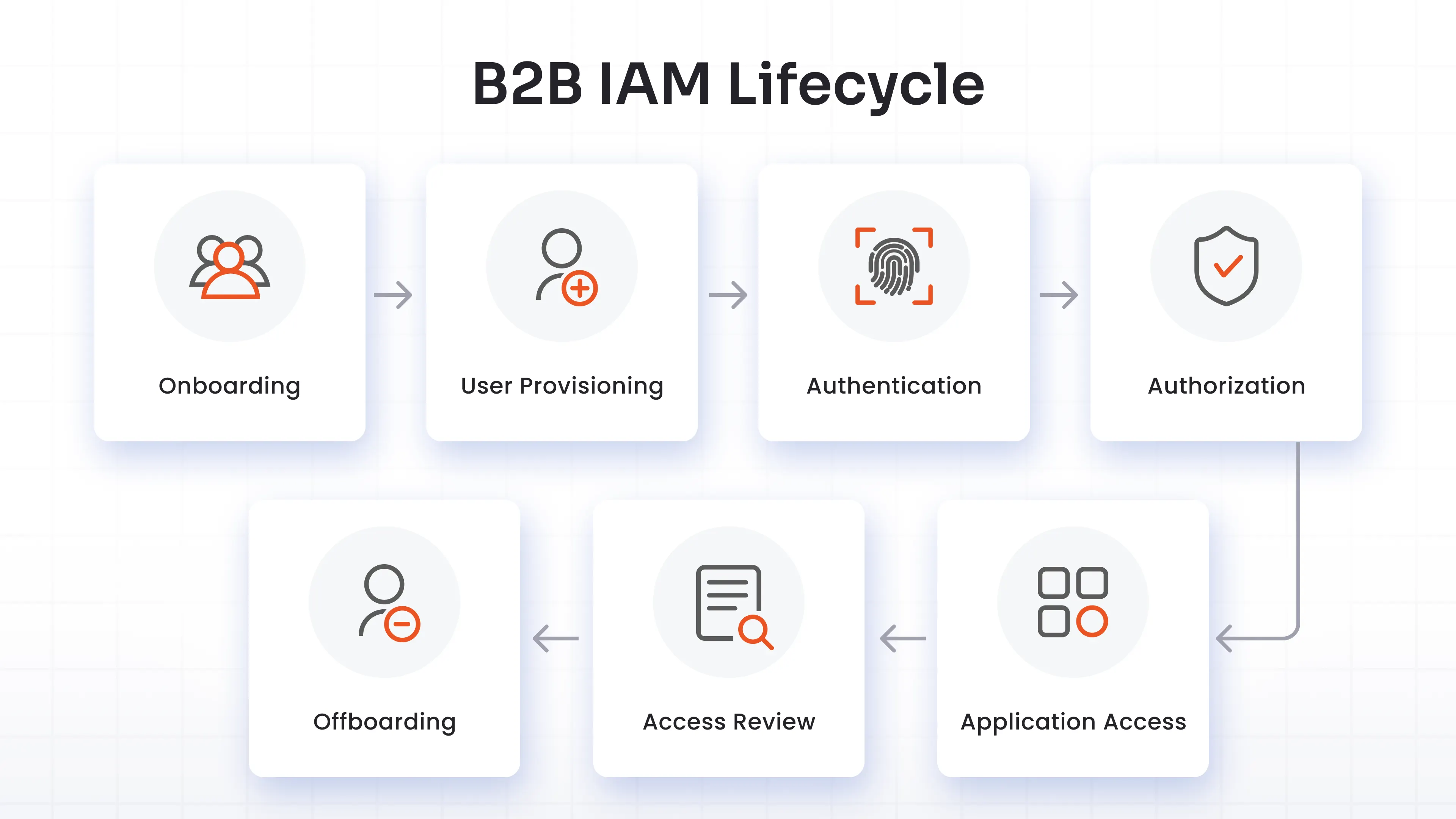
Each stage answers a different question about the external identity.
1. Organization and Partner Onboarding
The external business is first represented as an organization, partner entity, or tenant, depending on the identity architecture.
The organization can then be associated with:
- Its business relationship
- Available applications
- Security policies
- Roles and groups
- Administrative permissions
- Identity provider configuration
For more complex environments, organizations may also need hierarchical structures representing subsidiaries, regions, departments, or business units.
This organizational layer provides the context for the individual users who belong to it.
2. User Provisioning
Once an organization is established, its users can be brought into the environment.
Provisioning can happen through different mechanisms depending on the partner:
Invitation-based provisioning: An administrator invites specific users.
JIT provisioning: A user can be created automatically when they first authenticate through a trusted identity provider.
SCIM provisioning: User and group information can be synchronized between directories and applications.
API-driven provisioning: Business systems can trigger identity workflows automatically.
The objective is to make user creation predictable and minimize manual identity administration.
3. Authentication and B2B SSO
Authentication establishes that the user is who they claim to be.
B2B environments often use identity federation, allowing an external organization to authenticate its users through its existing identity provider.
Common technologies include:
- SAML
- OpenID Connect
- OAuth 2.0 for delegated authorization and API access
- Partner identity providers
- MFA
A Single Sign-On (SSO) solution can allow partner users to access applications using their existing organizational credentials rather than maintaining separate credentials for every service.
4. Authorization and Access Control
Authentication answers:
“Who are you?”
Authorization answers:
“What are you allowed to access?”
In B2B environments, authorization may consider more than the user's individual role.
Role-Based Access Control (RBAC) can establish baseline permissions, while attributes, relationships, and contextual policies can provide additional granularity.
This helps enforce least privilege without making every external user follow the same access model.
5. Access Reviews and Lifecycle Changes
B2B access is not static.
A user may change roles. A partner may change its relationship with the business. A contractor's engagement may end. An organization may be acquired or removed from a supplier network.
Identity Lifecycle Management connects these changes to access decisions.
A mature workflow can therefore look like:
Join → Provision → Change → Review → Suspend → Deprovision
This reduces the chance that external users retain access after their business need has changed.
B2B IAM vs Workforce IAM vs CIAM
B2B IAM overlaps with workforce IAM and CIAM technologies, but the identity context is different.
| Aspects | Workforce IAM | CIAM | B2B IAM |
|---|---|---|---|
| Users | Employees | Individual consumers | Business users and organizations |
| Identity ownership | Employer | Customer | External organization |
| Administration | IT | Self-service/central | IT + delegated partner admins |
| Organization hierarchy | Limited | Usually not central | Core requirement |
| Federation | Common | Sometimes | Common |
| Delegated administration | Limited | Limited | Important |
| Primary goal | Workforce security/productivity | Customer experience | Secure business collaboration |
The simplest way to distinguish them is:
Workforce IAM manages identities within an organization. CIAM focuses on individual customer identities. B2B IAM manages identities and access across organizational boundaries.
That boundary creates B2B-specific requirements such as organizational modeling, delegated administration, partner federation, and organization-scoped authorization.
Common B2B IAM Use Cases
B2B identity management applies wherever external organizations need controlled access to business resources.
Partner and Reseller Access
Partners and resellers may need access to sales portals, product catalogs, pricing, training, orders, or support resources.
B2B IAM can provide organization-specific access while allowing partner administrators to manage their own users within predefined boundaries.
Vendor and Supplier Access
Suppliers may need access to procurement, inventory, supply-chain, purchase-order, or operational systems.
Rather than treating every supplier user as an employee, access can be tied to the supplier organization, assigned role, and specific business resources.
Enterprise Customer Portals
Business customers often have multiple users who need access to dashboards, reports, services, support resources, or account information.
B2B IAM allows the customer to operate as an organization, with its own users, administrators, roles, and policies.
Contractor and Third-Party Access
Contractors may require access for a particular project or period.
Their access can be scoped to the required applications and automatically removed when the engagement ends, reducing the need to manually track temporary accounts.
B2B SaaS and Multi-Tenant Applications
For B2B SaaS companies, identity is closely connected to the application architecture.
Each customer organization may need separate:
- Users
- Administrators
- Roles
- Identity providers
- Authentication policies
- Access rules
- Data boundaries
The Identity and Access Management layer therefore needs to support multi-tenancy while maintaining strong separation between customer organizations.
Key Features of a B2B IAM Solution
A B2B IAM platform should do more than authenticate external users. It should provide the identity, access, and governance controls needed to manage business relationships throughout their lifecycle.
Multi-Tenant Organization and Identity Management
The organization should be treated as a meaningful identity object rather than simply a label attached to individual users.
Look for:
- Organization hierarchies
- Tenant isolation
- Organization-specific policies
- Relationship-based access
- Role and permission structures
This becomes especially important when an IAM platform serves thousands of business customers or partners.
Delegated Administration
Central IT cannot realistically manage every user belonging to every external organization.
Delegated administration solves this by giving partner administrators limited control over their own users.
For example, a partner administrator may be able to:
Manage: Users, invitations, predefined roles Not manage: Global security policies, other organizations, or unrestricted enterprise resources
The boundary is important: partners gain operational autonomy without gaining excessive privilege.
SSO and Identity Federation
External organizations may already have their own identity providers.
A B2B IAM platform should support federation standards such as SAML and OpenID Connect, allowing those organizations to authenticate users through their existing identity infrastructure.
This reduces credential duplication and simplifies access to business applications.
Provisioning and Deprovisioning
A strong IAM Software should support multiple provisioning approaches, including:
- SCIM
- JIT provisioning
- Automated workflows
- API-based provisioning
- User updates
- Deprovisioning
The goal is to ensure that user provisioning and deprovisioning follow the business relationship rather than depending entirely on manual requests.
Granular Access Control
B2B applications often contain sensitive business information, so organization-level access alone may not be sufficient.
Support for RBAC, groups, attributes, relationships, and contextual policies can help organizations define more precise permissions.
For example, two users from the same partner organization may legitimately need different access because they perform different functions.
MFA and Adaptive Authentication
Multi-Factor Authentication (MFA) provides an additional layer of protection for external identities.
Organizations can also use adaptive or risk-based authentication to apply stronger controls when circumstances warrant it, such as access to sensitive applications or unusual authentication behavior.
Access Governance
Continuous access governance answers whether a user can access something. Governance also asks whether they should still have that access.
Useful capabilities include:
- Access requests
- Approval workflows
- Access reviews
- Certifications
- Audit logs
- Reporting
- Remediation
These controls help organizations establish accountability around third-party access.
Integrations and Orchestration
B2B IAM needs to connect with the broader technology environment.
Relevant integrations can include:
Directories → Partner identities and groups Applications → Business resources Identity providers → Federated authentication APIs → Automated identity operations Business systems → Lifecycle triggers and workflows
Orchestration connects these systems so identity events can initiate the appropriate downstream actions.
B2B IAM Best Practices
A sustainable B2B IAM strategy should combine security controls with an identity model designed for external relationships.
1. Apply least privilege - Give users only the access required for their role and business relationship.
2. Automate provisioning and deprovisioning - Reduce manual identity administration and stale accounts.
3. Use SSO and federation - Let partners use established identity infrastructure where appropriate.
4. Set clear delegated-administration boundaries - Give partners useful self-service without excessive privilege.
5. Enforce MFA - Strengthen authentication for external identities and sensitive applications.
6. Review third-party access regularly - Validate that permissions remain justified.
7. Centralize audit visibility - Maintain records of authentication, access, and administrative activity.
8. Design for organizational scalability - Account for new partners, subsidiaries, users, applications, and identity providers from the beginning.
How to Choose a B2B Enterprise Identity Management Solution
When evaluating B2B enterprise identity management, don't start with the feature checklist alone. Start with the business relationships the platform must support.
Organization model
- Can it support multiple organizations and tenants?
- Can it model organizational hierarchies?
- Can policies be scoped to individual organizations?
- Does it provide tenant isolation?
Administration
- Can partners manage their own users?
- Can administrative privileges be scoped?
- Does central IT retain oversight?
Authentication
- Does it support SAML and OIDC?
- Can different partners use different identity providers?
- Does it support MFA and adaptive authentication?
Lifecycle
- Does it support SCIM and JIT provisioning?
- Can onboarding and offboarding be automated?
- Can identity events trigger downstream workflows?
Authorization
- Can access be restricted by organization and role?
- Does it support RBAC and granular policies?
- Can authorization incorporate attributes or relationships?
Governance and integration
- Are access approvals and reviews supported?
- Are audit logs and reporting available?
- Does it provide APIs and connectors?
- Can it integrate with existing IAM and business systems?
The right solution should make complex external relationships easier to govern as they grow, rather than simply adding another authentication layer.
Secure B2B Access With miniOrange
B2B relationships are becoming increasingly digital, but external access should not require organizations to choose between security and usability.
With miniOrange IAM, organizations can build a B2B identity strategy around:
- Secure external identities
- Simplified partner onboarding
- SSO and MFA
- Automated identity lifecycle management
- Controlled and governed third-party access
The objective is not simply to authenticate another user. It is to create a scalable identity layer for the business relationships behind those users.
FAQs
What is the difference between B2B IAM and workforce IAM?
Workforce IAM manages employees and internal users, while B2B IAM manages users belonging to external organizations. B2B IAM therefore needs stronger support for organizational relationships, delegated administration, federation, multi-tenancy, and external-user lifecycle management.
How does B2B IAM manage users from multiple organizations?
B2B IAM associates users with organizations or tenants and uses that context to determine access. Each organization can have its own users, administrators, roles, policies, and applications while remaining appropriately separated from other organizations.
Can partners manage their own users in a B2B IAM system?
Yes. Delegated administration allows approved partner administrators to manage users within defined boundaries. They can typically invite, update, assign predefined roles to, or deactivate users without gaining unrestricted control over the organization's broader IAM environment.
How does B2B SSO work between two organizations?
B2B SSO establishes trust between organizations through federation protocols such as SAML or OpenID Connect. The partner's identity provider authenticates the user, while the receiving organization determines which applications, resources, and permissions that authenticated user can access.
Leave a Comment