

Privileged accounts are the crown jewels of any IT environment. Admin credentials, root access, service accounts. These are what attackers go after first, because compromising one can hand them the entire organization. Forrester puts the number at 80% of security breaches involving privileged accounts.
NIST frameworks, particularly SP 800-53, exist to make sure you're not leaving that door unlocked.
This guide covers what NIST Privileged Access Management actually means, which NIST publications matter for PAM, and how to put the required controls into practice.
Key Takeaways
- SP 800-53's AC, IA, and AU control families define what you need to do for privileged access: least privilege, strong authentication, segregated accounts, and continuous logging.
- SP 800-207 adds the Zero Trust architecture that makes standing privileges unnecessary.
- CSF 2.0 ties it back to governance and executive accountability.
And a PAM Solution is what makes those requirements operational. Discovery, vaulting, JIT access, session recording, MFA, audit logs. These aren't separate projects. They're the same project, mapped to different controls.
What is NIST Privileged Access Management?
NIST Privileged Access Management is the practice of securing, monitoring, and controlling privileged accounts using policies and controls aligned with NIST cybersecurity publications.
The National Institute of Standards and Technology (NIST) doesn't sell software or run audits. It publishes frameworks: structured sets of controls, standards, and guidelines that organizations use to build a sound security posture. PAM sits at the center of several of those frameworks because privileged credentials are the highest-risk asset in most IT environments.
A privileged account isn't just an IT admin's login. It includes:
- Root and superuser accounts on servers
- Database administrator accounts
- Service accounts used by applications and automated processes
- Cloud infrastructure accounts with broad permissions
- Network device management accounts
When one of these gets compromised, the blast radius is much larger than a standard user account. An attacker with a privileged credential can move laterally, exfiltrate data, disable logging, or take down systems entirely. NIST's control frameworks are built with that threat in mind.
SP 800-53 is mandatory for U.S. federal agencies and contractors handling federal information systems under FISMA and FedRAMP. For private sector organizations in healthcare, finance, and critical infrastructure, it's technically optional. But it's increasingly treated as a baseline requirement by auditors, insurers, and enterprise customers.And PAM is what makes
Understanding the NIST Special Publications relevant to PAM
Several NIST publications touch on privileged access, but they approach it from different angles.
NIST SP 800-53: Privileged Access Management
SP 800-53 is the most directly relevant publication for PAM. It's a catalog of security and privacy controls organized into 20 families. 3 of those families carry most of the weight for privileged access.
AC: Access Control
AC governs who can access what. The controls most relevant to PAM:
- AC-2 (Account Management): Requires formal processes for creating, modifying, and removing accounts, including privileged ones. Anyone needing admin-level access needs approval from a designated authority.
- AC-5 (Separation of Duties): Prevents any single user from having unchecked authority over critical operations.
- AC-6 (Least Privilege): The core PAM principle in SP 800-53. Users, processes, and systems should have only the minimum access required to do their job. AC-6(5) specifically targets privileged accounts, requiring them to be restricted to defined personnel or roles. AC-6(9) requires that use of privileged functions gets logged.
IA: Identification and Authentication
IA covers how you verify that users are who they say they are before granting access:
- IA-2 (Identification and Authentication): Requires multi-factor authentication for privileged accounts accessing organizational systems.
- IA-5 (Authenticator Management): Governs how credentials are managed, including password complexity, rotation schedules, and protection of stored credentials.
AU: Audit and Accountability
AU governs logging:
- AU-2 (Event Logging): Defines which events need to be captured, including privileged function use.
- AU-3 (Content of Audit Records): Specifies what each log entry must contain: user ID, timestamp, event type, outcome, and source.
- AU-9 (Protection of Audit Information): Requires that logs themselves be protected from tampering.
The most recent update, SP 800-53 Release 5.2.0 (finalized August 27, 2025), responds to Executive Order 14306 and addresses software update security, resiliency by design, and software integrity validation. The core access control framework for PAM remains intact.
NIST SP 800-63: Strong authentication
SP 800-63 is NIST's identity assurance framework. It defines 3 Identity Assurance Levels (IAL), 3 Authenticator Assurance Levels (AAL), and corresponding Federation Assurance Levels.
For privileged access, AAL3 is the target: hardware-based MFA using phishing-resistant authenticators. Think FIDO2 security keys or PIV cards, not a text message code.
SP 800-63 also sets requirements for credential management. For example, how long passwords can remain valid, how authenticators must be protected, and what happens when a credential is compromised.
NIST SP 800-207: Zero Trust Architecture
SP 800-207 defines the Zero Trust approach, which assumes no user or device is trusted by default, even inside the network perimeter. For PAM, the most relevant concepts are:
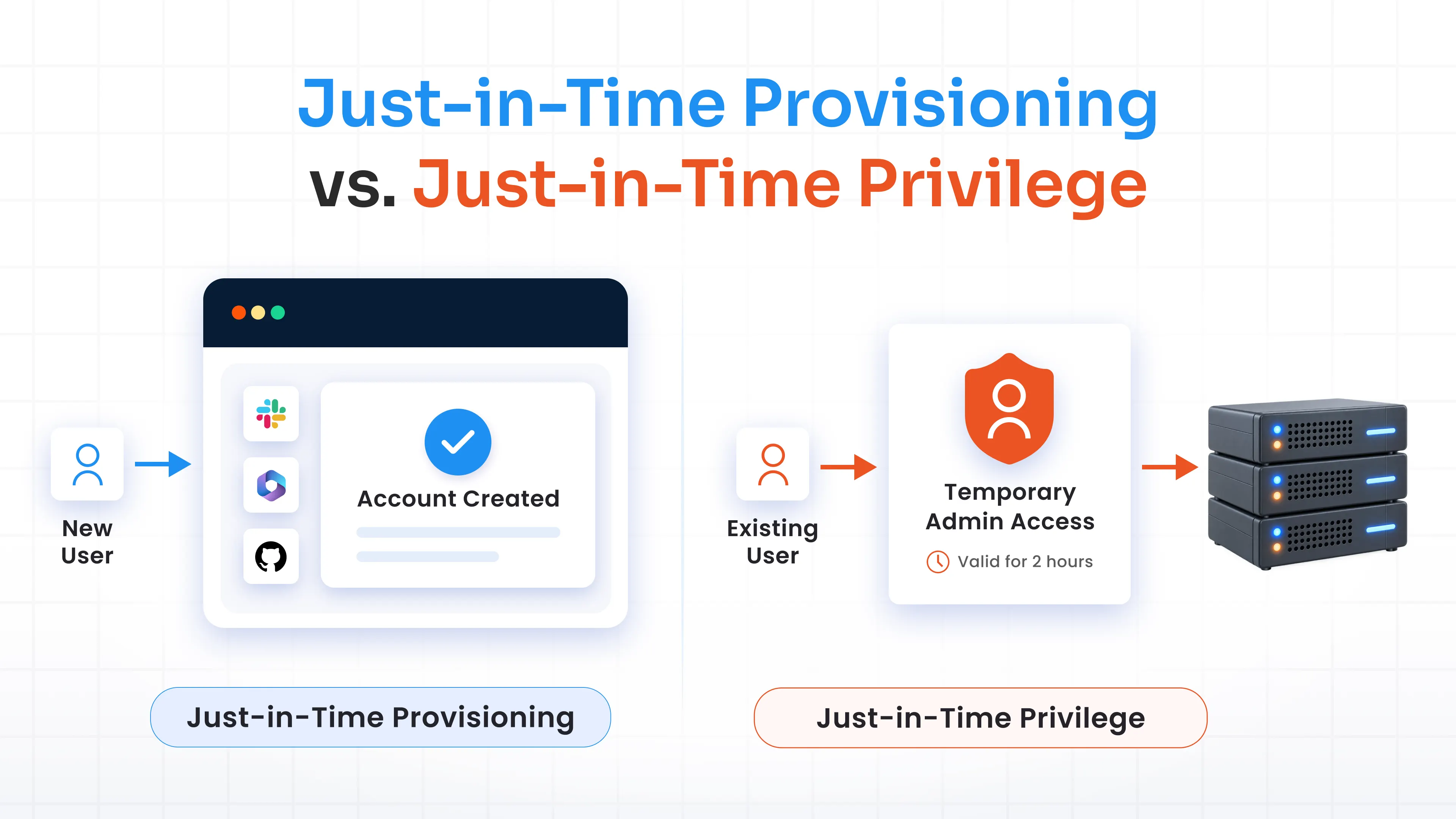
- Just-in-Time access: JIT access management ensures that privileged access is granted only for a specific task and a limited time period, and is automatically revoked once the task is completed or the time expires.
- Continuous verification: Access decisions are made in real time based on context, device health, behavior, and risk signals, not a single login event.
- Dynamic privilege assignment: Access policies adapt based on who's asking, from where, and what they're trying to do.
Zero Trust and PAM aren't separate disciplines. PAM is the operational mechanism that makes Zero Trust work for privileged accounts.
NIST CSF Privileged Access Management
NIST Cybersecurity Framework (CSF) 2.0, released February 26, 2024, expanded the original 5-function framework by adding a 6th function: Govern. The framework now covers:
- Govern: Sets the cybersecurity risk strategy, policies, and accountability structures. Supply chain risk management and AI risk sit here.
- Identify: Understand your assets, data, risks, and vulnerabilities.
- Protect: Implement controls around access management, credential security, and awareness training.
- Detect: Monitor for anomalous activity.
- Respond: Handle incidents when they occur.
- Recover: Restore operations after a breach.
PAM contributes most directly to Protect and Detect. But the Govern function matters the most now. Privileged access policies without executive ownership and board-level accountability are compliance theater. CSF 2.0 is explicit about that.
Core NIST PAM principles organizations must follow
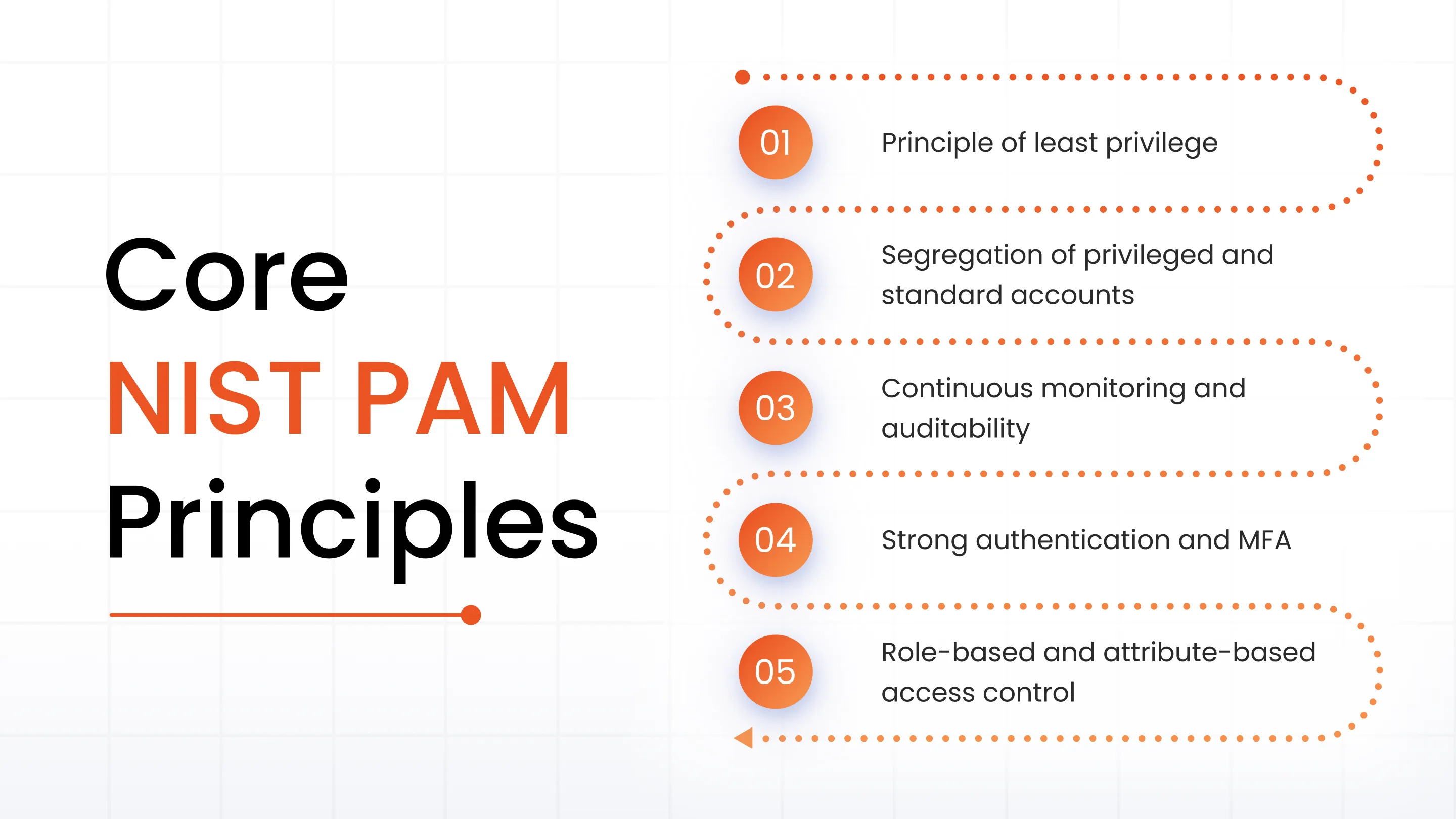
Principle of least privilege
NIST SP 800-53 AC-6's definition of least privilege control is precise: users, processes, and systems get only the access required to perform authorized tasks. Nothing more.
In practice, that means auditing what access people actually use (not what they were initially granted), removing permissions that haven't been used in 90 days, and building approval workflows for anything beyond standard access. NIST also requires periodic privilege reviews under AC-6(7). So "Set it and forget it" doesn't satisfy the control.
Segregation of privileged and standard accounts
AC-5 and AC-6 together require privileged operations to be done through dedicated accounts, separate from the standard credentials people use for email and day-to-day work. An IT admin shouldn't be browsing the web and managing servers from the same login.
This separation limits the blast radius if a standard account is phished. And it creates a cleaner audit trail.
Continuous monitoring and auditability
AU-2 requires logging & monitoring of privileged function use. AU-9 requires those logs to be tamper-resistant. CA-7 requires the organization to actively review what the logs contain.
Generating logs isn't enough. Someone needs to review them, and that review process needs to be documented.
Strong authentication and MFA
IA-2 requires MFA for privileged accounts. SP 800-63 sets the bar at AAL3 for high-sensitivity access: hardware-based authenticators like FIDO2 keys or PIV cards. Passwords alone don't satisfy the control.
Role-based and attribute-based access control
NIST SP 800-162 covers Attribute-Based Access Control (ABAC), where access decisions factor in role, department, device posture, and time of access. RBAC is more common, assigning access by job function.
Both work. The problem is role accumulation over time. NIST controls require periodic reviews precisely because that creep is common.
How PAM helps meet NIST compliance requirements
Discovery and inventory of privileged accounts
You can't control what you don't know exists. AC-2 requires a complete account inventory, including privileged accounts. PAM solutions scan the environment to discover privilege accounts across on-premises systems, cloud platforms, databases, and network devices, then classify them by risk and usage.
Service accounts are especially easy to miss. They often run automated processes, don't belong to a specific person, and rarely get reviewed. A PAM tool surfaces them.
Password vaulting and credential protection
IA-5 requires that privileged credentials be protected. PAM solutions store credentials in encrypted vaults, apply automatic rotation schedules, and make passwords inaccessible to users directly. Users check out access to a system without ever seeing the actual password.
That last part matters. When a credential is never exposed to the person using it, it can't be phished or written down.
Just-in-Time (JIT) access
Standing privileges are what NIST and Zero Trust architects both want you to eliminate. JIT access is the mechanism that makes that practical. When an admin needs to patch a production server, they request time-limited access. The request is approved, access is granted for the required window, and it automatically expires when the window closes.
The privileged account exists only when needed.
Session isolation and session recording
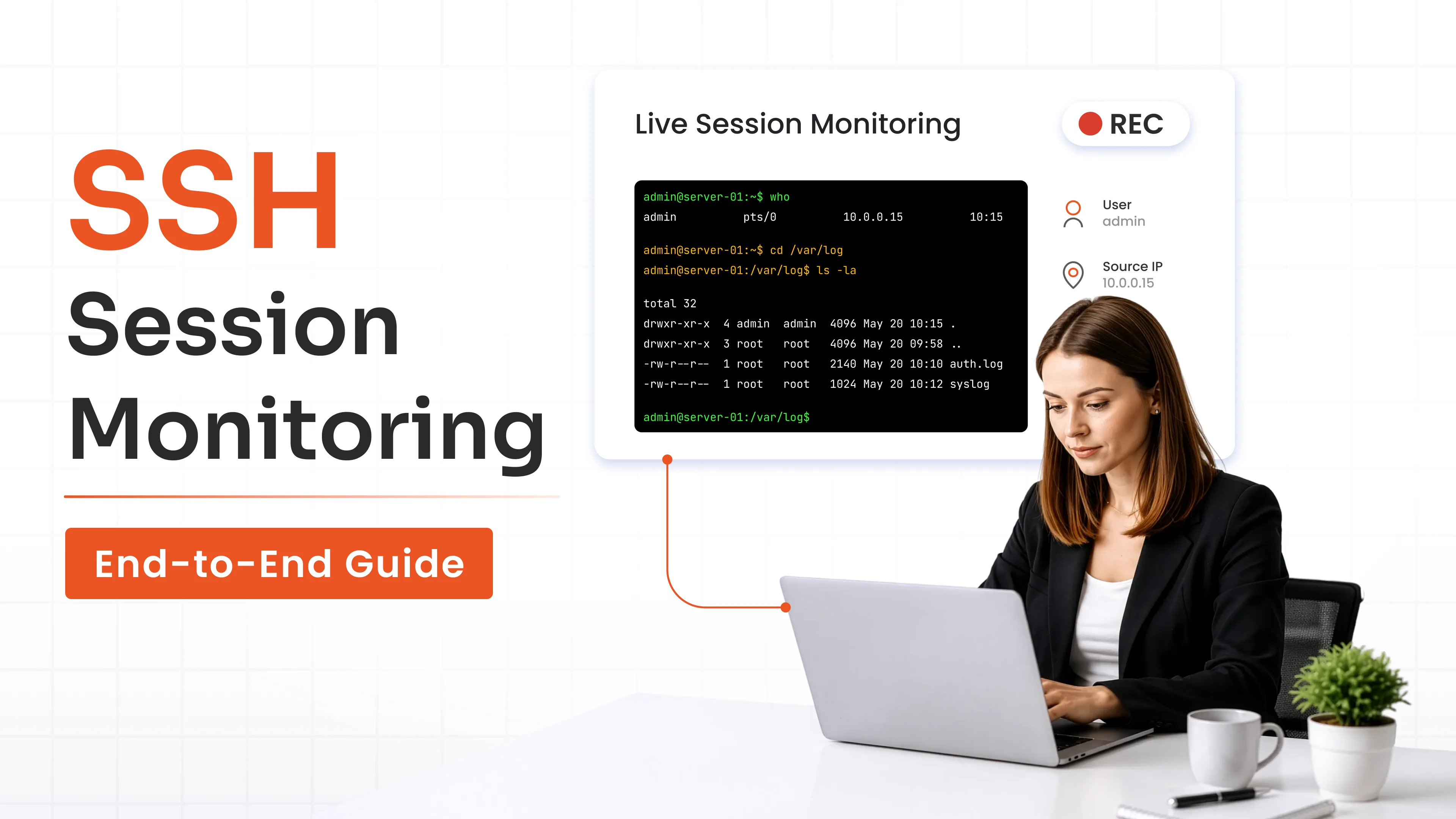
PAM tools proxy sessions so that privileged users connect through the PAM platform, not directly to the target system. This creates 2 things: isolation (the target system never exposes credentials directly to the endpoint) and a full recording of everything that happened during the session.
Privileged session recordings satisfy AU-2 and AU-3. They also give you something concrete to hand to an auditor when they ask how you know what your admins are doing.
Immutable audit logs
AU-9 requires protection of audit information. PAM solutions generate logs that can't be modified or deleted by the same accounts that performed the actions being logged. An admin can't clean up their own activity trail.
Those logs need to capture what NIST specifies: who, what, when, which system, and the outcome of each action.
MFA enforcement
PAM solutions enforce MFA at session initiation, not just at initial login. Even if someone is already authenticated through a corporate SSO, accessing a privileged account through PAM requires a second factor. This satisfies IA-2 and directly addresses the risk of lateral movement through stolen session tokens.
Automated privileged account lifecycle management
AC-2 requires that accounts be reviewed and removed when no longer needed. PAM automates that lifecycle: accounts are provisioned through defined workflows, usage is tracked, and access certifications run on a schedule. When someone leaves the organization or changes roles, their privileged access is revoked automatically, not when someone remembers to do it.
Segregation of duties (SOD)
AC-5 requires that duties be divided to prevent any single person from having unchecked control. PAM enforces this technically: the person who approves a privileged access request can be different from the person who uses it, and the person who reviews access logs can be different from both.
NIST Privileged Access Management best practices
Eliminate standing privileges
The goal is zero standing privilege: no account should have permanent admin access. JIT access for humans, short-lived tokens for automated processes, and time-bound elevation for everything else. This is harder to implement than persistent access. But it's where the risk reduction is.
Enforce least privilege by default
Provision new accounts with minimum access. Add permissions through a formal request and approval process. Audit existing accounts quarterly and remove access that hasn't been used. Make over-provisioning the exception, not the default.
Implement MFA everywhere
Every privileged session. Every time. No exceptions for "trusted" network locations or "known" devices. SP 800-63's AAL3 guidance exists because network location isn't a reliable signal of trust anymore.
Automate access reviews
Manual access reviews get skipped. Quarterly reviews that require someone to pull a spreadsheet and email it to managers produce rubber-stamp approvals. Automated access certifications that surface unused permissions, flag policy violations, and require active approval actually work.
Continuously monitor privileged sessions
Real-time monitoring means you catch the session where an admin starts exporting database records at 2 am, not 3 weeks later during a forensic review. Set behavioral baselines. Alert on deviations. Record everything.
Maintain tamper-proof audit trails
Logs that can be deleted by the people being logged aren't audit trails. Write logs to append-only storage, ship them to a separate system that the privileged accounts can't access, and verify their integrity on a schedule.
miniOrange PAM solution for NIST compliance
miniOrange PAM is built to support the controls SP 800-53 requires, without the implementation complexity that typically comes with enterprise PAM.
It covers the full set of controls this guide has walked through: privileged account discovery and inventory, credential vaulting with automatic rotation, Just-in-Time access with approval workflows, session isolation and recording, MFA enforcement at session initiation, immutable audit logs, and automated lifecycle management.
Each of those directly maps to SP 800-53 controls. AC-2, AC-6, IA-2, IA-5, AU-2, AU-3, AU-9. And miniOrange generates audit-ready reports that reflect those mappings, so you're not assembling evidence from scratch before each audit cycle.
FAQs
What is NIST Privileged Access Management?
NIST Privileged Access Management is the practice of securing, monitoring, and controlling privileged accounts using controls defined in NIST cybersecurity publications, primarily SP 800-53 and the Cybersecurity Framework.
How does PAM support NIST compliance?
PAM enforces least privilege, secures credentials in encrypted vaults, requires MFA for privileged sessions, records and monitors privileged activity, and generates the tamper-resistant audit logs that NIST SP 800-53 AU-6’s controls require.
Is NIST mandatory?
SP 800-53 is mandatory for U.S. federal agencies and contractors under FISMA and FedRAMP. The Cybersecurity Framework is voluntary, though widely adopted in healthcare, finance, and critical infrastructure.
What is the definition of the NIST principle of least privilege?
NIST SP 800-53 AC-6 requires users, processes, and systems to have only the minimum access needed for authorized tasks. Provision minimum access by default, remove unused permissions, and review assignments on a regular schedule.
What is the difference between NIST CSF and NIST 800-53?
CSF provides high-level governance guidance across 6 functions. SP 800-53 is the detailed control catalog with 1,196 specific controls. Most organizations use both: CSF for direction, SP 800-53 for implementation.
Leave a Comment