

Most organizations do not fail IAM because they chose the wrong technology. They fail because identity controls evolve unevenly across the environment. MFA may protect workforce users but not contractors. Provisioning may be automated for SaaS applications while privileged accounts are still managed manually. Access reviews may exist on paper but lack enforcement, visibility, or accountability.
The IAM maturity model helps organizations measure how effectively their identity program actually operates across authentication, lifecycle management, governance, privileged access, and monitoring. Instead of treating IAM as a checklist of deployed tools, it provides a structured way to identify operational gaps, benchmark maturity levels, and prioritize the controls that reduce the most risk.
This guide breaks down the five levels of IAM maturity, the framework used to assess IAM programs, and the practical roadmap organizations can use to build a more mature, measurable, and Zero Trust-aligned identity security strategy.
What is an IAM Maturity Model?
An IAM maturity model is a structured framework used to evaluate the effectiveness, consistency, governance, and automation maturity of an organization's identity and access management program.
The model measures IAM capabilities across multiple areas, including authentication, lifecycle management, access governance, privileged access management, monitoring, and machine identity security. Most frameworks follow a five-level progression that starts with ad-hoc identity practices and advances toward optimized and continuously improving IAM programs.
Rather than simply verifying whether a control exists, IAM maturity models evaluate how consistently that control operates, how effectively it reduces risk, and whether it is continuously measured and improved.
Why Organizations Use IAM Maturity Models
Organizations use IAM maturity models to benchmark their current IAM posture and identify gaps that increase operational or security risk. These assessments help security teams prioritize IAM investments based on measurable maturity gaps rather than reactive decision-making.
IAM maturity models also support:
- Compliance readiness
- Zero Trust initiatives
- Operational efficiency improvements
- Executive reporting and benchmarking
- Long-term IAM roadmap planning
By providing a structured evaluation framework, maturity assessments align security teams, IT operations, compliance leaders, and executive stakeholders around identity priorities.
IAM Maturity Model vs IAM Checklist
An IAM checklist verifies whether a control exists within the environment, while an IAM maturity model evaluates how effectively that control functions across the organization. The difference is important because deploying a control does not necessarily mean it is consistently enforced, governed, or operationally mature.
For example, an organization may technically deploy MFA but still operate at a low maturity level if MFA coverage is inconsistent across applications, legacy systems bypass enforcement policies, exceptions are unmanaged, or monitoring and reporting capabilities are limited. In these cases, the control exists, but the surrounding governance and operational processes remain immature.
IAM maturity models focus on operational consistency, enforcement quality, automation, visibility, and continuous improvement rather than point-in-time validation. This makes them significantly more effective for measuring real-world identity security posture.
Why IAM Maturity Assessment Matters
Identity has become the primary security perimeter for modern enterprises. Cloud adoption, hybrid work, SaaS applications, APIs, and machine identities have significantly expanded the attack surface, making identity governance more complex than ever before.
Reducing Identity Security Risks
IAM maturity assessments help organizations identify high-risk identity gaps before they become security incidents. Common issues include inconsistent MFA enforcement, orphaned accounts, shared administrative credentials, excessive privileges, weak offboarding processes, and unmonitored service accounts.
Maturity assessments provide visibility into these inconsistencies and help organizations prioritize remediation efforts based on risk exposure.
Improving Compliance Readiness
IAM maturity directly affects compliance outcomes across frameworks such as SOX, HIPAA, PCI DSS, ISO 27001, and NIST. Regulatory requirements increasingly depend on strong identity governance, access control enforcement, and audit visibility.
IAM maturity assessments help organizations demonstrate control effectiveness while identifying gaps that may create audit findings or compliance failures.
Increasing Operational Efficiency
Mature IAM programs improve operational efficiency by automating onboarding, offboarding, provisioning workflows, access requests, access certifications, and password management processes.
Organizations with low IAM maturity often rely heavily on manual ticket-based processes that create delays, increase support workload, and introduce operational inconsistencies. As IAM maturity improves, organizations typically see faster provisioning, reduced helpdesk dependency, and more reliable lifecycle governance.
Supporting Executive Visibility
IAM maturity scoring gives CISOs and security leaders measurable visibility into identity security posture. This helps justify IAM investments, communicate risk exposure to executive leadership, and track program improvement over time.
A structured maturity framework also allows organizations to align IAM modernization efforts with broader business goals such as Zero Trust adoption, cloud transformation, and compliance readiness.
The 5 Levels of IAM Maturity: A Technical Breakdown
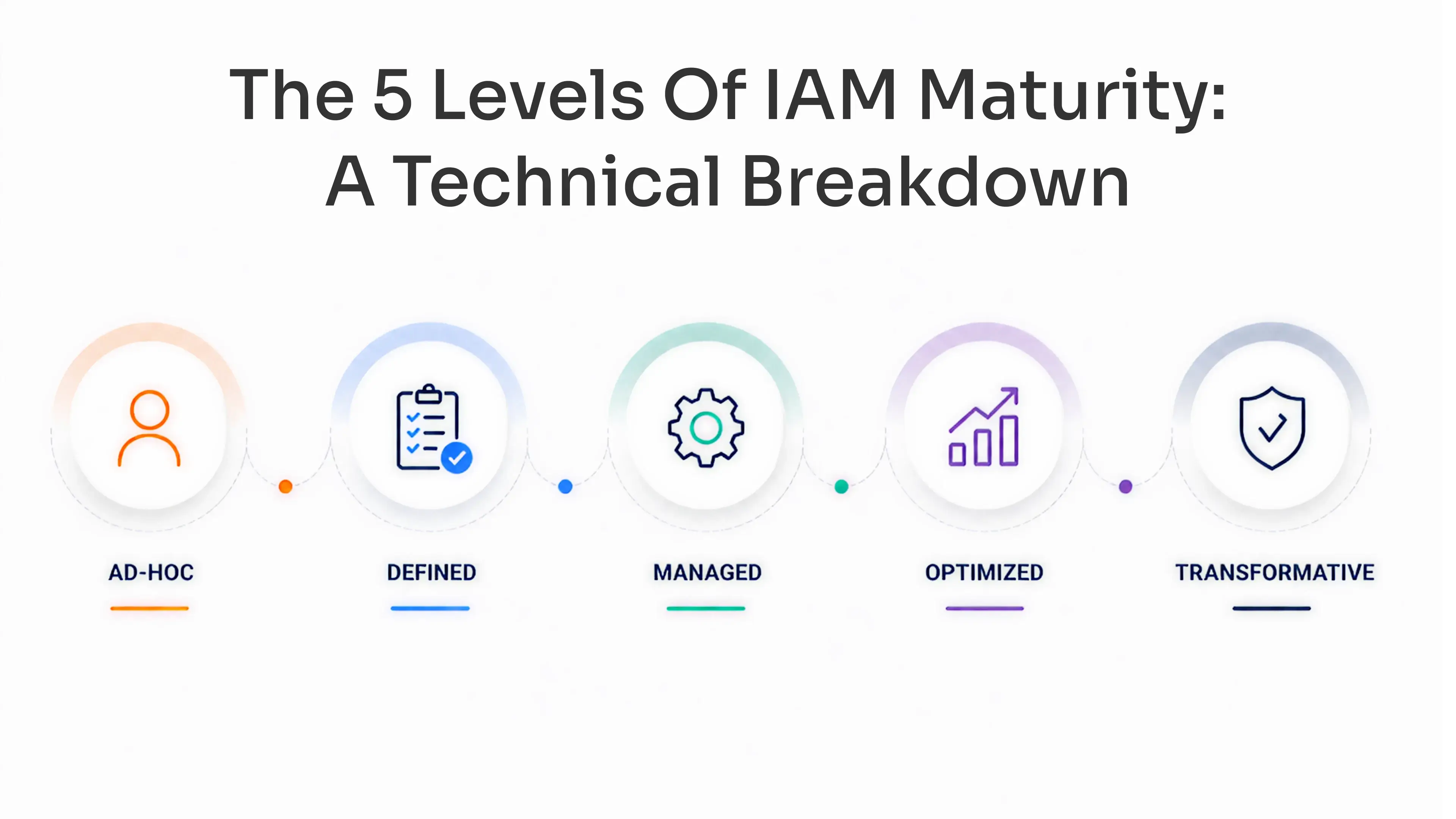
Most IAM maturity frameworks define five progressive levels that describe how identity security capabilities evolve across governance, automation, monitoring, and risk management. Each level reflects not only the technologies deployed, but also how consistently identity controls are enforced, monitored, and operationalized.
Level 1: Ad-hoc
Defining characteristic: IAM controls exist informally, inconsistently, and without documented policy or centralized governance.
Authentication
Password-only authentication is common across most systems, with little or no MFA enforcement. Shared credentials are frequently used within infrastructure and operations teams, making accountability difficult. Password policies are either weak or inconsistently enforced, and legacy authentication protocols often remain active across critical systems.
Identity Lifecycle
Provisioning and deprovisioning processes are heavily manual, typically managed through tickets, emails, or spreadsheets with no defined SLA. Offboarding processes lack consistency, leading to orphaned accounts and excessive privileges remaining active long after users leave the organization. Access reviews, if conducted at all, happen on an ad-hoc basis without centralized tracking or governance.
Governance and Monitoring
Organizations at this level usually lack formal RBAC models, segregation of duties controls, or centralized approval workflows. Authentication logs may exist locally, but identity telemetry is rarely centralized or actively monitored for suspicious activity. Privileged accounts often operate without vaulting, credential rotation, or session monitoring.
Risk Indicators
Organizations operating at Level 1 face a high probability of undetected credential misuse, insider threats, and compliance failures. These environments typically struggle to pass basic SOX ITGC, HIPAA, or PCI DSS identity control requirements due to inconsistent governance and limited audit visibility.
Level 2: Defined
Defining characteristic: IAM policies and foundational controls are documented, but enforcement remains inconsistent across systems and business units.
Authentication
MFA is commonly deployed for privileged users, VPN access, and critical systems, while SSO adoption begins for major enterprise applications. Password complexity and rotation policies become more standardized, but legacy applications may still bypass centralized authentication controls.
Identity Lifecycle
Provisioning workflows become semi-automated and may integrate with HR systems for basic joiner-mover-leaver processes. Organizations begin introducing periodic access reviews and approval workflows, although enforcement quality and completion rates may vary significantly across departments.
Governance and Monitoring
Basic governance structures begin to emerge, including role definitions and documented access approval procedures. Logging and audit visibility improve, but monitoring capabilities remain reactive rather than proactive. IAM telemetry is collected inconsistently and rarely integrated into centralized detection workflows.
Risk Indicators
Organizations at this stage improve compliance readiness but still face elevated risk from inconsistent enforcement, unmanaged exceptions, and manual operational processes. Governance gaps frequently create audit findings related to excessive privileges, orphaned accounts, and incomplete access certifications.
Level 3: Managed
Defining characteristic: IAM controls are standardized, measurable, and increasingly automated across the enterprise.
Authentication
Universal MFA enforcement becomes standard across workforce users and enterprise applications. SSO coverage expands significantly using modern federation protocols such as SAML 2.0 and OpenID Connect. Authentication policies become centrally managed, while adaptive access controls may begin using contextual risk signals.
Identity Lifecycle
Identity lifecycle management becomes significantly more mature through SCIM-based provisioning, centralized onboarding and offboarding governance, and automated deprovisioning workflows. Quarterly access certifications and structured approval processes improve visibility into entitlement usage and access risk.
Governance and Monitoring
Organizations implement formal RBAC governance, segregation of duties controls, privileged access vaulting, session monitoring, and automated password rotation for administrative accounts. IAM integrates with SIEM platforms, enabling centralized monitoring of authentication anomalies, privilege misuse, and suspicious access activity.
Risk Indicators
Level 3 organizations generally meet baseline enterprise IAM maturity requirements and satisfy most regulatory expectations. Operational consistency improves significantly, although gaps may still exist in machine identity governance, behavioral analytics, or advanced adaptive access capabilities.
Level 4: Optimized
Defining characteristic: IAM becomes adaptive, data-driven, and continuously evaluated using behavioral and contextual risk signals.
Authentication
Organizations implement risk-based authentication, adaptive MFA, and continuous session evaluation based on device posture, location, user behavior, and access patterns. Authentication decisions become increasingly dynamic rather than relying solely on static policies.
Identity Lifecycle
Access rights and entitlements are continuously evaluated based on role changes, usage analytics, and operational context. Machine identity governance matures significantly, with improved visibility into API keys, service accounts, certificates, and workload identities across cloud-native environments.
Governance and Monitoring
IAM software integrates deeply with SIEM, SOAR, and UEBA platforms to support automated threat detection and response workflows. Governance evolves beyond periodic certifications toward continuous access evaluation and automated remediation of excessive privileges or policy violations.
Risk Indicators
Organizations at this stage significantly reduce identity-related threats through automation, behavioral analytics, and continuous monitoring. However, maintaining policy consistency and visibility across rapidly evolving cloud environments remains an ongoing operational challenge.
Level 5: Innovating
Defining characteristic: IAM operates as a strategic business capability fully aligned with Zero Trust, enterprise security, and digital transformation initiatives.
Authentication
Passwordless authentication becomes the default for workforce and privileged access scenarios. AI-assisted anomaly detection and predictive risk analysis continuously influence authentication and authorization decisions in real time.
Identity Lifecycle
Organizations implement unified identity fabrics that govern workforce, customer, partner, and machine identities through centralized identity intelligence. Lifecycle governance becomes highly automated and adaptive across hybrid and multi-cloud environments.
Governance and Monitoring
Identity Threat Detection and Response (ITDR), advanced analytics, and continuous policy optimization become core operational capabilities. IAM controls integrate deeply with broader enterprise security ecosystems, enabling proactive threat prevention and dynamic risk mitigation.
Risk Indicators
Organizations operating at Level 5 maintain highly resilient and adaptive identity security programs capable of evolving continuously alongside changing business requirements, emerging threats, and regulatory expectations.
Core Dimensions of IAM Maturity
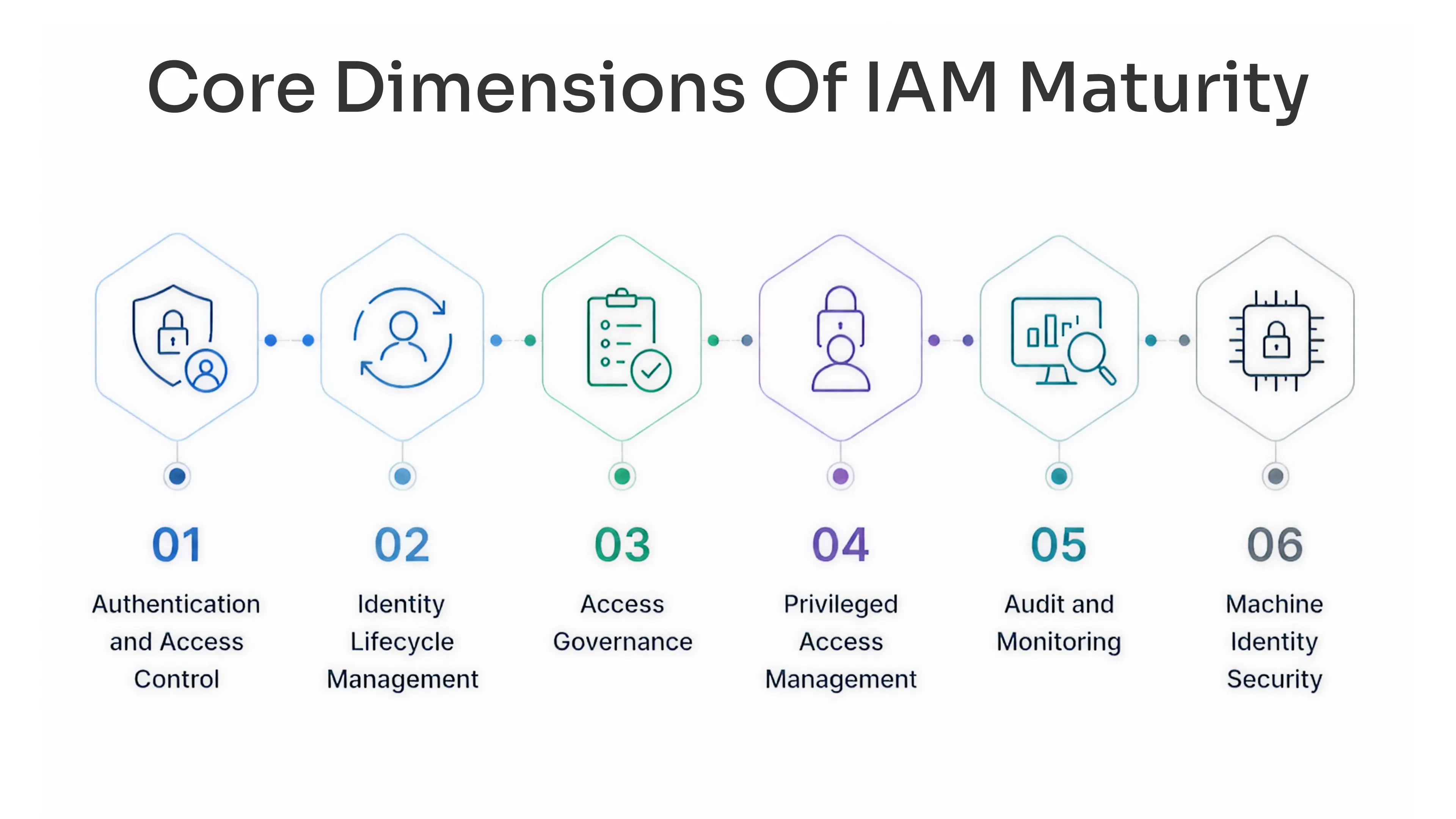
IAM maturity is evaluated across multiple dimensions rather than a single overall score. Organizations often operate at different maturity levels across different identity domains, which means strong authentication maturity may still coexist with weak governance, monitoring, or machine identity controls.
Authentication and Access Control
This dimension evaluates the strength, consistency, and enforcement of authentication controls across users, applications, and access pathways. It includes MFA adoption, SSO coverage, authentication protocols, adaptive access policies, passwordless readiness, and exception management processes that collectively reduce identity-related breach risks.
Identity Lifecycle Management
Lifecycle maturity measures how effectively organizations manage onboarding, role changes, offboarding, contractor identities, provisioning automation, and orphaned account detection. Strong lifecycle governance improves operational efficiency while reducing excessive access, stale permissions, and identity inconsistencies across hybrid and cloud environments.
Access Governance
Access governance maturity evaluates how organizations enforce least privilege access through RBAC models, access certifications, segregation of duties controls, entitlement visibility, and approval workflows. Weak governance remains a common IAM gap because operational consistency requires both policy enforcement and long-term administrative discipline.
Privileged Access Management
PAM maturity focuses on how elevated privileges are governed across administrative accounts, cloud root users, infrastructure systems, and service accounts. Key indicators include credential vaulting, Just-in-Time access, session monitoring, privileged activity visibility, and automated credential rotation practices.
Audit and Monitoring
Monitoring maturity evaluates authentication logging, SIEM integration, identity threat detection, alerting workflows, audit reporting, and visibility. Organizations with mature monitoring capabilities gain stronger visibility into suspicious access behavior, privilege misuse, and identity-related attack activity across the environment.
Machine Identity Security
Machine identity maturity evaluates governance over API keys, certificates, workload identities, secrets management, and service accounts. As cloud-native environments continue expanding, machine identities often outnumber human users, making centralized visibility and lifecycle governance increasingly important for enterprise security.
IAM Maturity Assessment Framework: How to Conduct One
An IAM maturity assessment helps organizations benchmark IAM capabilities, identify governance gaps, measure operational consistency, and build a roadmap for improving identity security maturity over time.
Define Scope and Stakeholders
Organizations must first define which environments, identity populations, systems, and compliance requirements fall within the assessment scope. Stakeholders typically include IAM teams, security leadership, HR, compliance teams, IT operations, and application owners responsible for identity-related workflows and governance processes.
Collect IAM Evidence
Evidence collection provides the data required to evaluate IAM maturity accurately across authentication, governance, provisioning, and monitoring domains. Common evidence sources include Active Directory exports, MFA reports, HR lifecycle records, provisioning logs, PAM inventories, SIEM detections, and access certification reports.
Conduct Stakeholder Interviews
Stakeholder interviews help assess how reliably IAM controls operate in practice across business units and operational environments. These discussions commonly focus on MFA exceptions, provisioning delays, offboarding enforcement, privileged access governance, service account ownership, and access review consistency across systems.
Score IAM Dimensions
Each IAM domain is scored independently based on maturity criteria and operational consistency. Organizations should avoid overestimating maturity based solely on technology deployment because true maturity requires centralized enforcement, measurable governance, continuous monitoring, and repeatable operational processes across the environment.
Build a Gap Analysis and Roadmap
The final assessment output includes the current maturity profile, identified operational gaps, risk exposure analysis, prioritized remediation recommendations, and target maturity goals. This roadmap becomes the foundation for long-term IAM modernization, governance improvements, and Zero Trust alignment initiatives.
IAM Assessment Questionnaire: Domain-by-Domain Checklist
These questionnaires help organizations identify governance weaknesses, operational inefficiencies, and identity security gaps across critical IAM domains.
Authentication and Access Control Questions
- Is MFA enforced across all applications and user populations?
- Are legacy authentication protocols still enabled?
- Is adaptive or risk-based authentication configured?
- What percentage of applications are integrated with SSO?
- Are phishing-resistant authentication methods available for privileged users?
Identity Lifecycle Management Questions
- Is provisioning automated through HR-driven workflows?
- How quickly are terminated users deprovisioned?
- Are contractor and third-party identities governed separately?
- Is SCIM provisioning implemented for connected applications?
- Are orphaned accounts detected and remediated automatically?
Access Governance Questions
- Is RBAC formally defined and consistently enforced?
- How frequently are access certifications conducted?
- Are segregation of duties violations monitored?
- Are access approvals centrally managed and documented?
- Is role drift identified and remediated regularly?
Privileged Access Management Questions
- Are privileged accounts centrally inventoried and monitored?
- Is credential vaulting implemented for administrative accounts?
- Are privileged sessions recorded and audited?
- Is Just-in-Time access enforced for critical tasks?
- How frequently are privileged credentials rotated?
Audit and Monitoring Questions
- Are authentication logs centrally collected and retained?
- Is IAM telemetry integrated with SIEM or SOAR platforms?
- Are identity threat detections actively monitored?
- Is there a defined process for responding to IAM alerts?
- Are audit reports generated regularly for compliance reviews?
How to Score and Interpret Your IAM Assessment
IAM maturity scoring should reflect operational consistency rather than technology deployment alone.
Applying Maturity Scoring Consistently
A maturity level is achieved only when all associated controls are consistently enforced and operationalized.
For example, partial MFA deployment or inconsistent access governance may significantly reduce maturity scores even if technologies are technically deployed.
Organizations should avoid over-scoring partially implemented controls.
Weighted Risk-Based Scoring
Different IAM dimensions carry different levels of risk depending on the organization.
For example:
- Financial institutions may prioritize governance and PAM
- Healthcare organizations may prioritize audit logging
- Cloud-native companies may prioritize machine identity governance
Weighted scoring helps organizations align maturity assessments with business and regulatory priorities.
Interpreting IAM Maturity Levels
Lower maturity levels typically indicate elevated operational and compliance risk due to inconsistent controls and manual processes.
Higher maturity levels indicate:
- Strong governance
- Automated lifecycle management
- Adaptive authentication
- Advanced monitoring
- Continuous risk evaluation
Organizations should focus on continuous improvement rather than simply achieving a target score.
Building Your IAM Maturity Roadmap
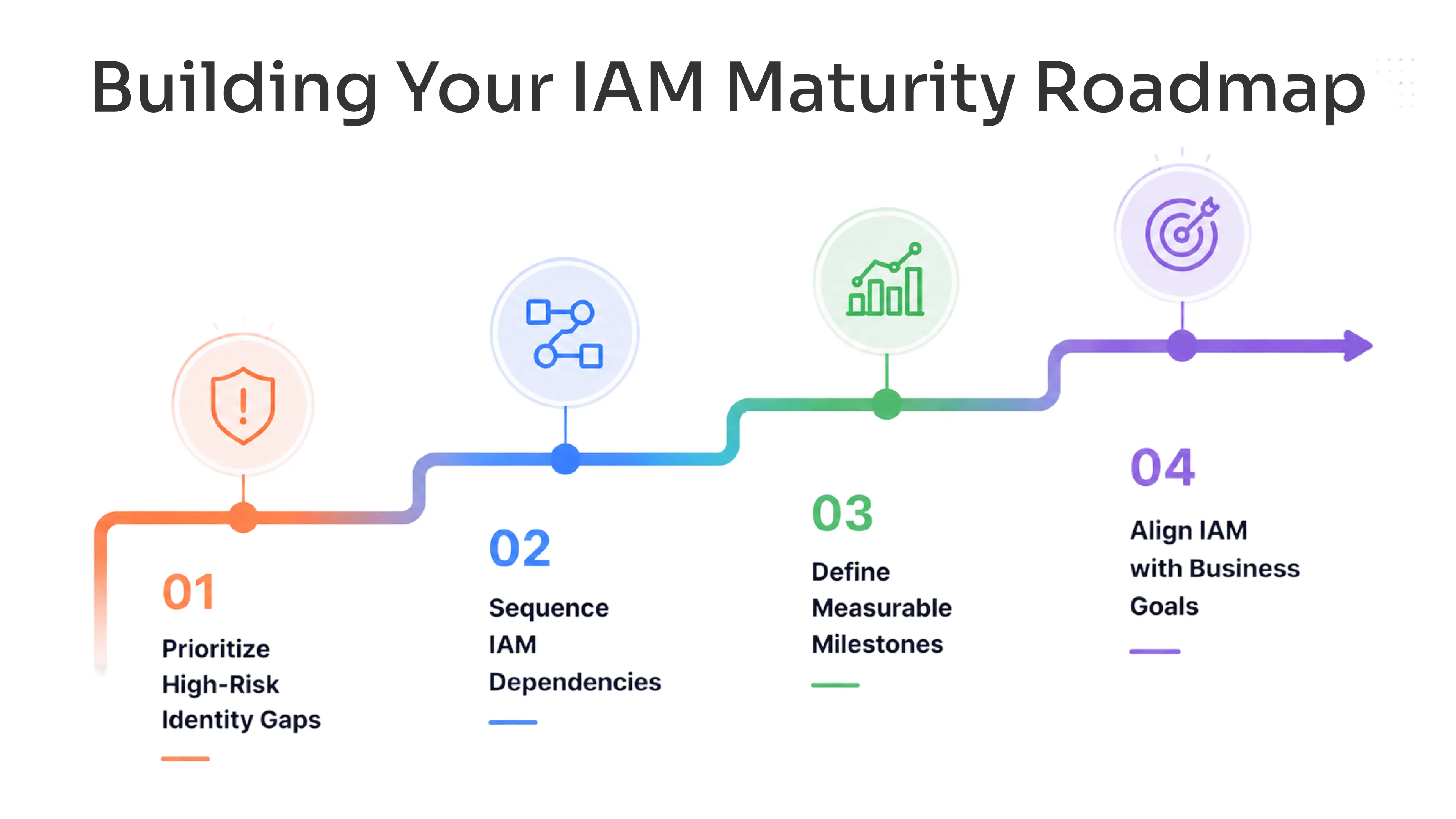
An IAM maturity assessment identifies operational and security gaps, while the roadmap turns those findings into a structured plan for improving identity governance, automation, and risk management.
Prioritizing High-Risk Identity Gaps
Organizations should address foundational identity risks first, including MFA gaps, excessive privileges, orphaned accounts, weak offboarding controls, and shared administrative credentials. Resolving these issues early helps reduce immediate security exposure and strengthens the baseline for future IAM improvements.
Sequencing IAM Dependencies
Certain IAM capabilities depend on foundational controls before they can operate effectively. For example, adaptive MFA depends on universal MFA enforcement, while Just-in-Time access requires mature PAM deployment. Proper sequencing reduces implementation complexity and prevents operational disruptions.
Defining Measurable IAM Milestones
Effective IAM roadmaps use measurable milestones such as 99% MFA enrollment, complete privileged account inventory visibility, sub-4-hour deprovisioning SLAs, and high access certification completion rates. These metrics help organizations track progress and measure operational maturity improvements over time.
Aligning IAM with Business Goals
IAM modernization should support broader business objectives such as cloud transformation, compliance initiatives, Zero Trust adoption, operational efficiency, and secure remote access. Mature IAM programs create the most value when identity security improvements align directly with organizational priorities and risk management goals.
IAM Maturity in Specific Contexts: Cloud, Hybrid, and Regulated Industries
IAM maturity requirements vary depending on the organization's environment, architecture, and regulatory obligations, with cloud-native, hybrid, and regulated industries each facing distinct identity governance and access management challenges.
Cloud-Native Environments
Cloud-native IAM maturity focuses heavily on cloud IAM governance, workload identities, Kubernetes access controls, API security, and secrets management. Many organizations mature workforce IAM controls while still struggling with machine identity visibility, excessive cloud permissions, and unmanaged service accounts across distributed cloud environments.
Hybrid Environments
Hybrid environments introduce additional IAM complexity because organizations must maintain consistent identity governance across cloud and on-premises systems. Challenges such as directory synchronization, identity federation, legacy application integration, and policy consistency often create visibility gaps and operational inconsistencies across environments.
Regulated Industries
Regulated industries prioritize IAM maturity differently based on compliance obligations and operational risk exposure. Healthcare organizations focus on MFA enforcement and PHI access governance, financial institutions prioritize segregation of duties and privileged access management, while retail organizations emphasize PCI DSS compliance, access monitoring, and administrative access controls.
Common Gaps Found in IAM Maturity Assessments
IAM maturity assessments consistently reveal similar operational and governance weaknesses across organizations.
Inconsistent MFA Enforcement
Organizations frequently allow exceptions for executives, contractors, or legacy applications. These gaps significantly weaken authentication security.
Orphaned Accounts
Contractor and vendor accounts often remain active after engagements end because offboarding processes are disconnected from HR workflows.
Access Certification Fatigue
Managers frequently approve access reviews without meaningful validation due to excessive certification volume and limited visibility into entitlement usage.
Service Account Sprawl
Service accounts accumulate over time without ownership tracking, credential rotation, or centralized governance.
Weak Cloud IAM Governance
Cloud IAM roles often lack proper segregation of duties, enforcement, and privileged access monitoring.
Limited Identity Monitoring
Many organizations collect IAM logs but fail to integrate identity into centralized threat detection workflows.
IAM Maturity Assessment Tools and Approaches
Organizations can conduct IAM maturity assessments using several different approaches depending on resources, expertise, and assessment goals.
Self-Assessments
Self-assessments are conducted internally using structured maturity frameworks and checklists.
These assessments are:
- Faster to complete
- Lower cost
- Useful for baseline evaluations
However, self-assessments may introduce bias or overlook operational gaps.
Third-Party Assessments
Independent IAM assessments provide:
- External benchmarking
- Deeper technical analysis
- Regulatory defensibility
- Industry expertise
Third-party assessments are commonly used for audit preparation, post-incident reviews, and strategic IAM transformation initiatives.
Platform-Native Assessment Tools
Modern IAM platforms increasingly include built-in maturity indicators such as:
- MFA coverage dashboards
- Provisioning analytics
- Orphaned account visibility
- PAM monitoring
- Governance reporting
These tools provide continuous visibility into IAM posture between formal assessments.
In Summary
The IAM maturity model provides organizations with a structured framework for improving identity security, governance, automation, and operational resilience.
Rather than treating IAM as a collection of isolated technologies, maturity assessments evaluate how effectively identity controls function together across authentication, lifecycle management, governance, privileged access, and monitoring.
The most valuable outcome of an IAM maturity assessment is not the maturity score itself. It is the prioritized roadmap that identifies which identity gaps create the greatest risk, which controls should be implemented first, and how the organization can progress toward a more adaptive and Zero Trust-aligned identity security posture.
Frequently Asked Questions
What is the IAM maturity model?
The IAM maturity model is a framework used to evaluate the effectiveness and maturity of an organization's identity and access management program across authentication, lifecycle management, governance, privileged access, and monitoring.
What are the five levels of IAM maturity?
The five levels are Ad-hoc, Defined, Managed, Optimized, and Innovating. Each level represents increasing maturity across governance, automation, monitoring, and risk management.
How do you conduct an IAM maturity assessment?
An IAM maturity assessment typically includes scope definition, evidence collection, stakeholder interviews, maturity scoring, gap analysis, and roadmap development.
What does an IAM assessment checklist include?
An IAM assessment checklist evaluates authentication controls, lifecycle management, access governance, privileged access management, monitoring capabilities, and machine identity governance.
Why is IAM maturity important for Zero Trust?
Zero Trust security depends heavily on strong identity verification, least privilege enforcement, adaptive authentication, and continuous monitoring, all of which require mature IAM capabilities.
Leave a Comment