

Identities, like people, service accounts, and machines, have become the new security perimeter. That's because organizations are moving to the cloud, adopting SaaS apps, automating processes, and relying on APIs. The common factor connecting them all is identity.
Every employee, contractor, application, service account, and AI agent requires some level of access to business systems. The challenge is ensuring they have the right access at the right time, and nothing more. Otherwise, the consequences can be catastrophic in times of rising cyberattacks.
According to research by Identity Defined Security Alliance (IDSA), 79% of organizations have experienced an identity breach in the past two years. In 2025, 65% of breaches involved identity-related attacks.
At the same time, regulatory requirements continue to become more demanding. Organizations must demonstrate who has access to sensitive systems, why they have that access, and whether it is reviewed regularly.
This is where an Identity Governance Framework becomes essential.
An Identity Governance Framework helps organizations control, monitor, and govern access across users, applications, devices, and Non-Human Identities (NHIs).
This guide explains what an identity governance framework is and why it matters in 2026. You'll get practical, technical details you can act on.
What Is an Identity Governance Framework?
An Identity Governance Framework is a set of policies, processes, controls, and technologies used to manage identity lifecycle events, govern access rights, enforce security policies, and maintain compliance across enterprise systems.
It forms the foundation of Identity Governance and Administration (IGA) programs by providing visibility and control over how access is granted, modified, reviewed, and revoked.
In simple terms, identity governance ensures that access is not only provisioned but also properly controlled throughout its lifecycle.
Why Organizations Need Identity Governance
Most organizations today operate in highly distributed environments.
Employees use SaaS applications such as Microsoft 365, Salesforce, Slack, Jira, ServiceNow, and hundreds of other cloud services. At the same time, AI tools are creating non-human identities that aren't being tracked.
As you can see, things are complicated. Without governance in place, it not only becomes unmanageable but also risky. For instance, ex-employees might still have access to their accounts. An admin account might receive extra permissions that are never removed.
Identity governance helps reduce that risk by ensuring access is continuously reviewed.
How an Identity Governance Framework Works
An Identity Governance Framework operates across the entire identity lifecycle from onboarding to offboarding.
It starts by collecting identity data from authoritative sources such as HR systems, Active Directory, LDAP directories, and cloud identity providers.
The framework then establishes governance policies that determine who should receive access, how approvals should work, and which controls should be enforced.
Automated workflows manage access according to predefined rules as users join, move within, or leave the organization.
Identity Governance Framework Example
You hire a new salesperson. The HR system creates an employee record, which triggers the governance system. Based on the salesperson role, the framework assigns standard entitlements: email, CRM read/write access, and sales analytics dashboards.
The system enforces SoD checks, logs approval events, and sends credentials via a secure vault or identity provider. Monthly access reviews ensure the salesperson still needs those entitlements; if not, access is revoked automatically.
Why Identity Governance Matters in 2026
Identity governance always matters. But several trends have made it a priority for organizations in 2026.
Cloud and SaaS Sprawl
Every department in your company is likely using its own set of SaaS tools. Without a centralized framework, it's nearly impossible to keep an eye on who's accessing them.
An identity governance framework provides centralized visibility and governance across both cloud and on-premises environments.
Insider Threats and Excessive Access
When employees have more permissions than their roles require, the blast radius of a compromised account or a disgruntled insider increases dramatically. According to IBM's Cost of Data Breach report, the average cost of breaches initiated by malicious insiders is $4.9M.
Regulatory Compliance Requirements
Standards like SOC 2, ISO 27001, PCI DSS, HIPAA, GLBA, and regional privacy laws require documented access controls and audit trails. An identity governance framework provides the evidence and process controls that auditors expect.
Third-Party and Vendor Access Risks
Organizations frequently grant access to consultants, vendors, service providers, outsourcing partners, and temporary contractors, who operate outside standard processes. That makes them difficult to track. An access governance framework helps establish clear controls around third-party access.
AI Agents and Non-Human Identities
AI agents and non-human identities can have broad API permissions and persist beyond expected lifetimes. You must govern them as strictly as employees.
Identity Governance Framework vs. IAM, PAM, and CIEM
| Capability | IGA | IAM | PAM | CIEM |
|---|---|---|---|---|
| User provisioning | ✓ | ✓ | Limited | Limited |
| Access governance | ✓ | Limited | No | Limited |
| Access reviews | ✓ | No | Limited | Limited |
| Compliance reporting | ✓ | Limited | Limited | Limited |
| Privileged access management | Limited | No | ✓ | No |
| Cloud entitlement visibility | Limited | Limited | No | ✓ |
| Role governance | ✓ | Limited | No | Limited |
| Identity lifecycle management | ✓ | Limited | No | No |
Identity Governance vs IAM
You can look at Identity and Access Management (IAM) as the operational layer. It helps people log in through mechanisms like:
IGA builds on IAM by adding governance. It checks whether the access provided through IAM is valid or not through:
- Policy Enforcement
- Access Certification
- Role Governance
- SoD
- Risk-Aware Decisioning
Identity Governance vs. PAM
Privileged Access Management (PAM) focuses specifically on protecting high-risk accounts. These are your domain admins, database administrators, and root enterprise users. PAM tools lock these credentials in a secure vault, rotate passwords automatically, and record active sessions to prevent catastrophic insider or outsider damage.
IGA addresses access governance for the broad population, including privilege administration, but not the session-level controls PAM provides.
Identity Governance vs CIEM
Cloud Infrastructure Entitlement Management (CIEM) is a specialized branch of identity security built for the cloud. This includes environments like AWS, Azure, or Google Cloud Platform where permissions are granular and constantly changing.
Standard IAM and IGA tools struggle to track the thousands of distinct micro-permissions assigned to cloud resources. Here, CIEM provides fine-grained discovery and entitlement analytics for cloud resources.
The 5 Core Pillars of an Identity Governance Framework
Every successful identity governance framework is built on a few core capabilities. Let's understand what these are.
1. Identity Lifecycle Management
This is the "Joiner, Mover, Leaver" (JML) process. Governance begins the moment an identity is created (onboarding), continues as their role changes (moving), and ends when they leave the organization (offboarding).
An identity governance solution automates this using authoritative identity sources such as HR systems, Active Directory, LDAP directories, and cloud identity providers.
2. Access Governance
This pillar establishes policies for access. It involves policy definition, access request workflows, role management, and entitlement catalogs. It moves your organization away from manual, request-based access toward Role-Based Access Control (RBAC). You get correct access provisioning by assigning access based on a user's job function rather than individual requests.
3. Access Reviews and Certifications
You cannot assume that once access is granted, it is permanently valid. Access reviews require managers or application owners to periodically confirm that users still need access. If they aren't, the framework triggers an automatic revocation.
4. Risk and Compliance Intelligence
Risk intelligence maps entitlements to data sensitivity and calculates identity risk scores. This helps you identify high-risk users, such as those who have excessive permissions. Your security team can prioritize their time on the most critical threats.
5. Automation and Orchestration
Manual governance processes do not scale. Automation allows identity governance programs to operate efficiently without piling work for your IT and security teams. Common automated processes include:
- User provisioning
- User deprovisioning
- Role assignments
- Access approvals
- Access certifications
- Policy enforcement
- Compliance reporting
Automation removes the human bottleneck and ensures that security policies are applied consistently across every system.
Identity Governance Framework Architecture
Let's understand the identity governance architecture so you can build a system that scales across your enterprise without breaking down. Although implementations vary, most modern identity governance architectures follow a similar structure.
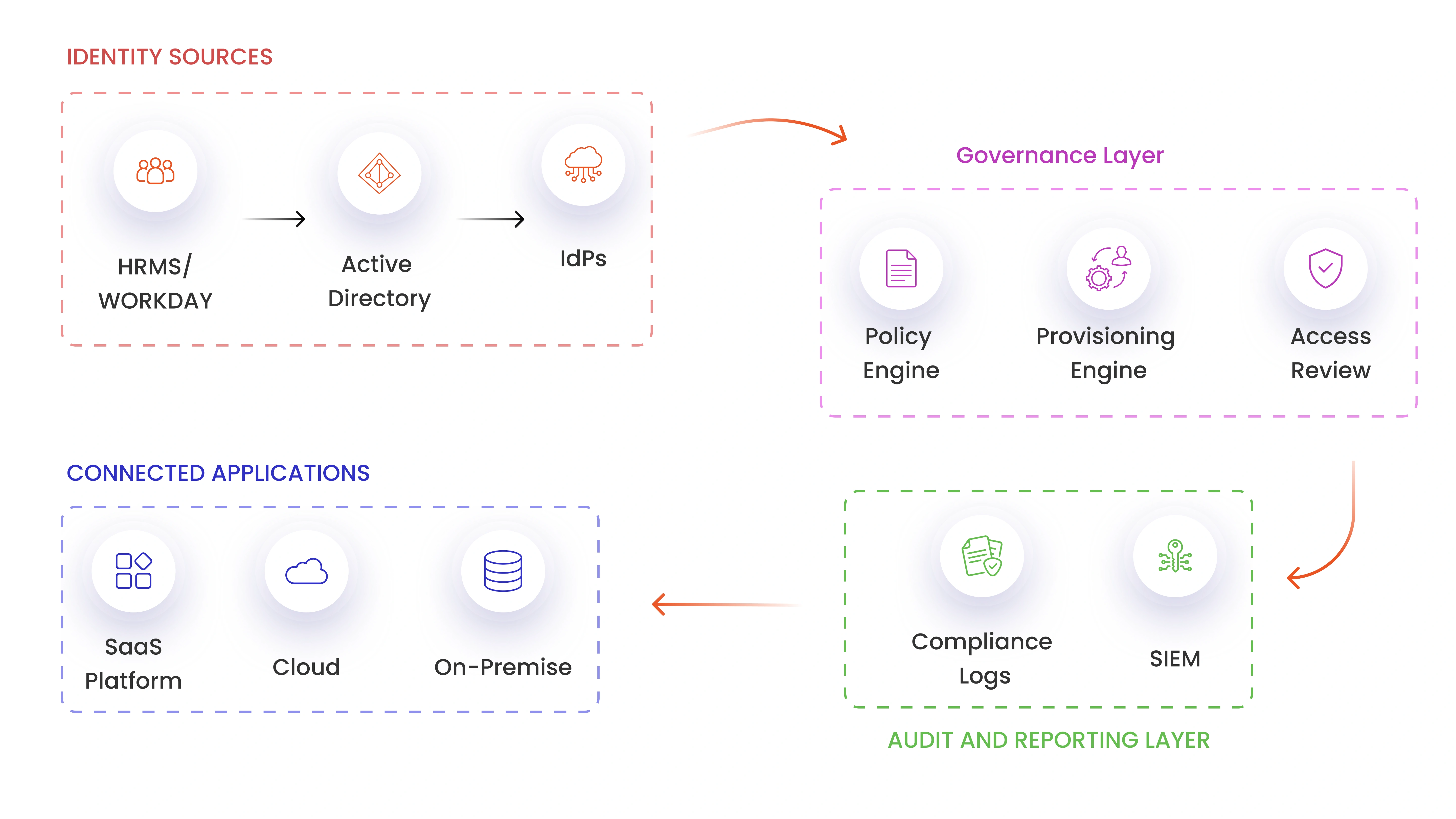
Identity Sources
Your IGA architecture begins here. These systems establish who is actually part of your organization.
HRMS: The source of truth for employee lifecycle and business attributes. Active Directory/LDAP: Often authoritative for domain accounts and on-prem entitlements. Cloud Identity Providers: Solutions like Okta, Entra ID, or Google Workspace anchor your cloud identity perimeter, handling authentication for your remote workforce.
Governance Layer
This layer collects information from identity sources and connected applications to create a unified view of access across the organization. You can govern identities, manage policies, perform reviews, and monitor risk.
Policy Engine
This component holds the rules for your Role-Based Access Control (RBAC) blueprints and your Segregation of Duties (SoD) restrictions. It reduces the likelihood of unauthorized access.
Provisioning Engine
The provisioning engine automates access delivery across connected applications and systems.
When a governance decision is approved, the provisioning engine executes the required actions, from creating accounts to removing access.
Access Review Engine
This is a critical layer of the access governance architecture that manages access certification campaigns. It identifies users, permissions, and applications that require review and routes them to the appropriate reviewers.
Audit and Reporting Layer
This layer sits parallel to your governance processes, acting as an unalterable system recorder. It logs every single access modification, lifecycle event, managerial approval, and policy override. It helps demonstrate compliance during audits.
Connected Applications
The final layer consists of the applications and systems being governed.
These may include:
- SaaS applications
- On-premises applications
- Databases
- Cloud platforms
- File storage systems
- ERP systems
- Collaboration tools
Key Components of an Identity Governance Framework
Beyond architecture, several functional components work together to support effective governance.
1. Identity Discovery
You cannot govern what you do not know exists. Identity discovery scans your entire enterprise network to identify all accounts it contains.
2. User Provisioning and Deprovisioning
This component controls the entry and exit points of your identity pipeline.
Provisioning builds accounts instantly when an employee arrives, assigning baseline access based on their department. Deprovisioning strips all access rights across every single connected application at the exact hour an employee leaves.
3. Role-Based Access Control (RBAC)
Assigning individual permissions to individual employees becomes unmanageable. RBAC simplifies access management by assigning permissions based on job roles rather than individual users.
4. Access Requests
In many cases, employees need temporary or net-new access to perform specific ad hoc tasks. Access request workflows allow users to request access through a structured approval process. It leverages a portal that includes request catalogs, estimated approval times, and visibility into entitlement owners.
5. Access Reviews and Certification
This component runs on an automated schedule, forcing system owners and department managers to audit user access lists. Managers must explicitly click to certify or revoke every permission their employees hold.
6. Segregation of Duties (SoD)
SoD prevents internal fraud and systemic errors by ensuring no single identity has excessive power over a critical business process. Your IGA must let you define SoD rules and detect violations proactively, blocking requests that introduce conflicts or flagging existing conflicts for remediation.
7. Identity Risk Scoring
This component analyzes user entitlements, access history, and behavioral anomalies for identity risk scoring. A user with access to highly sensitive customer databases who hasn't logged in for six months will flag a high risk score, warning your security team to do something about it.
8. Audit Reporting
Audit reporting provides evidence that governance controls are functioning properly. These reports should be exportable, filterable, and tied to specific regulation requirements.
9. Workflow Automation
This links your entire framework together. It handles routing access requests, sending reminders for late reviews, triggering account lockouts, and syncs updates between your HR platforms and technical IT directories.
Benefits of Implementing an Identity Governance Framework
Organizations typically implement an identity governance framework to improve security and compliance. However, those benefits aren't even scratching the surface. Here is what your organization gains when you execute this strategy:
Improved Security
You reduce attack surface by enforcing least privilege, removing orphaned accounts, and detecting risky access patterns before they are exploited.
Reduced Identity Risk
Risk scoring and access certification help you prioritize high-risk users and entitlements, leading to targeted remediation.
Enhanced Compliance
Automated access reviews and audit trails make it straightforward to demonstrate controls to auditors and meet regulatory requirements.
Better Audit Readiness
Pre-built reports and exportable evidence cut audit time and reduce manual evidence collection.
Faster User Onboarding
Automated JML workflows and role-based assignments speed up new hire productivity and reduce friction between HR and IT.
Reduced IT Workload
Self-service access requests, automated provisioning, and workflow automation reduce ticket volume and manual intervention.
Improved Operational Efficiency
Centralized governance reduces duplication and standardizes access decisions across applications.
Identity Governance Maturity Model
You cannot build a perfect identity governance environment overnight. This is where an identity governance maturity model can help you gauge your current capabilities and map out realistic upgrades over time.
| Level | Stage | Core Characteristics |
|---|---|---|
| 1 | Manual Governance | Heavy reliance on spreadsheets, manual access reviews, slow ticket-based provisioning, and widespread privilege creep. |
| 2 | Policy-Based Governance | Formal policies are documented, and baseline roles are defined, but enforcement and verification remain highly manual. |
| 3 | Automated Governance | HR platforms connect to provisioning systems, core lifecycles run automatically, and digital access reviews replace paper trails. |
| 4 | Risk-Based Governance | Identity analytics prioritize anomalies, high-risk entitlements trigger instant alerts, and risk scores guide review cycles. |
| 5 | AI-Powered Governance | Predictive access modeling tracks behavior, automated remediation corrects policy deviations, and continuous micro-certifications occur. |
Assessing Your Governance Maturity
To move forward, you need to be honest about where you stand right now. Look closely at how your team handles a standard employee departure or a compliance review. If your department still relies on tracking access permissions via manual Excel files, emails, or reactive support tickets, your organization is operating at Level 1. Identifying these exact process gaps tells you exactly what should be done next.
Moving Toward Automated Governance
Your primary goal should be moving past the manual hurdles of Levels 1 and 2 and reaching Level 3 (Automated Governance) of the IGA maturity model. These points can help you out:
- Integrate HRMS as a source of truth.
- Build a role model and role lifecycle.
- Implement SCIM connectors for provisioning where available.
- Automate offboarding (deprovisioning and license reclaim).
- Start with scheduled access reviews and move to event-driven certifications.
How to Implement an Identity Governance Framework
Building an identity governance framework isn't just about installing software. If you go straight to software installation, you will only automate your existing problems. Follow this structured multi-step roadmap to deploy your framework successfully in the first go.
Step 1: Discover Identities and Applications
- Connect to HRMS, AD/LDAP, cloud identity providers, and major SaaS apps.
- Inventory accounts, groups, entitlements, and service credentials.
- Tag entitlements with sensitivity and owner metadata.
Step 2: Define Access Policies
- Map regulatory requirements to policies (e.g., access to financial systems requires two approvers).
- Define SoD rules and role-eligibility criteria.
Step 3: Implement RBAC and SoD Controls
- Use role mining to suggest roles based on current access patterns.
- Validate roles with business owners.
- Enforce SoD checks in access request workflows.
Step 4: Automate Identity Lifecycle Management
- Integrate HR events for joiner, mover, and leaver actions.
- Implement SCIM or API-based provisioning where supported.
- Ensure deprovisioning covers sessions, tokens, and external apps.
Step 5: Establish Access Reviews
- Run certification campaigns for sensitive apps and privileged roles first.
- Assign clear owners and timelines.
- Automate follow-up and remediation on non-response or revocation.
Step 6: Implement Risk-Based Access Governance
- Define risk scoring criteria (privilege level, SoD, activity anomalies).
- Prioritize remedial actions based on the risk score.
- Use conditional access or step-up authentication for high-risk scenarios.
Step 7: Continuously Monitor and Improve
- Integrate logs into SIEM, and feed risk signals back into governance.
- Regularly update role models and SoD rules.
- Measure KPIs: time to provision, certification completion, orphan accounts, and number of high-risk users.
Identity Governance Framework Best Practices
A governance framework is only effective if it is implemented correctly. The following best practices can help you get the most out of it:
Adopt a Zero Trust Security Model
Zero Trust operates on a simple principle:
"Never trust. Always verify."
Rather than assuming users should be trusted because they are inside the corporate network, access decisions should be continuously evaluated based on identity, context, and risk.
Identity governance supports Zero Trust by providing visibility into who has access and whether that access is justified.
Enforce Least Privilege Access
Users should only receive the minimum access required to perform their responsibilities.
Excessive permissions increase the impact of both insider threats and compromised accounts.
Identity governance helps enforce least privilege through:
- RBAC
- Access reviews
- Risk scoring
- Automated access controls
The fewer unnecessary permissions users have, the lower the overall attack surface.
Automate Joiner-Mover-Leaver Workflows
The JML process is one of the most important areas to automate.
Delays in onboarding affect productivity, while delays in offboarding create security risks. Automated workflows ensure access changes occur consistently and quickly.
Conduct Regular Access Reviews
Access that was appropriate six months ago may no longer be appropriate today.
Regular reviews help organizations:
- Remove unused access
- Identify privilege creep
- Validate business need
- Maintain compliance
Many organizations perform reviews quarterly for critical systems and annually for lower-risk applications.
Govern Third-Party Access
Contractors, vendors, consultants, and partners often require access to business systems.
However, these identities frequently fall outside traditional employee processes.
Best practices include:
- Defining access expiration dates
- Requiring sponsorship
- Conducting regular reviews
- Removing inactive accounts promptly
Third-party governance should receive the same level of oversight as employee access.
Monitor Identity Risk Continuously
Identity risk is constantly changing.
New permissions, role changes, acquisitions, cloud migrations, and organizational restructuring can introduce new governance challenges.
Continuous monitoring helps organizations identify risks before they become security incidents.
Centralize Governance Policies
Governance policies should be standardized across applications and business units whenever possible.
A centralized approach improves:
- Consistency
- Audit readiness
- Policy enforcement
- Operational efficiency
It also makes governance programs easier to scale.
Governing Non-Human Identities and AI Agents
Non-human identities include service accounts, API keys, machine identities, and AI agents that perform automated tasks. They often have elevated permissions and longer lifetimes than human accounts.
Non-human identities vastly outnumber human users in the enterprise ecosystem. They represent a massive, unmanaged security risk if left out of your governance strategy.
Risks of Unmanaged Service Accounts
Service accounts are a prime target for modern cybercriminals. They are built to handle automated backend processes and are typically granted broad access across critical systems. Even worse, they rarely have built-in password expiration rules, they don't use multi-factor authentication, and they lack a human supervisor to monitor their behavior. This leads to security risks like:
- Forgotten credentials that never rotate.
- Standing privileges that allow lateral movement.
- Orphaned accounts after system changes.
- Credential leakage in code repositories or logs.
- Compliance violations.
API Keys and Machine Credentials
You must inventory API keys, enforce rotation policies, apply least privilege, and ensure keys are not embedded in source code. Use secret stores and rotate credentials programmatically.
AI Agent Governance
Modern AI agents do not just answer simple prompts. They actively connect to your corporate data repositories, read internal emails, and call external APIs to execute tasks autonomously.
If you do not include AI agents in your identity governance framework, an agent could easily surface confidential payroll data or proprietary trade secrets to an unauthorized user who simply asks the right question.
Why Organizations Choose miniOrange for Identity Governance
When it comes to putting a comprehensive identity governance framework into action, trying to stitch together different point solutions and manual scripts will quickly exhaust your IT team.
miniOrange can deliver the exact tools you need to complete visibility, policy enforcement, and audit readiness across your entire on-premises, cloud, and SaaS ecosystem.
Identity Governance & Administration (IGA): Centralize your identity governance with automated access control, regular access reviews, and continuous compliance tracking.
User Lifecycle Management: Fully automate your Joiner-Mover-Leaver workflows, managing user access from onboarding to offboarding across all applications and systems.
Role-Based Access Control (RBAC): Assign access privileges strictly by role to enforce consistent permissions and maintain least privilege.
Secure AI Agents: Address modern non-human identity risks by securely deploying autonomous AI agents with identity-first access controls.
Just-in-Time (JIT) Privileged Access: Minimize your attack surface by granting temporary, need-based privileged access to your most critical resources instead of leaving admin rights open indefinitely.
FAQs
What is an Identity Governance Framework?
It's a structured set of processes, policies, and technologies used to manage and control user and machine access across the enterprise. It combines discovery, lifecycle management, access requests, review/certification, risk scoring, and reporting.
What are the core components of an Identity Governance Framework?
Core components include identity discovery, provisioning/deprovisioning, RBAC, access request and approval workflows, access reviews, SoD enforcement, identity risk scoring, and audit/reporting.
What is the difference between IAM and Identity Governance?
IAM focuses on authentication, authorization, and access management mechanisms (SSO, directories, provisioning). Identity governance adds policy, oversight, certification, and risk-aware decision-making to manage access responsibly across the organization.
Why are access reviews important?
Access reviews confirm that users still need access and provide audit evidence. They reduce privilege creep and help detect orphaned or excessive entitlements.
How does identity governance improve compliance?
IGA provides documented processes, automated access certification, proof of approvals, and audit trails that map to regulatory controls, making it easier to demonstrate you control access to sensitive data.
Leave a Comment