Hello there!
Need Help? We are right here!

Need Help? We are right here!
Search Results:
×The analysis helps organizations to get an overview of today’s situation and bridge the gaps.
Organizations feel highly confident in their ability to prevent NHI attacks, yet 69% say they're concerned about them.
Organizations report between 1–100 unsanctioned AI agents running in their environment, with undefined ownership for a majority.
Said AI agents never exceeded their given permissions; 44% reported low or no confidence in detecting AI agent-specific threats.
AI agents query databases, trigger workflows, call APIs, and spin up other agents, all without a human in the loop. The problem isn't the agents. It's how they're being trusted.
Most organizations rely on shared API keys, hardcoded credentials, or borrowed human tokens, none designed for autonomous systems. The result: identities that are active, privileged, and invisible to your security team. No attribution. No revocation. No blast radius control.
miniOrange treats every AI agent as a first-class identity; issued, scoped, audited, and revocable the same way you govern any privileged account.
miniOrange wraps every AI agent in a complete identity lifecycle: from the moment it is created to the moment its task ends.
Every agent gets a distinct, non-transferable credential at creation. No shared keys. No borrowed human tokens. You can't govern what you can't identify.
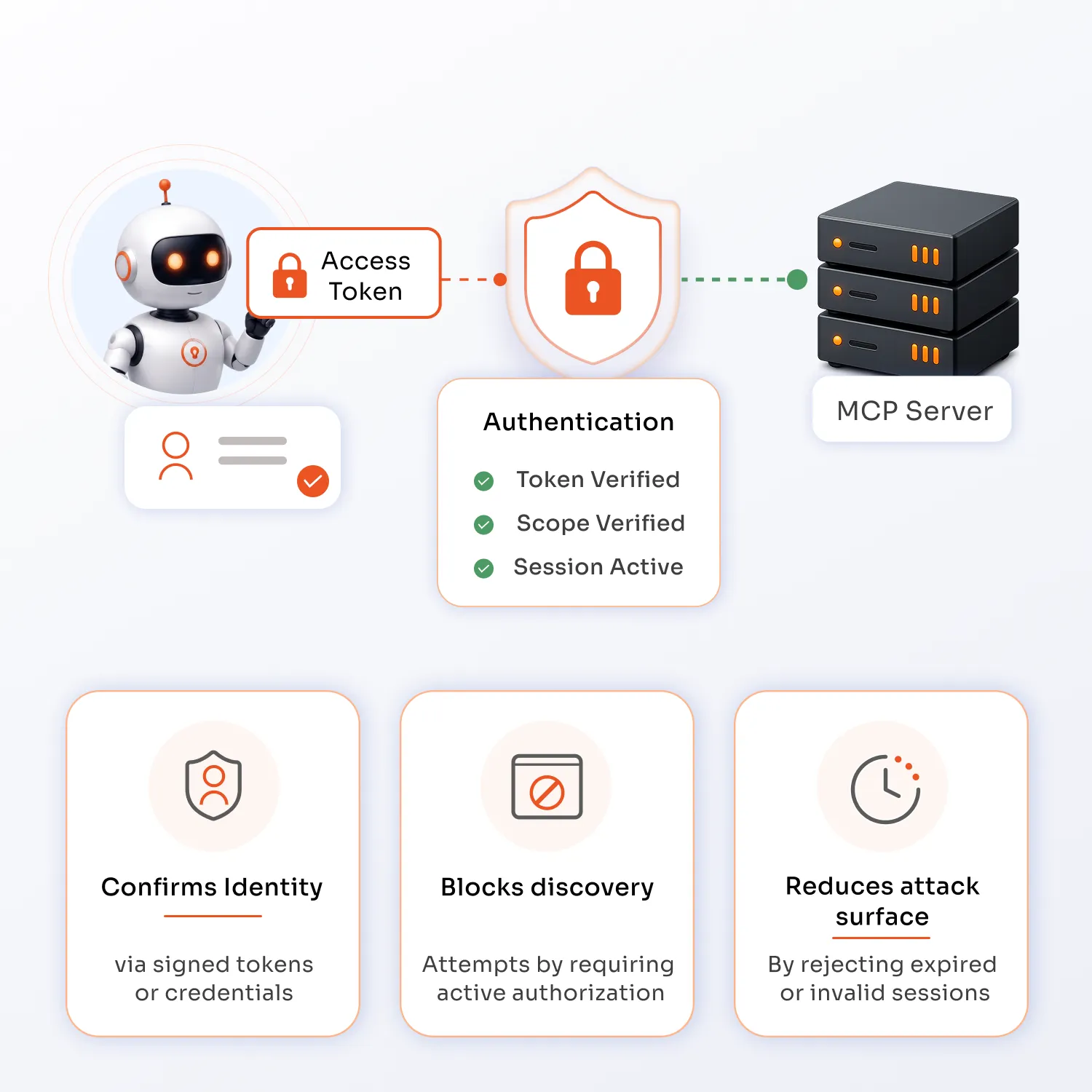
Before touching any tool or API, the agent authenticates via OAuth 2.0 client credentials. A short-lived token is issued to that request.
Authorization controls what an agent can and cannot do. Every action is scoped and time-bound.
Every API call and data access is logged against that specific agent identity. If something goes wrong mid-task, one kill switch terminates all active sessions.
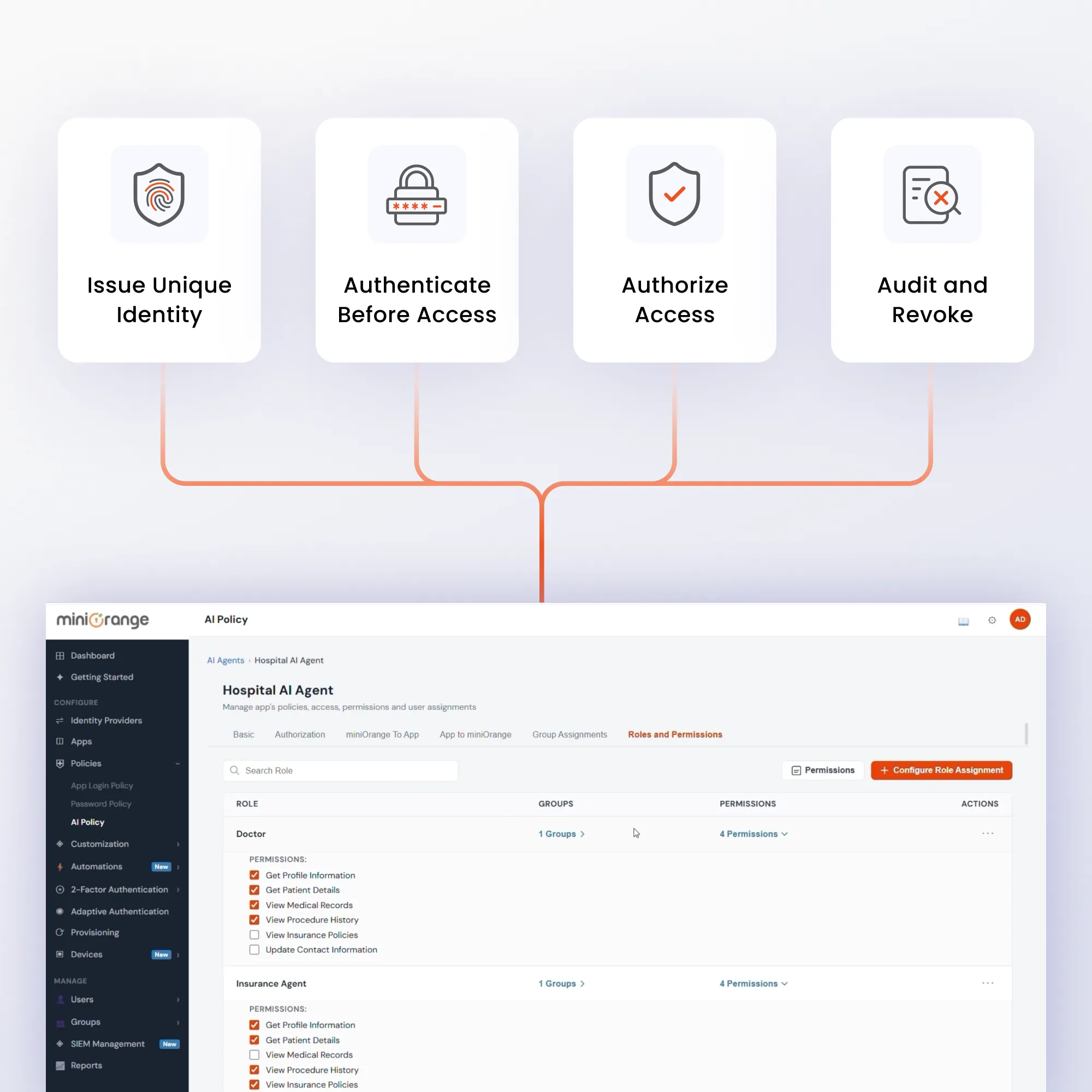
Every feature your security team needs to stop treating AI agents as an ungoverned identity class.

Every agent, service account, and workflow gets a distinct, non-transferable identity at creation. When an agent is decommissioned, its identity is revoked instantly.

Agents authenticate via OAuth 2.0 client credentials: no passwords, no static keys, no secrets in code. Short-lived, signed tokens are issued, which are bound to a specific agent identity and scoped to a single request.

Permissions are defined per task. An agent gets access only to what its current task requires, nothing adjacent, nothing broader. When the task ends, access ends automatically.

Identities and tokens are issued the moment a task starts and revoked the moment it ends. No idle credentials between runs. If a token isn't in active use, it doesn't exist.

Every tool call, data access, and API request is logged. Logs are immutable and structured for direct SIEM ingestion, giving a full attribution chain back to the source.

If an agent exceeds its scope or triggers an anomaly rule, all active tokens for that identity are revoked simultaneously across every connected resource. Other agent workloads running in parallel are unaffected.
Verifies agent identity and scope before any MCP server responds, ensuring only trusted callers proceed. Agents without a valid, unexpired credential are denied access, even if they discover the endpoint.
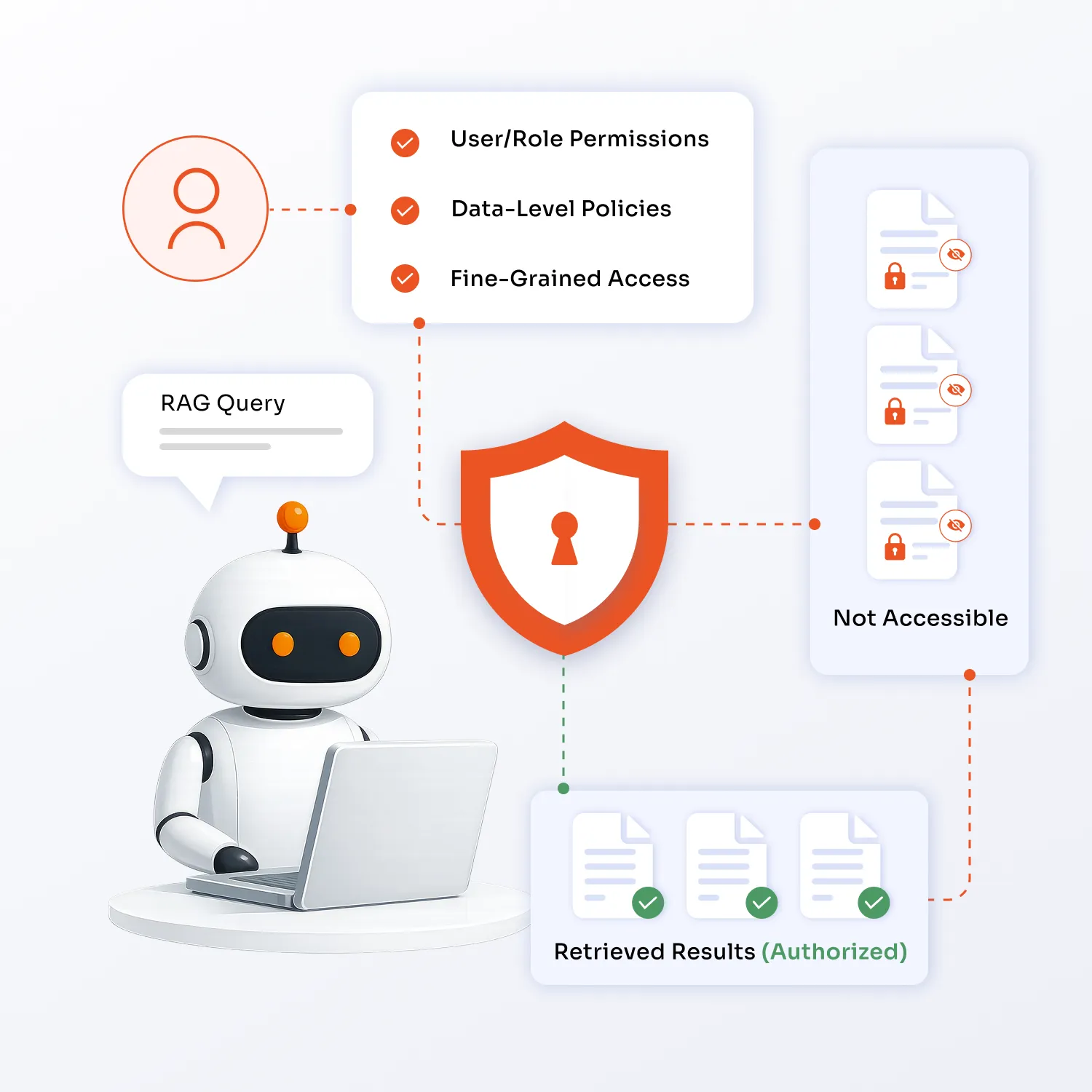
Applies Fine-Grained Authorization (FGA) to control exactly which documents or data chunks an agent can retrieve during a RAG query. This ensures retrieval respects per-user or per-role permissions, not just broad system access.

Fully managed. Elastic scaling as agent volume grows. No infrastructure to maintain. Ideal for cloud-native AI workloads running on AWS, Azure, or GCP.

Agent identities and access tokens never leave your infrastructure. Required for government, defense, healthcare, and financial sector deployments

Single policy layer governing agent identities across cloud and on-premise environments simultaneously.
When an AI agent accesses regulated data, your organization is responsible for what it does. miniOrange gives your compliance and security teams the audit trail, access controls, and access review capabilities they need to demonstrate governance of AI agent activity under any regulatory framework.
View Compliance Frameworks
Cybersecurity
Cloud Compliance
Cybersecurity
ISMS

Privacy

Cybersecurity

India

Cybersecurity