Hello there!
Need Help? We are right here!

Need Help? We are right here!
Search Results:
×
Static rules and signature-based tools miss what looks normal on paper but isn't. User and entity behavior analytics solutions learn
how every user and device actually behaves, so a deviation, not just a rule violation, triggers the alert.

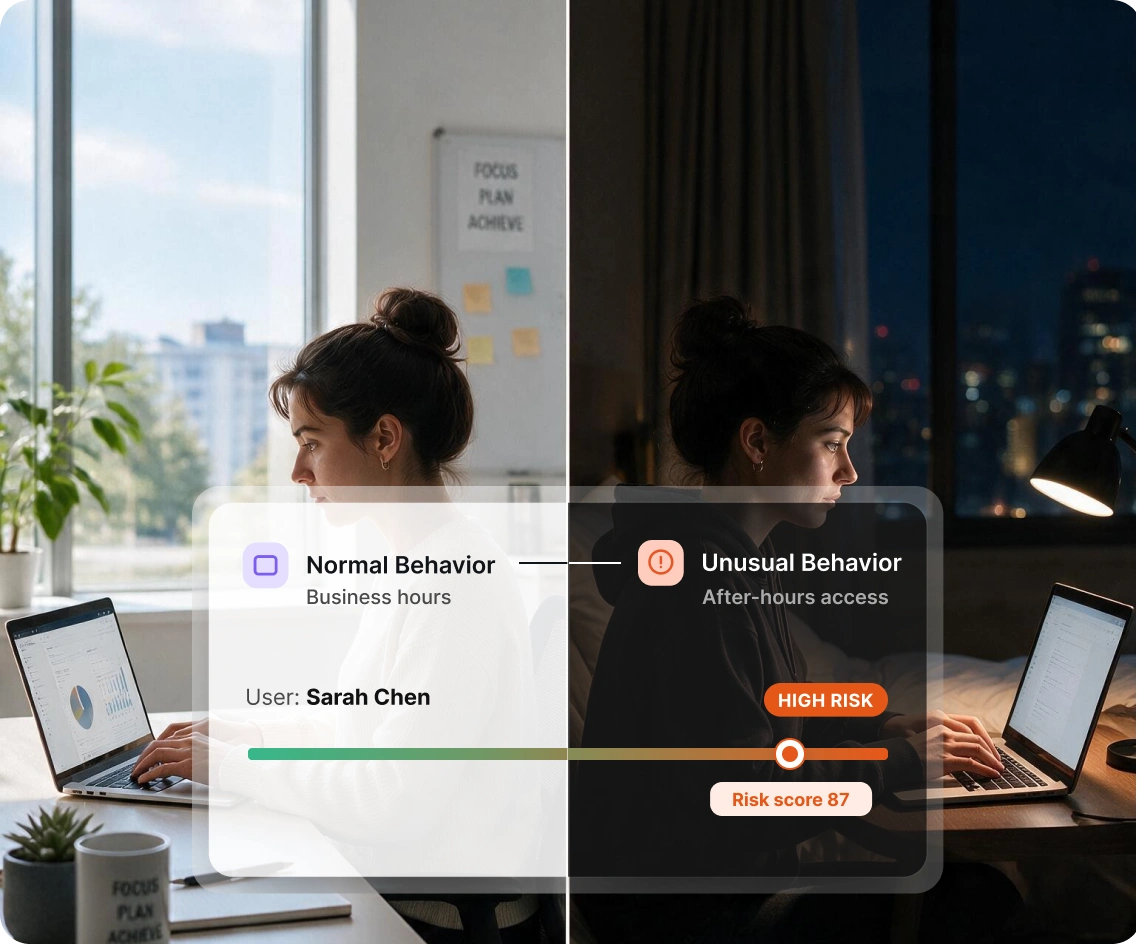
The platform continuously learns typical login times, access patterns, and data usage for every user and entity, building a dynamic profile instead of relying on fixed thresholds.

The moment activity breaks from an established baseline, such as a login from an unfamiliar location or an unusual spike in file downloads, the system flags it instantly.

Behavior isn't analyzed in isolation. The platform correlates signals across users, devices, and applications to surface coordinated attack patterns that single-point monitoring tools miss.
These user entity behavior analytics capabilities work together to surface the threats that actually matter.
The system builds a contextual profile for every user and entity based on historical login patterns, resource access, device usage, and time-of-day activity, creating a reliable "normal" to measure against.
That baseline gets sharper over time, so the platform adapts as roles, devices, and work patterns change.
UEBA security solutions translate raw behavioral signals into structured intelligence your security team can investigate, prioritize, and act on without digging through disconnected logs.

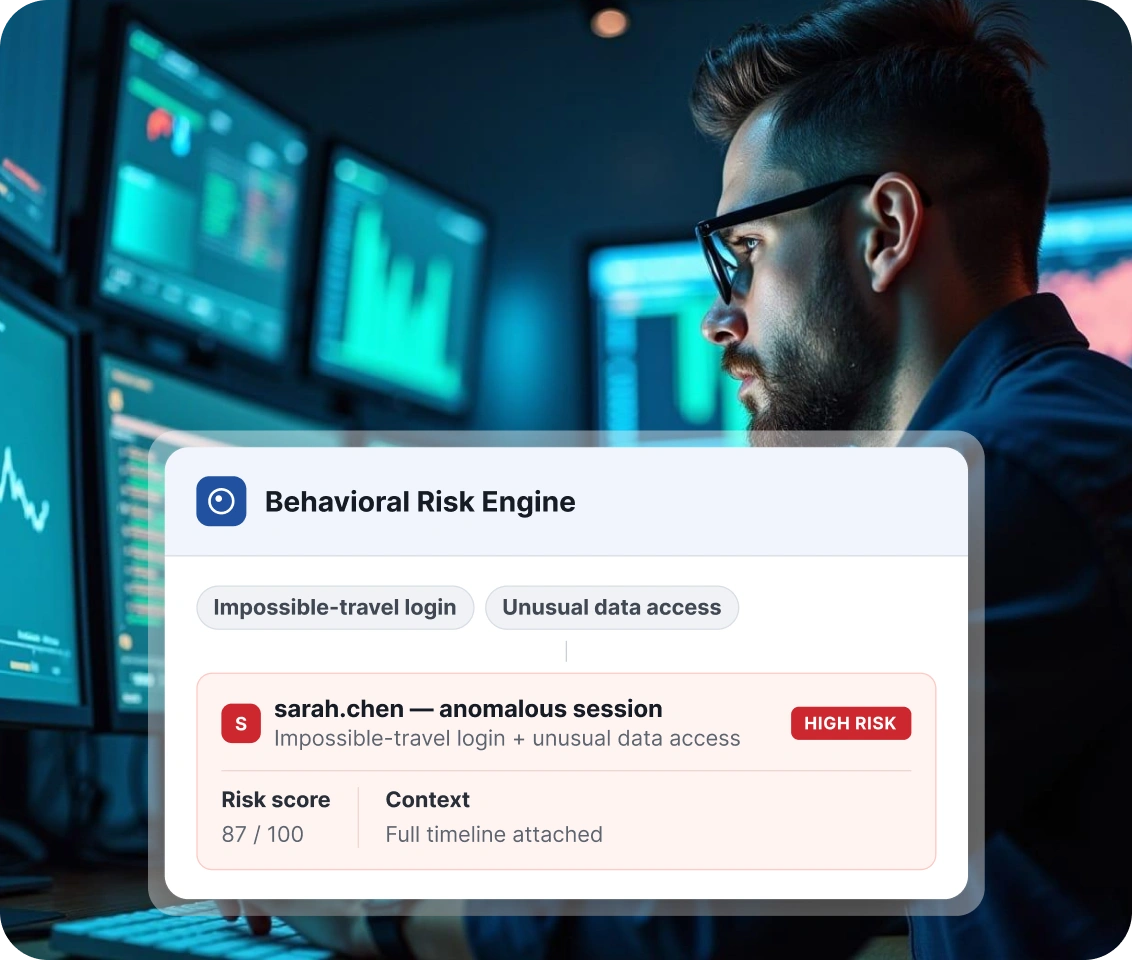
Every user gets a risk profile that updates continuously based on behavior, access patterns, and historical anomalies, giving analysts a view of who poses the highest risk currently.

Devices, servers, and applications are scored the same way users are, so compromised machines and misused service accounts don't slip through unnoticed.

Reconstruct exactly what happened, and in what order, with a chronological view of every login, access request, and behavioral flag tied to a user or entity.

Analysts get a consolidated view of related alerts, risk scores, and context in one place, cutting the time it takes to move from detection to a confirmed incident.

Trace an incident back to its origin point, whether that's a phished credential, a misconfigured permission, or an insider policy violation, so remediation addresses the actual cause.

Behavioral findings are enriched with threat intelligence feeds, helping teams tell the difference between an unusual-but-harmless action and a known attack pattern.
A UEBA platform is only as strong as the data it can see. miniOrange connects directly with your SIEM, IAM, and endpoint tools,
so there are no data silos or blind spots.










Security operations centers don't need more alerts; they need the right alerts, delivered with enough context to act fast. The UEBA solution is built for teams that are done chasing false positives and starting from scratch on every investigation.
Whether you're an enterprise SOC or a security team stretched across identity, cloud, and on-prem systems, the platform scales to match your environment without adding operational overhead.
Get a single view of behavior across every user, device, and application in your environment, instead of stitching together data from disconnected tools.
Deploy in the cloud, on-premises, or across a hybrid environment, with the same behavioral analytics engine adapting to your infrastructure.
Pre-built integrations with leading SIEM and IAM platforms mean your team spends less time on setup and correlation logic and more time on actual threat response.
The platform scales with your organization, from a single department to a global enterprise, handling growing volumes of users, entities, and log data.
Still have questions? Explore more FAQs.
Yes, UEBA is specifically designed to catch insider threats because it flags deviations from a user's own established behavior, such as an employee suddenly accessing files outside their role or downloading unusually large volumes of data.
Yes, compromised accounts often show behavioral red flags before any damage occurs, including logins from new devices, impossible-travel scenarios, or access attempts at odd hours.
The platform monitors human users along with non-human entities, including service accounts, servers, endpoints, applications, and network devices.
Yes, miniOrange's UEBA solution integrates with SIEM tools, along with IAM and identity platforms, to correlate authentication, access, and admin event data in one pipeline.
UEBA gives SOC analysts risk-scored alerts, complete activity timelines, and root-cause context in a single view, replacing manual log correlation with a structured investigation trail.
Yes, the platform is built for flexible deployment across cloud, on-premises, and hybrid infrastructure.