

Credential compromise is one of the fastest-growing cybersecurity threats affecting organizations today. Attackers increasingly target usernames, passwords, session tokens, API keys, and authentication credentials because identities provide direct access to business systems, cloud applications, and sensitive data. Once attackers gain access to valid credentials, they can bypass many traditional perimeter-based security controls.
The rise of cloud adoption, remote work, hybrid infrastructure, and SaaS applications has significantly expanded the identity attack surface. Organizations now manage thousands of user accounts, devices, and access points across distributed environments. This creates more opportunities for cybercriminals to steal, abuse, or exploit identities.
Understanding what credential compromise is and how attackers exploit identities is critical for building stronger cybersecurity defenses.
Credential Compromise: What You Need to Know
Credential compromise occurs when attackers gain unauthorized access to authentication credentials and use them to impersonate users, administrators, or systems. Unlike traditional malware-focused attacks, identity-based attacks rely on valid accounts to move across systems without immediately triggering security alerts.
A compromised credential gives attackers the ability to access applications, email accounts, cloud platforms, VPNs, databases, and privileged systems. Since the login appears legitimate, security teams may struggle to distinguish between authorized users and attackers using stolen identities.
Cybercriminals target identities because credentials are easier to exploit than hardened infrastructure. Many organizations still rely heavily on passwords, weak authentication practices, or inconsistent access controls. Reused passwords, unmanaged devices, and human error further increase the risk of credential compromise.
Modern attacks also leverage automation and AI-driven phishing campaigns to steal credentials at scale. Attackers frequently combine credential theft with ransomware attacks, business email compromise, and lateral movement techniques to maximize financial and operational damage.
How Credentials Become Compromised
Credential compromise can happen through several attack methods that exploit human behavior, weak authentication, vulnerable endpoints, or poor identity security practices. Cybercriminals constantly adapt their techniques to bypass security controls and gain access to valid user accounts.
Phishing and AI Phishing Attacks
Phishing remains one of the most effective methods for stealing a compromised credential because attackers manipulate users into revealing login details. Modern phishing campaigns use fake login pages, spoofed emails, malicious QR codes, and AI-generated content to make attacks more convincing. AI phishing attacks personalize messages using employee information, increasing click-through rates and credential theft success.
Organizations increasingly adopt phishing-resistant MFA solutions to reduce these risks. Passwordless authentication methods such as FIDO2 security keys and passkeys help eliminate reliance on passwords while protecting against credential replay and phishing attacks.
Credential Stuffing and Password Spraying
Credential stuffing occurs when attackers use previously leaked usernames and passwords to gain access to additional accounts. Since many users reuse passwords across multiple applications, attackers can automate login attempts against cloud services, VPNs, and enterprise platforms.
Password spraying attacks work differently by testing commonly used passwords across many accounts instead of repeatedly targeting a single user. This approach helps attackers avoid account lockout policies while increasing the likelihood of compromising accounts with weak passwords.
Malware, Infostealers, and Session Hijacking
Malware attacks and infostealer malware can capture usernames, passwords, browser-stored credentials, cookies, and authentication tokens from infected endpoints. Attackers often distribute malware through malicious downloads, phishing emails, or compromised websites.
Session hijacking allows attackers to steal active user sessions without needing the original password. By capturing session cookies or authentication tokens, cybercriminals can bypass login prompts and access applications directly. These techniques are frequently associated with ransomware attacks and large-scale cybersecurity attacks.
MFA Fatigue and Social Engineering
MFA fatigue attacks occur when attackers repeatedly send authentication push notifications until users accidentally or intentionally approve access requests. Attackers often combine this with social engineering attacks, pretending to be IT support or security administrators.
Although organizations deploy multi-factor authentication (MFA) solutions to improve security, poorly implemented MFA can still be abused. Attackers exploit user trust, confusion, or urgency to gain approvals. Adaptive authentication, phishing-resistant MFA, and user education significantly reduce the effectiveness of MFA fatigue attacks.
Why Credential Attacks Are Increasing in Hybrid and Cloud Environments
- Employees now access business applications from remote locations, personal devices, and unmanaged networks, increasing exposure to credential attacks.
- Organizations manage multiple SaaS platforms, cloud identities, APIs, and third-party integrations, making identity governance more complex.
- Remote work has increased reliance on email, collaboration tools, and browser-based authentication, creating more phishing opportunities for attackers.
- Misconfigured cloud permissions, weak access controls, and shadow IT applications expand the attack surface across hybrid environments.
- A single compromised credential can provide attackers with broad access to interconnected systems, enabling lateral movement and privilege escalation.
Risks and Consequences of Compromised Credentials
A compromised credential can create severe operational, financial, and reputational consequences for organizations. Identity-based attacks often remain undetected longer because attackers use valid accounts that appear legitimate within existing systems.
Data Breaches and Ransomware Attacks
Compromised credentials are one of the leading causes of ransomware attacks and major cybersecurity attacks. Attackers often use stolen credentials to access email systems, cloud platforms, file servers, and privileged administrative accounts.
After initial access, attackers can disable security controls, move laterally, encrypt systems, and steal sensitive information before launching ransomware. Many modern ransomware groups rely heavily on identity compromise instead of exploiting software vulnerabilities directly.
Financial and Reputational Damage
Credential compromise can lead to direct financial losses through fraud, ransomware payments, operational downtime, and recovery expenses. Organizations may also face lost productivity, service disruptions, and significant remediation costs following an attack.
Beyond financial impact, compromised accounts can damage customer trust and brand reputation. Public disclosure of a security incident often affects customer confidence, business partnerships, and long-term organizational credibility.
Regulatory and Compliance Penalties
Organizations handling sensitive customer information must comply with regulations related to identity protection and access security. A compromised credential incident may trigger regulatory investigations, audit failures, and compliance penalties.
Security frameworks increasingly require stronger authentication controls, MFA software implementation, identity monitoring, and privileged access management. Failure to implement adequate credential protection measures can increase legal and regulatory exposure.
How Can You Prevent Compromised Credentials?
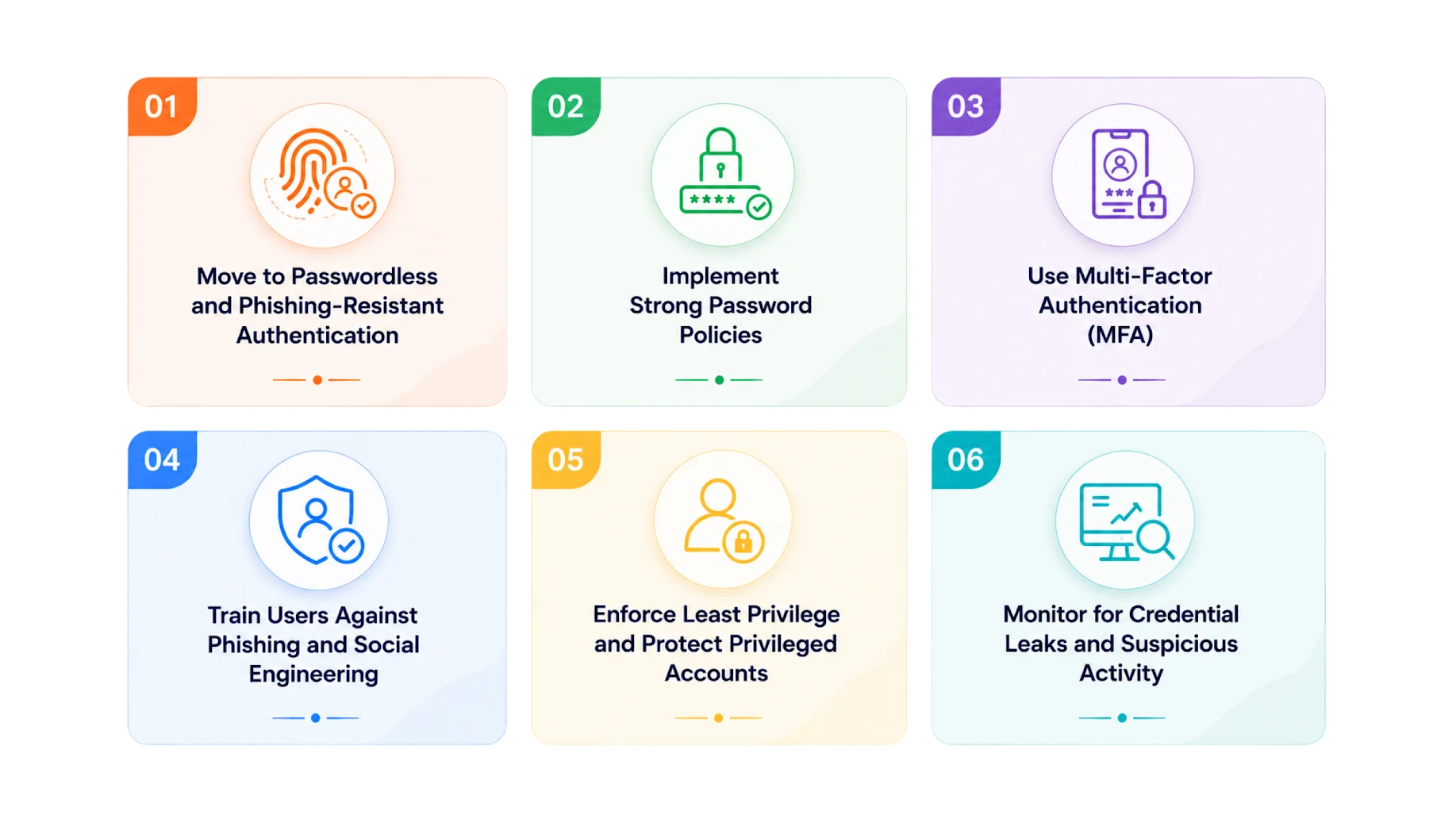
Preventing credential compromise requires a layered identity security strategy that combines strong authentication, continuous monitoring, user awareness, and access governance. Organizations must move beyond password-only security models and implement controls designed for modern identity threats.
Since attackers continuously adapt their methods, organizations should focus on reducing credential exposure, limiting account privileges, and validating user trust throughout every access request.
1. Move to Passwordless and Phishing-Resistant Authentication
Passwordless authentication solutions reduce reliance on passwords, which remain one of the weakest security controls. Technologies such as passkeys, biometric authentication, FIDO2 security keys, and certificate-based authentication provide stronger identity protection against phishing and credential theft.
Phishing-resistant MFA solutions prevent attackers from replaying credentials or intercepting authentication approvals. By eliminating traditional password dependencies, organizations significantly reduce the attack surface associated with credential compromise.
2. Implement Strong Password Policies
Organizations should enforce strong password policies that require long, unique, and complex passwords for every account. Password reuse remains a major contributor to credential stuffing and account compromise attacks.
Password managers help users securely generate and store credentials while reducing the temptation to reuse passwords across applications. Regular password audits and breach monitoring also help identify exposed credentials before attackers can exploit them.
3. Use Multi-Factor Authentication (MFA)
Multi-factor authentication adds an additional verification layer beyond passwords, making it more difficult for attackers to access accounts using stolen credentials alone. MFA providers offer several authentication methods, including push notifications, biometrics, hardware tokens, and authenticator applications.
Organizations should prioritize phishing-resistant MFA methods instead of relying solely on SMS or push-based authentication. Adaptive MFA solutions can also evaluate device trust, location, and user behavior before approving access requests.
4. Train Users Against Phishing and Social Engineering
User awareness remains essential for preventing phishing attacks and social engineering attempts. Employees should understand how attackers impersonate trusted contacts, create urgency, and manipulate users into revealing credentials.
Organizations should conduct regular phishing simulations and security awareness training to improve user recognition of suspicious activity. Educating users about phishing-resistant authentication methods also helps strengthen overall identity security posture.
5. Enforce Least Privilege and Protect Privileged Accounts
Least privilege access ensures users only receive the minimum permissions required to perform their job responsibilities. Limiting unnecessary access reduces the impact of a compromised credential and restricts attacker movement across systems.
Privileged accounts require additional protection because they provide elevated access to sensitive systems and infrastructure. Organizations should implement privileged access management solutions , multi-factor authentication (MFA), session monitoring, and just-in-time access controls for administrative accounts.
6. Monitor for Credential Leaks and Suspicious Activity
Organizations should continuously monitor for credential compromise indicators such as leaked passwords, unusual login patterns, impossible travel events, or abnormal account activity. Early detection helps security teams respond before attackers escalate access.
Threat intelligence platforms, identity analytics, and security monitoring tools can identify suspicious behavior associated with compromised credentials. Automated alerts and incident response workflows help organizations contain threats more effectively.
The Role of Zero Trust in Preventing Credential Compromise
Zero Trust security models assume that no user, device, or system should automatically receive trusted access. Instead, organizations continuously verify identity, device posture, authentication strength, and contextual risk before granting access to applications or resources.
This approach helps reduce credential compromise risks because attackers cannot rely solely on stolen usernames and passwords to move freely across environments. Zero Trust policies evaluate additional risk factors such as device health, geographic location, user behavior, and access sensitivity.
Continuous authentication and adaptive access controls help organizations detect abnormal activity in real time. If user behavior changes unexpectedly or risk signals increase, access can be restricted, reauthenticated, or blocked automatically.
Zero Trust also improves visibility across hybrid and cloud environments by centralizing identity governance, access monitoring, and policy enforcement. This allows organizations to respond faster to suspicious activity while minimizing unnecessary access exposure.
How to Identify Credential Compromise Before Account Damage
Early detection is critical because attackers often spend time exploring systems before deploying ransomware or stealing sensitive data. Organizations should focus on identifying suspicious behavior patterns and account anomalies before attackers escalate privileges or expand access.
Maintain Endpoint and Identity Visibility
Organizations need comprehensive visibility across endpoints, identities, cloud applications, and authentication systems to identify compromised credential activity early. Security teams should monitor login attempts, device posture, access requests, and identity behavior continuously.
Centralized logging and identity visibility platforms help correlate suspicious events across environments. This allows organizations to identify abnormal activity patterns associated with account compromise or unauthorized access attempts.
Establish Behavioral Baselines and Risk Signals
Behavioral analytics helps organizations establish normal user activity patterns and identify deviations that may indicate credential compromise. Examples include unusual login times, impossible travel events, excessive file access, or unexpected privilege escalation.
Risk-based authentication systems can evaluate these signals dynamically and trigger additional verification requirements when suspicious behavior occurs. This helps reduce unauthorized access while minimizing user disruption.
Accelerate Investigation and Incident Response
Rapid investigation and response capabilities are essential for containing ransomware attacks and identity-based threats. Security teams should automate alert triage, credential resets, session revocation, and account isolation workflows wherever possible.
Incident response plans should also include clear procedures for compromised credential containment, forensic investigation, privileged access review, and post-incident remediation. Faster response times significantly reduce attacker dwell time and operational impact.
Wrapping It Up
Credential compromise has become one of the most significant cybersecurity threats facing modern organizations. As businesses continue adopting cloud services, remote work, and SaaS applications, identity security is pivotal more than ever.
Attackers increasingly target credentials because stolen identities provide direct access to systems, applications, and sensitive information. Phishing attacks, credential stuffing, malware attacks, MFA fatigue, and social engineering continue to evolve rapidly, making traditional password-based security insufficient.
Organizations must adopt layered identity security strategies that combine phishing-resistant authentication, MFA, Zero Trust principles, behavioral monitoring, privileged access controls, and continuous visibility. Preventing credential compromise requires more than securing passwords. It requires continuously validating identity trust across every access request and monitoring for suspicious behavior before attackers can cause damage.
FAQs
What does credential compromise mean?
Credential compromise means that usernames, passwords, authentication tokens, or other login credentials have been stolen, exposed, or accessed by unauthorized individuals. Attackers use compromised credentials to impersonate legitimate users and gain access to applications, systems, or sensitive data.
Is it bad if my password is compromised?
Yes, a compromised password can allow attackers to access your accounts, steal sensitive information, or launch additional attacks. If your password is compromised, you should immediately change it, enable multi-factor authentication, and review account activity for suspicious behavior.
Does compromised mean hacked?
In cybersecurity, compromised usually means a system, account, or credential has been accessed or affected by unauthorized activity. While hacking often refers to the attack itself, compromise describes the successful impact or unauthorized access resulting from the attack.
Can I delete compromised passwords?
You cannot technically delete compromised passwords from previous data breaches, but you can stop using them immediately. Change exposed passwords, use unique credentials for every account, enable MFA, and store passwords securely using a password manager.
Leave a Comment