Hello there!
Need Help? We are right here!

Need Help? We are right here!
Search Results:
×
Implementing Oracle Single Sign-On (SSO) often requires Oracle Access Manager (OAM) or Oracle Internet Directory (OID), along with complex identity provider integrations—leading to higher costs and slower deployment.
miniOrange eliminates this complexity by enabling secure SSO across Oracle applications using your existing identity provider—without requiring OAM or OID.
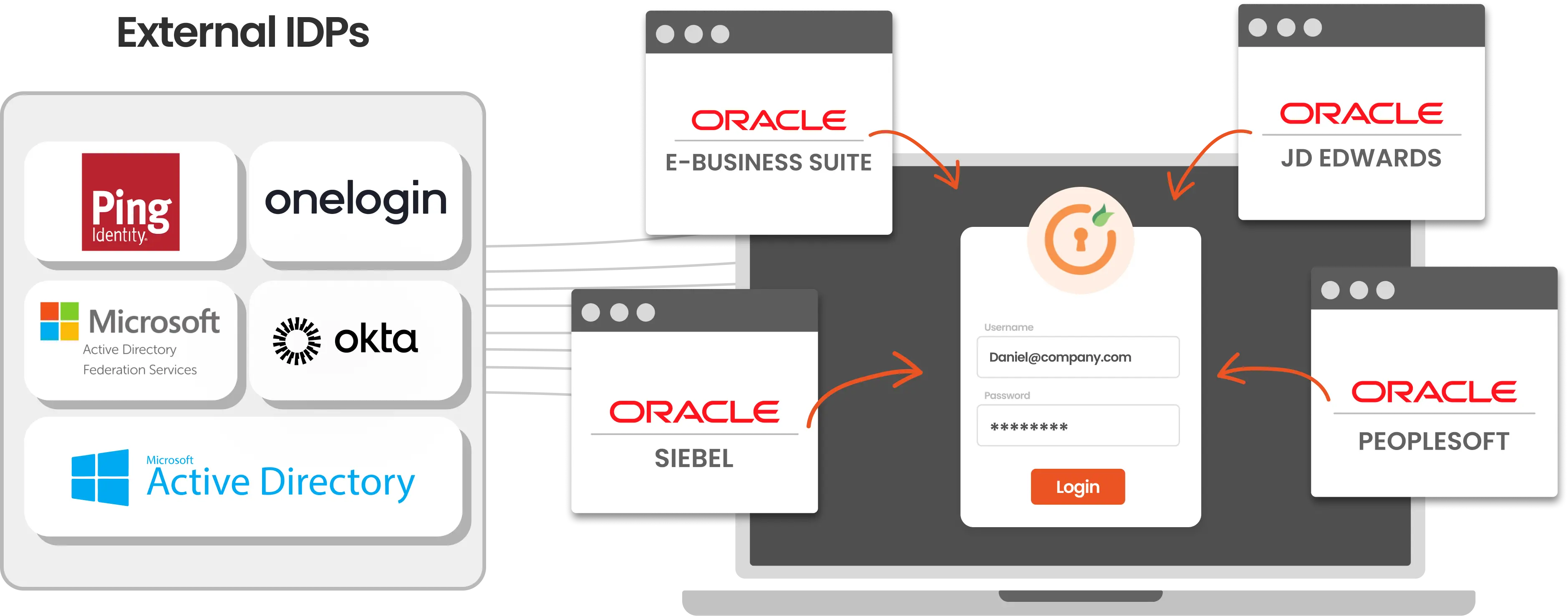
Integrates with Azure AD and any IdP supporting SAML 2.0 or OAuth
Enables SSO for Oracle EBS, PeopleSoft, JD Edwards, Siebel, and more
Allows login using existing credentials—no multiple passwords
Eliminates complex Oracle IAM infrastructure
Trusted as an Oracle Partner Network (OPN) partner, miniOrange helps streamline access while improving security and user experience.
Oracle SSO works across all Oracle applications without Oracle Access Manager (OAM) or Oracle Internet Directory (OID). miniOrange Oracle SSO enables single sign-on using standard protocols like SAML and OAuth.
Users can authenticate with Azure AD, ADFS, LDAP, or any SAML/OAuth-compliant IdP, allowing secure access to Oracle applications without creating additional accounts through miniOrange Oracle SSO.
miniOrange Oracle SSO integrates with enterprise directories for user authentication and account management, enabling employees to log in with existing credentials across Oracle applications.
Add an extra layer of security with OTPs, push notifications, or hardware tokens. miniOrange Oracle SSO ensures Oracle applications remain protected even if credentials are compromised.
miniOrange Oracle SSO allows access restrictions based on IP address or device type, protecting Oracle applications from unauthorized logins and maintaining security compliance.
Automate creation, updates, and removal of user accounts while assigning roles to control access across Oracle applications. miniOrange Oracle SSO ensures users have appropriate permissions at all times.
Oracle Single Sign-On (SSO) enables users to access multiple Oracle applications using a single set of credentials,
ensuring secure and seamless authentication across systems.
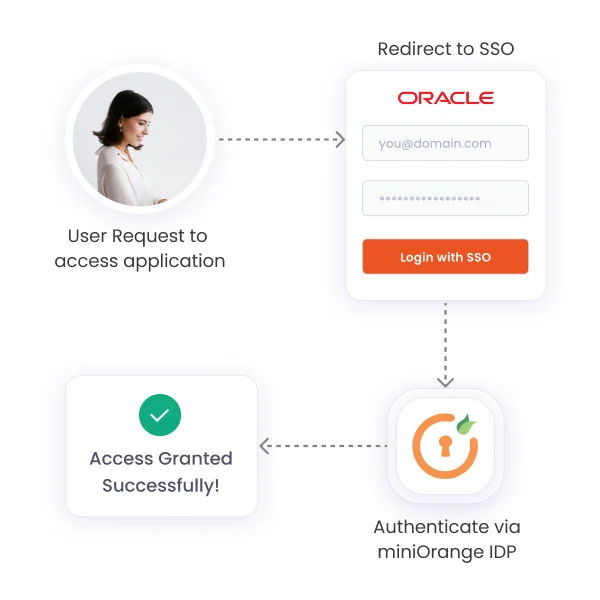
Step 1: User Requests Access: The user attempts to access an Oracle application.
Step 2: Redirect to Identity Provider: The request is redirected to the miniOrange Identity Provider (IdP) or an external IdP.
Step 3: Secure Authentication: The user is authenticated using standard protocols like SAML 2.0 or OAuth, with optional Multi-Factor Authentication (MFA).
Step 4: Seamless Access Granted: Once verified, the user gains instant access to Oracle applications without additional logins.
All of this is achieved without requiring Oracle Identity Manager (OIM) or Oracle Access Manager (OAM), while IT teams maintain centralized control for security and compliance.
Enable seamless Oracle SSO integration across applications like Oracle EBS, PeopleSoft, JD Edwards, Siebel, Apex, and Fusion—using your existing identity provider.

Oracle EBS
Oracle Peoplesoft
Oracle JD Edwards
Oracle Siebel CRM
Oracle Apex
Oracle Fusion
*Please contact us to get volume discounts for higher user tiers.
Oracle SSO improves productivity and user experience by allowing users to access multiple Oracle applications with a single login. Users no longer need to remember multiple passwords or log in repeatedly.
There is no need to migrate existing user data from Identity Providers (IdP), Active Directory (AD), or other user databases. This simplifies setup for both administrators and end users.
In addition to SSO authentication, an extra layer of security can be added with Multi-Factor Authentication (MFA). Users can also log in using backup codes if their phone or device is unavailable.
Users can access multiple Oracle and non-Oracle applications with a single login. This reduces password fatigue and ensures a consistent login experience across all applications.
With Oracle SSO, users no longer need to remember individual application URLs. A single set of credentials provides access to any Oracle application.
Oracle SSO helps organizations meet compliance requirements for audits such as SOC 2, HIPAA, and others, especially when enabling SSO for applications like Oracle EBS 11i and R12.