Hello there!
Need Help? We are right here!

Need Help? We are right here!
Search Results:
× Unified IAM platform built for global compliance standards alignment
Continuous access monitoring with real-time audit trails and policy enforcement
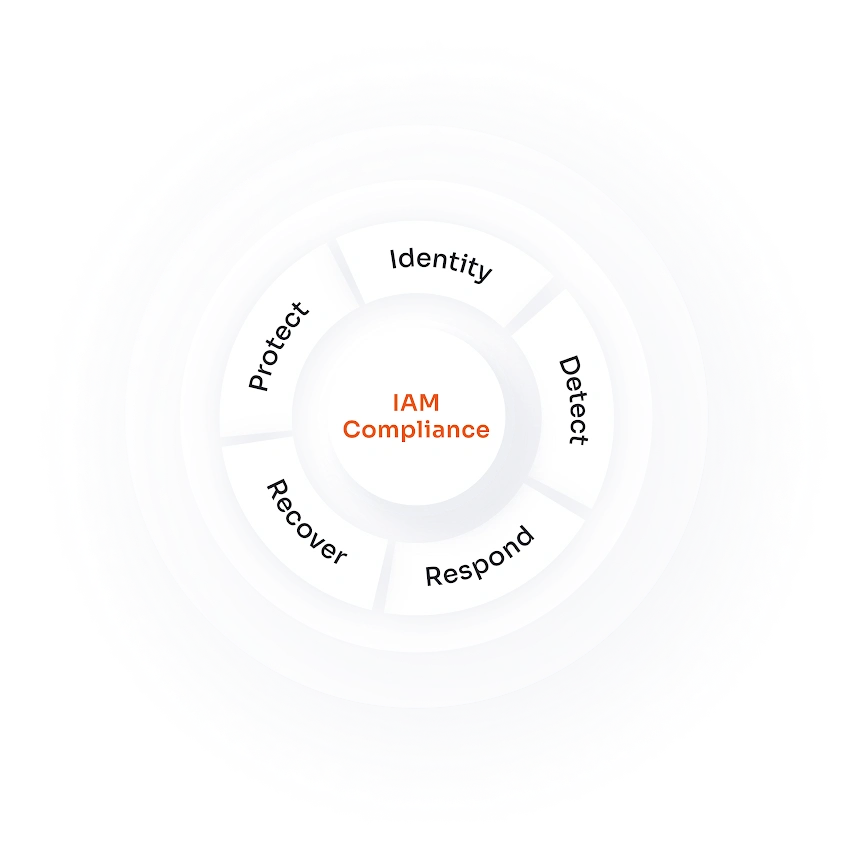
Most organizations struggle with identity and access management compliance because access provisioning is manual, visibility across systems is fragmented, and orphaned accounts go undetected. Aligning with multiple regulations, such as GDPR, NIST, and SOC 2, simultaneously makes IAM compliance even harder to maintain.
miniOrange simplifies identity management compliance by automating user lifecycle management, enforcing multi-factor authentication, and delivering continuous audit-ready monitoring. Therefore, if you're achieving IAM-compliant status for the first time or scaling governance, miniOrange aligns your identity infrastructure to every framework you need.

Non-compliance with GDPR, ISO 27001, or DPDP can lead to heavy fines and increased regulatory scrutiny.

Orphaned accounts and excessive privileges increase the risk of breaches. A single compromised identity can expose critical systems.

Manual processes and fragmented systems make audits difficult, leading to delays, higher costs, and loss of trust.
Granular access control ensures only authorized users can reach sensitive systems, data, and applications. Role-based policies enforce least privilege across your organization, a foundational requirement for staying IAM compliant under any regulatory framework.
Strong authentication mechanisms verify every identity before granting access to critical business resources. From MFA to adaptive authentication, miniOrange ensures your login infrastructure meets GDPR, HIPAA, and SOC 2 authentication mandates.
Continuous monitoring and detailed audit logs give compliance teams the visibility they need during regulatory reviews. Every access event is recorded, timestamped, and reportable, making identity and access management compliance audits faster and more defensible.
Automate the entire user lifecycle from provisioning and de-provisioning without manual intervention or delayed access removal. Automated provisioning eliminates orphaned accounts and ensures access rights are always aligned with current roles and compliance policies.
Centralized policy enforcement ensures consistent application of compliance rules across every system, user, and access point. miniOrange translates regulatory requirements into enforceable identity policies, reducing compliance drift and manual governance overhead.
Enforce privacy-first access controls and support data subject rights with centralized identity governance.
Protect cardholder data with strong authentication and strict access control policies.
Meet cybersecurity mandates with strong authentication, access controls, and monitoring.
Ensure cloud compliance with robust identity governance aligned to national and global frameworks.
Enable data principal rights and accountability through automated identity lifecycle and access management.
Align identity governance with information security management standards and controls.
Demonstrate compliance through continuous monitoring, access controls, and detailed audit logs.
Map IAM controls across NIST’s core functions to strengthen risk management and security posture.
Support consumer data rights with automated access governance and visibility into user data access.
Restrict access to sensitive health data and maintain complete audit trails for compliance.
Ensure segregation of duties and track all access and changes across financial systems.

miniOrange connects with your existing directories, applications, and cloud environments without requiring a full infrastructure overhaul.

Our platform grows with your organization, supporting complex multi-tenant, hybrid, and multi-cloud IAM compliance environments.

Lower licensing, faster deployment, and reduced IT overhead make miniOrange the most practical path to sustained regulatory alignment.
Get expert guidance and a tailored IAM solution aligned with your regulatory needs, deployed fast, and built to scale.
Identify exposed identities, orphaned accounts, and unmet regulatory requirements across your environment.
Map applicable frameworks, such as GDPR, HIPAA, SOC 2, to your identity governance needs.
Implement SSO, MFA, IAM, and PAM with guided onboarding and dedicated compliance support.
Track access behavior, enforce policies, and refine governance as regulations evolve.
x
Your download should start now. If not, please email us at idpsupport@xecurify.com or contact us.