Hello there!
Need Help? We are right here!

Need Help? We are right here!
Search Results:
×
AI agents reason, decide, and act autonomously at machine speed but security built for human users and apps leaves gaps in identity, access, orchestration, and runtime behavior.

Agentic AI systems can make decisions and perform actions independently. Without governance controls, a single incorrect decision can impact multiple systems and workflows.

AI agents often require access to APIs, data sources, and enterprise applications. Overprivileged access increases the risk of misuse, lateral movement, and unauthorized actions.

Modern AI environments frequently involve multiple agents working together to complete tasks. Compromising one agent can create security risks across interconnected workflows.

AI agents continuously generate actions based on context, prompts, and available tools. Without runtime validation, unsafe decisions can reach production systems.

AI workflows rely on APIs, plugins, databases, and automation tools to complete tasks. Each integration introduces additional attack surfaces and security dependencies.

Organizations often lack visibility into what AI agents are doing, what systems they access, and what actions they perform. This creates governance blind spots and compliance challenges.
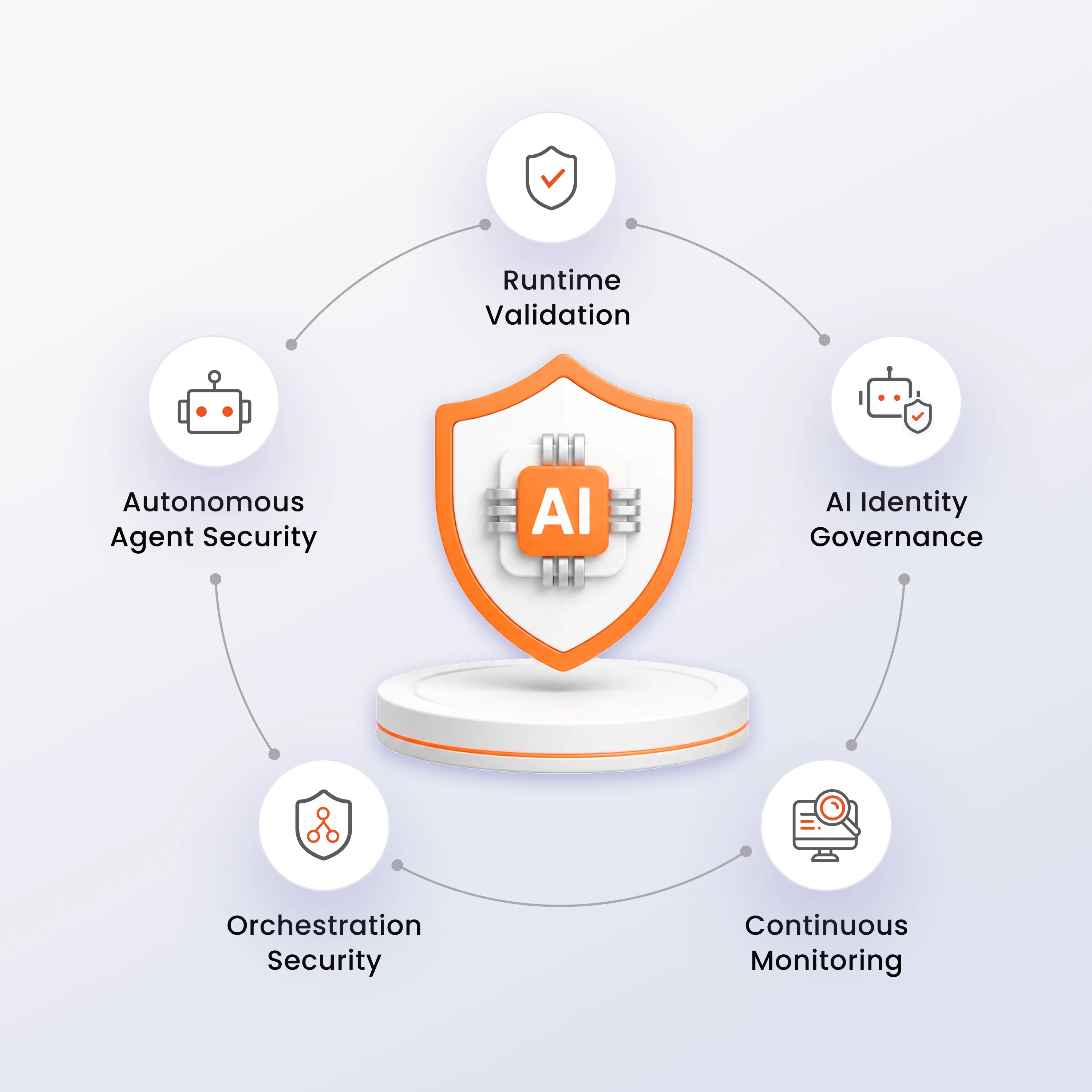
Agentic AI acts independently deciding, accessing tools and APIs demanding runtime validation, identity governance, and oversight beyond traditional AI security.
Security Area
Traditional AI Security
Agentic AI Security
Protecting AI models and prompts
Securing autonomous AI agents and workflows
Human-supervised AI interactions
Independent AI reasoning and execution
Static permissions and API keys
Dynamic, identity-based access controls
Prompt-level monitoring
Runtime behavior and decision validation
Single AI application protection
Multi-agent and multi-system orchestration security
User-focused authentication
AI identity governance for agents and workloads
Basic AI misuse detection
Protection against prompt injection, tool abuse, and privilege escalation
Limited AI visibility
Continuous monitoring, auditability, and policy enforcement
Individual AI applications
Enterprise-wide autonomous AI ecosystems
Secure AI across enterprise workflows and APIs with governance, visibility, and runtime protection as systems grow more autonomous.

Secure AI systems operating within predefined workflows, policies, prompts, and controlled execution paths. Maintain visibility and governance across AI-assisted business processes and enterprise automation.

Secure AI systems that combine automated reasoning with human checkpoints at key decision points. Maintain governance across workflows where AI acts independently for low-risk steps but requires approval or review before high-impact actions.

Protect autonomous AI systems performing independent reasoning, API interactions, orchestration, and multi-step decision-making. Reduce risks associated with unsupervised actions while maintaining operational flexibility.
Apply continuous security controls across AI agents, orchestration pipelines, APIs, and enterprise systems to reduce runtime risks and improve governance.
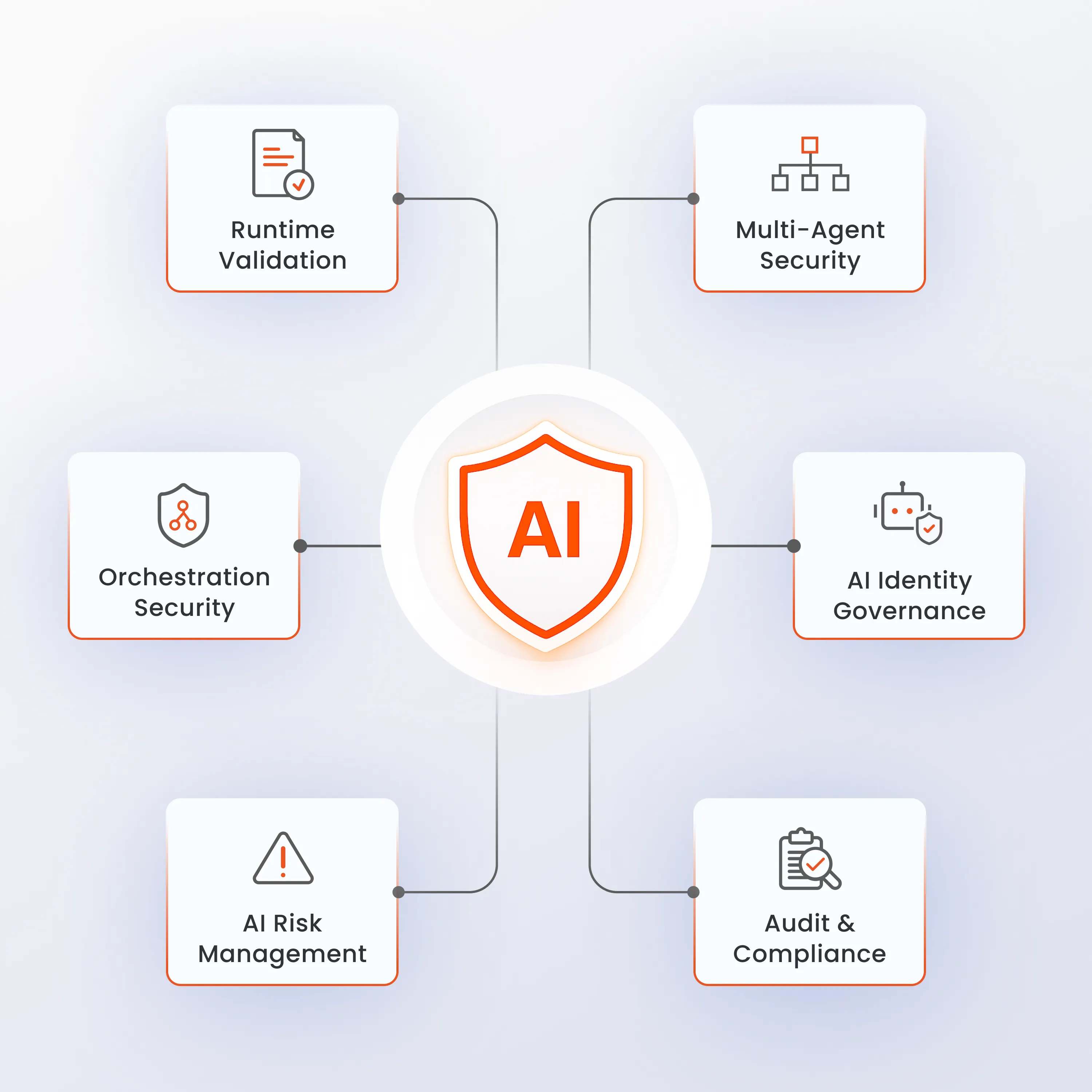
Validate prompts, permissions, reasoning paths, and AI actions before execution. Prevent unsafe decisions from reaching enterprise systems, APIs, and business workflows.
Secure communication, trust relationships, and interactions between connected AI agents. Prevent compromised agents from impacting other systems within the AI ecosystem.
Protect workflows, APIs, plugins, tools, and automation pipelines from unauthorized access and misuse. Maintain secure execution across complex AI-driven processes.
Manage AI agents as governed machine identities with authentication, authorization, and policy enforcement. Ensure every AI action is tied to an approved identity and permission set.
Detect unsafe AI behavior, runtime anomalies, excessive permissions, and privilege escalation attempts. Continuously monitor AI activity to identify emerging risks before they impact operations.
Maintain visibility into AI decisions, runtime activity, policy enforcement, and security events. Generate audit-ready records to support governance and compliance requirements.
Malicious prompts can manipulate AI reasoning and influence how agents make decisions. Runtime validation helps prevent unsafe actions triggered by prompt injection attempts.
Compromised or misconfigured AI agents can misuse APIs, tools, databases, and enterprise systems. Continuous monitoring helps identify and block unauthorized actions before they impact operations.
A vulnerable AI agent can potentially affect connected agents, workflows, and business systems. Security controls help contain risks and enforce least-privilege access across multi-agent environments.
AI agents often interact with sensitive enterprise and customer data during task execution. Runtime governance helps prevent unauthorized access, sharing, or exposure of confidential information.
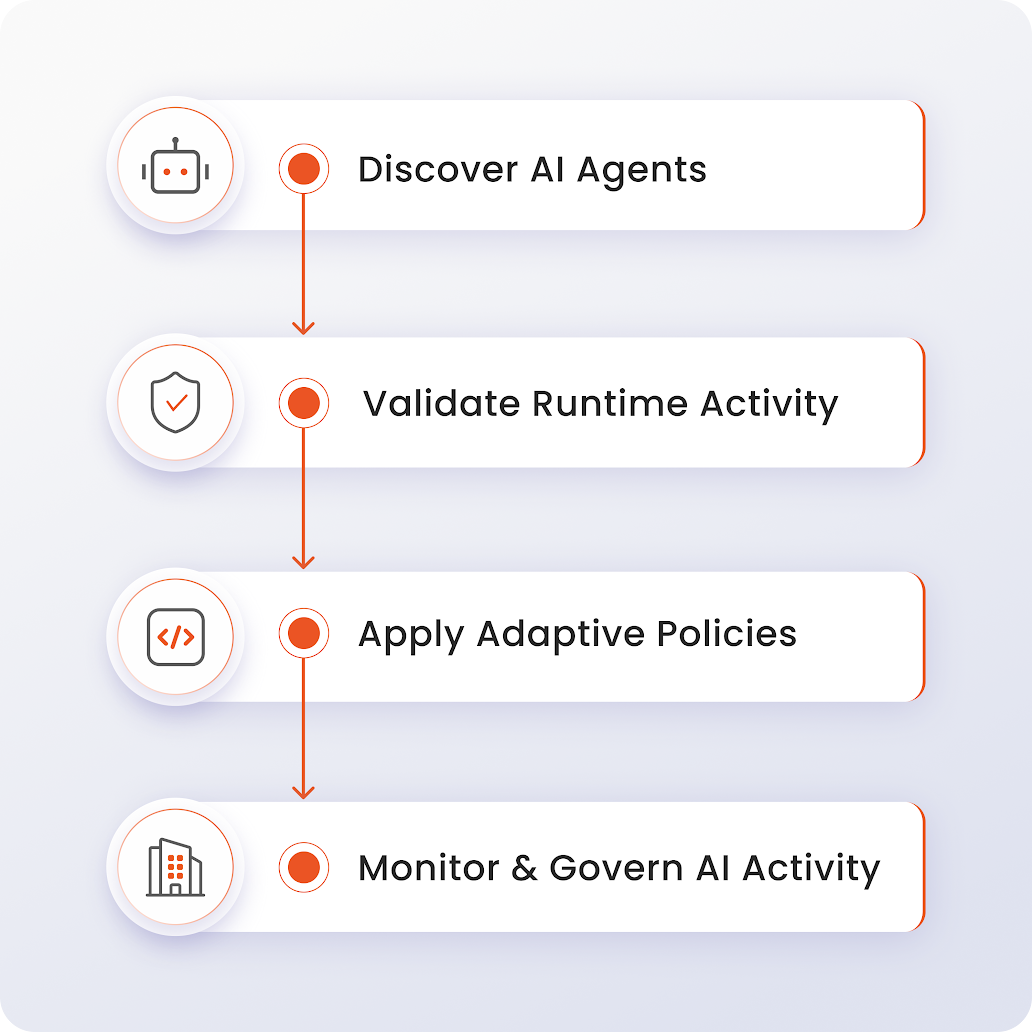
Protect autonomous AI systems through continuous discovery, runtime validation, adaptive policy enforcement, and centralized governance.
Identify AI agents, orchestration frameworks, APIs, tools, and connected workflows across your environment. Gain visibility into the AI ecosystem before risks emerge.
Continuously analyze AI behavior, prompts, permissions, reasoning paths, and runtime actions. Detect risky activity before it reaches enterprise systems.
Enforce dynamic security policies based on context, permissions, identity, and risk level. Ensure AI agents operate within approved boundaries at all times.
Maintain visibility into AI decisions, system interactions, policy enforcement, and security events. Generate audit-ready records to support governance and compliance.
Secure autonomous AI systems across enterprise environments with runtime validation, governance controls, and continuous monitoring.
Secure enterprise AI assistants accessing internal systems, knowledge bases, and business data. Enforce identity-aware access controls and runtime validation for every interaction.
Protect AI-driven workflows interacting with APIs, tools, and enterprise applications. Prevent unauthorized actions while maintaining visibility into automated decision-making.
Manage trust relationships, permissions, and communication between interconnected AI agents. Maintain governance controls across complex multi-agent ecosystems.
Secure AI development agents interacting with code repositories, CI/CD pipelines, and infrastructure environments. Reduce risks associated with automated code generation, deployment, and system access.
Monitor AI behavior, runtime activity, and policy violations across autonomous environments. Identify emerging risks early and maintain continuous oversight of AI operations.
Integrate with AI models, orchestration frameworks, APIs, IAM platforms, and enterprise security tools to secure agentic AI environments without disrupting existing workflows.
OpenAI · Anthropic · Google Gemini · Azure OpenAI · AWS Bedrock
LangChain · LangGraph · CrewAI · AutoGen · Semantic Kernel
Active Directory · Microsoft Entra ID · Okta · Ping Identity · LDAP
SIEM Platforms · SOAR Platforms · PAM Solutions · ITSM Tools · Security Analytics
Secure autonomous AI systems with runtime visibility, AI identity governance, orchestration security, and adaptive policy enforcement designed for enterprise environments.
Manage AI agents, machine identities, and runtime permissions from a centralized platform. Apply consistent governance controls across AI systems and enterprise resources.
Validate AI decisions, workflows, prompts, and runtime activity continuously. Prevent unsafe actions before they impact enterprise systems and business processes.

Extend existing IAM, PAM, and access governance controls to AI agents and autonomous workflows. Leverage your current identity infrastructure without introducing security silos.

Apply dynamic security policies based on identity, context, risk level, and runtime behavior. Ensure AI systems operate within approved security boundaries.

Gain centralized visibility into AI activity, runtime decisions, policy violations, and governance events. Improve security oversight across complex AI ecosystems.