Hello there!
Need Help? We are right here!

Need Help? We are right here!
Search Results:
×x
Your download should start now. If not, please email us at idpsupport@xecurify.com or contact us.
Please enter your valid work email-id
OneLogin works well for many organizations, but its fit can change as identity becomes more deeply embedded across the technology stack and business operations.
Teams securing VPNs, WiFi, servers, devices, local resources, and diverse applications may need identity controls extending beyond web application access.
Maturing identity programs may require granular policies, access reviews, certifications, lifecycle controls, separation of duties, and detailed reporting for stronger governance.
Specialized environments may require customizable authentication flows, developer extensibility, and integration patterns tailored to unique applications, workflows, and identity requirements.
Hybrid, multi-cloud, regulated, or isolated environments may prioritize customer-controlled identity infrastructure and greater deployment flexibility over dependence on cloud-managed control planes.
Bring your most demanding application or infrastructure use case to miniOrange and determine how it can be secured without compromising your architecture.
Capability
miniOrange
OneLogin
Goes beyond SSO with IAM, IGA, PAM, CIAM, MFA, lifecycle management, and access controls across different identity and infrastructure requirements.
Provides workforce IAM covering SSO, MFA, lifecycle management, application access, directories, and customer identity capabilities.
Offers cloud, hybrid, on-premises, and customer-hosted deployment options, with air-gapped deployment possible where architecture and licensing support it.
Uses a cloud-managed IAM model; OneLogin Access provides local enforcement for on-premises applications while management remains cloud-based.
Supports SaaS, on-premises, legacy, custom, thick-client, and non-standard applications through SSO, Access Gateway, and applicable integration methods.
Supports SaaS, custom, homegrown, and on-premises applications through OneLogin's access capabilities.
Supports SAML, OAuth 2.0, OIDC, with additional protocol options including WS-Fed, JWT, RADIUS, and TACACS+ depending on product and licensing requirements.
Supports SAML, OAuth 2.0, OIDC, RADIUS, and other authentication and integration capabilities.
Connects Active Directory and LDAP with database- and API-backed identity sources, enabling diverse repositories within the identity architecture.
Supports Active Directory, LDAP, HR systems, cloud directories, and other identity sources.
Wait! There is more, to view Download Full Comparison
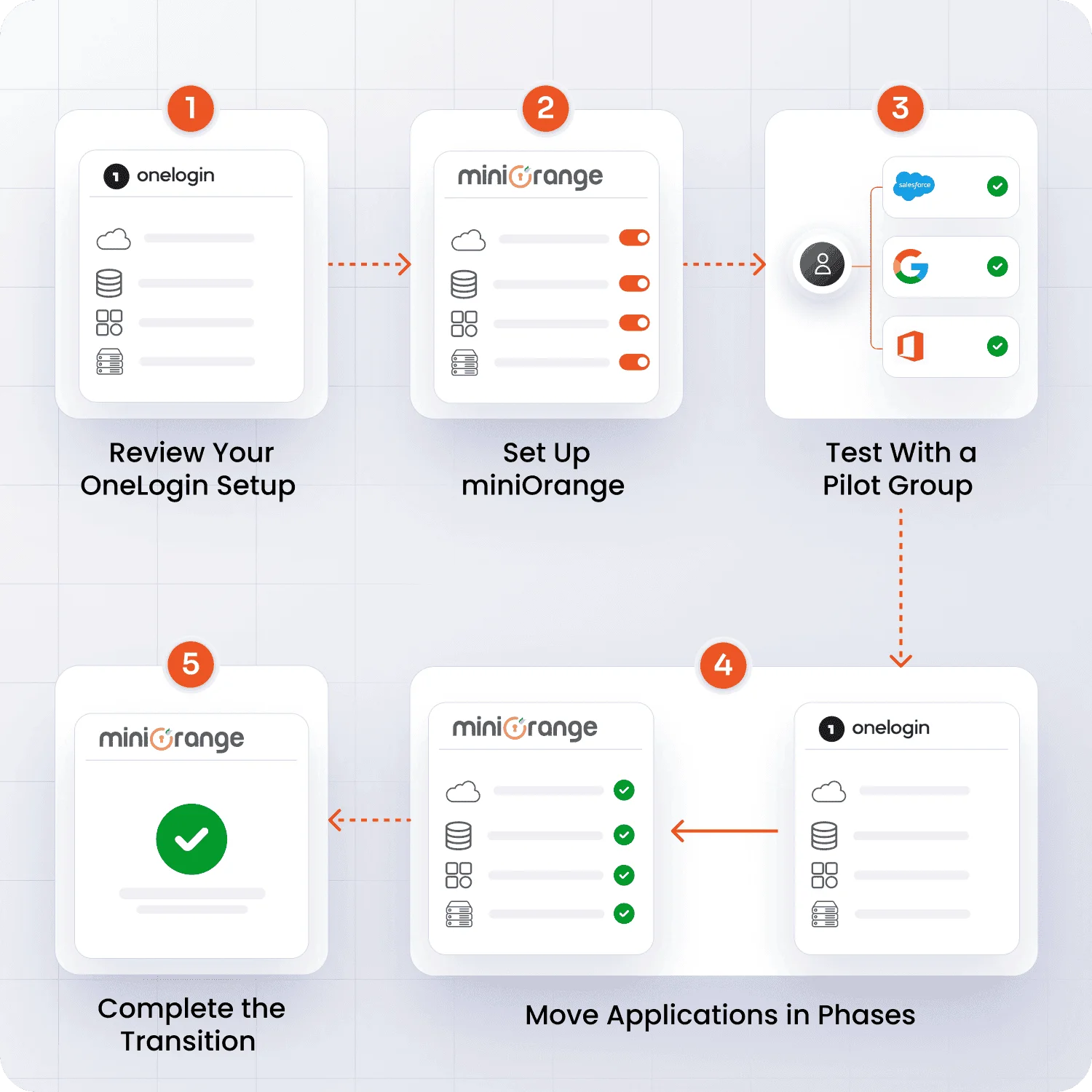
A structured migration helps teams preserve existing access while gradually moving authentication, applications, users, and identity workflows from OneLogin.
Review applications, users, groups, authentication policies, directories, provisioning workflows, custom integrations, and existing access dependencies.
Connect identity sources and configure applications, SSO, MFA, provisioning, lifecycle workflows, policies, and required gateway integrations.
Move a representative user group first, testing authentication, MFA, application access, provisioning, policies, and critical integrations before wider migration.
Transition applications according to business priority and integration complexity, keeping OneLogin available until each migration phase is validated.
Monitor authentication, provisioning, and application access after migration, resolve remaining issues, and shift users fully to miniOrange.
Extend modern SSO and MFA to older and non-standard applications without forcing every workload to support the same authentication architecture.
Yes. miniOrange supports SAML-based SSO alongside OAuth 2.0 and OpenID Connect. It can integrate applications using standards-based authentication while providing additional protocol and integration options based on the deployment, application architecture, and licensed capabilities required.
Yes. miniOrange supports on-premises IAM alongside cloud, hybrid, and private-cloud deployment models. This gives organizations greater control over identity infrastructure when data residency, regulatory requirements, network isolation, or internal security policies require customer-hosted identity management.
Yes. miniOrange can secure applicable legacy and non-standard applications through gateway and connector-based integration patterns. Access Gateway can extend SSO and MFA to applications that do not natively support modern authentication, helping organizations add centralized access controls without replacing existing application infrastructure.
Yes. miniOrange integrates with Active Directory and LDAP and can federate or synchronize identities from these sources while operating as an identity provider. It can also work with database- and API-backed identity sources where organizations need multiple repositories within their authentication and identity management architecture.
Yes. miniOrange supports custom application integration through standards-based protocols, APIs, SDKs, and gateway-based approaches. The appropriate integration depends on the application's architecture and authentication capabilities, including whether it is browser-based, thick-client, legacy, or uses a non-standard authentication mechanism.
Yes. Organizations can evaluate miniOrange before committing to a OneLogin migration through available trial and evaluation options. The appropriate evaluation depends on the required products, deployment model, applications, users, and identity capabilities, allowing teams to validate technical fit before planning a broader migration.