Hello there!
Need Help? We are right here!

Need Help? We are right here!
Search Results:
×Single Sign-On (SSO) governs who can sign in to enterprise applications, but application-to-application API access introduces another layer of authorization.
When an application or AI agent needs data from another application, enterprises must manage the connection and determine which users are authorized to access the target resource.
miniOrange Cross-App Access extends identity-based access policies to supported application and AI agent integrations. It checks user assignments before issuing an Identity Assertion JWT Authorization Grant (ID-JAG), allowing the requesting application to obtain an access token from the resource application's authorization server.
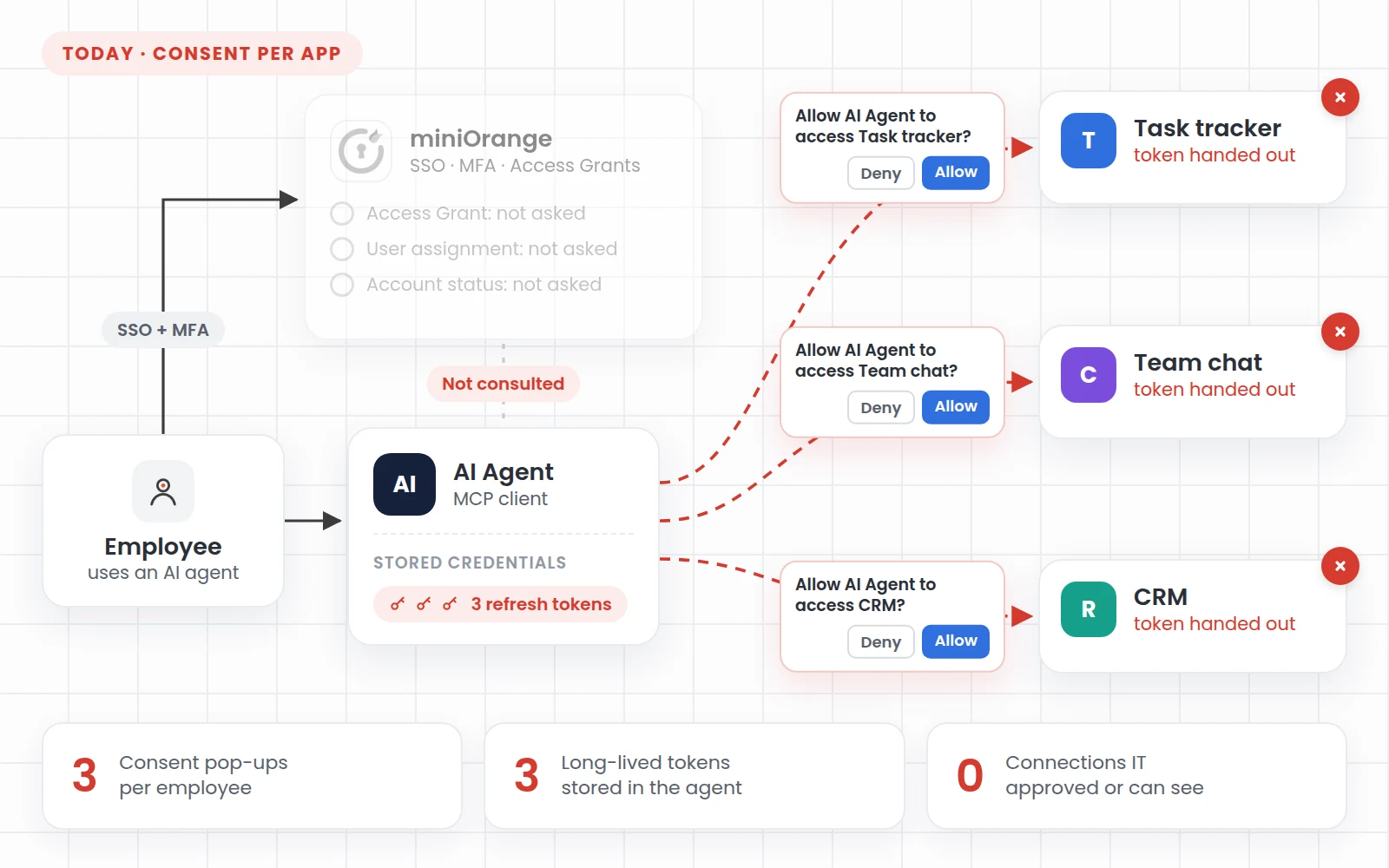
Every app asks the user, and IT never sees it
SSO signs Alice in to the AI agent, then steps aside. Each app the agent needs shows its own consent pop-up, and the agent keeps a long-lived token for each one.
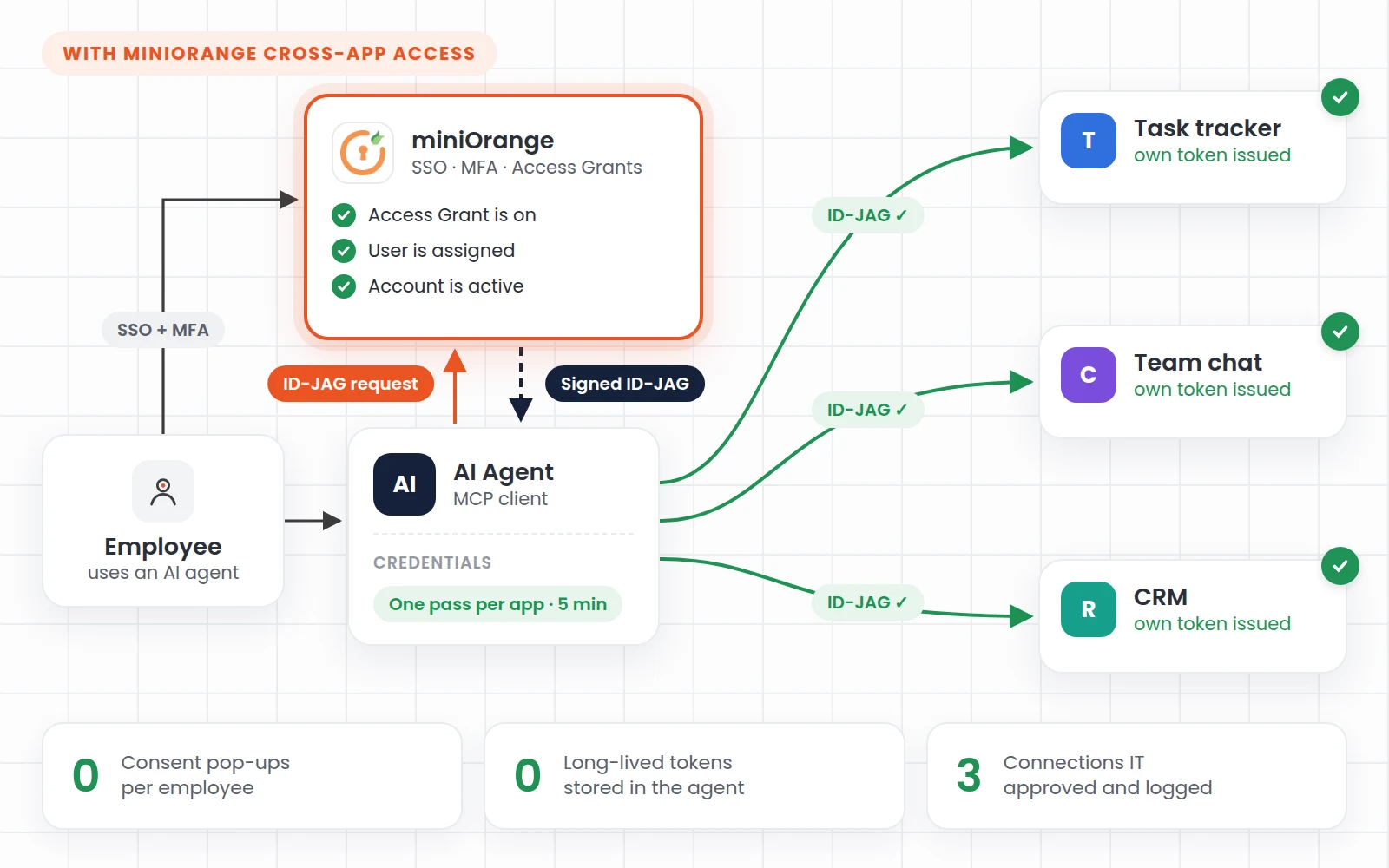
IT approves once, and miniOrange checks every request
The agent asks miniOrange, not Alice. miniOrange checks the Access Grant and that Alice is assigned and active, then issues a 5-minute ID-JAG for one app. The app checks it and issues its own token.
Manage cross-app access grants through the miniOrange admin console by configuring requesting and resource applications and defining eligible users through existing user and group assignments. Disable connections to block new authorization grants and review audit logs to track issued ID-JAGs.
Enable backend token exchange between applications without requiring separate interactive consent for each configured connection. miniOrange issues ID-JAGs through OAuth 2.0 token exchange, and the resource application redeems them with the JWT bearer grant, preserving user identity and enabling browser-independent access for supported AI agents and MCP clients.
ID-JAG tokens provide signed, short-lived authorization grants that resource applications validate using miniOrange's published keys before issuing access tokens. Each grant is valid for 5 minutes, addressed to one resource application, and bound to the user and the requesting client.
The Cross-App Access Report records every ID-JAG issued and every request refused, with the requesting application, user, target application and scopes. Admins see the exact reason for each refusal; the requesting app only receives a generic error. Disable connections to prevent new grants from being issued.
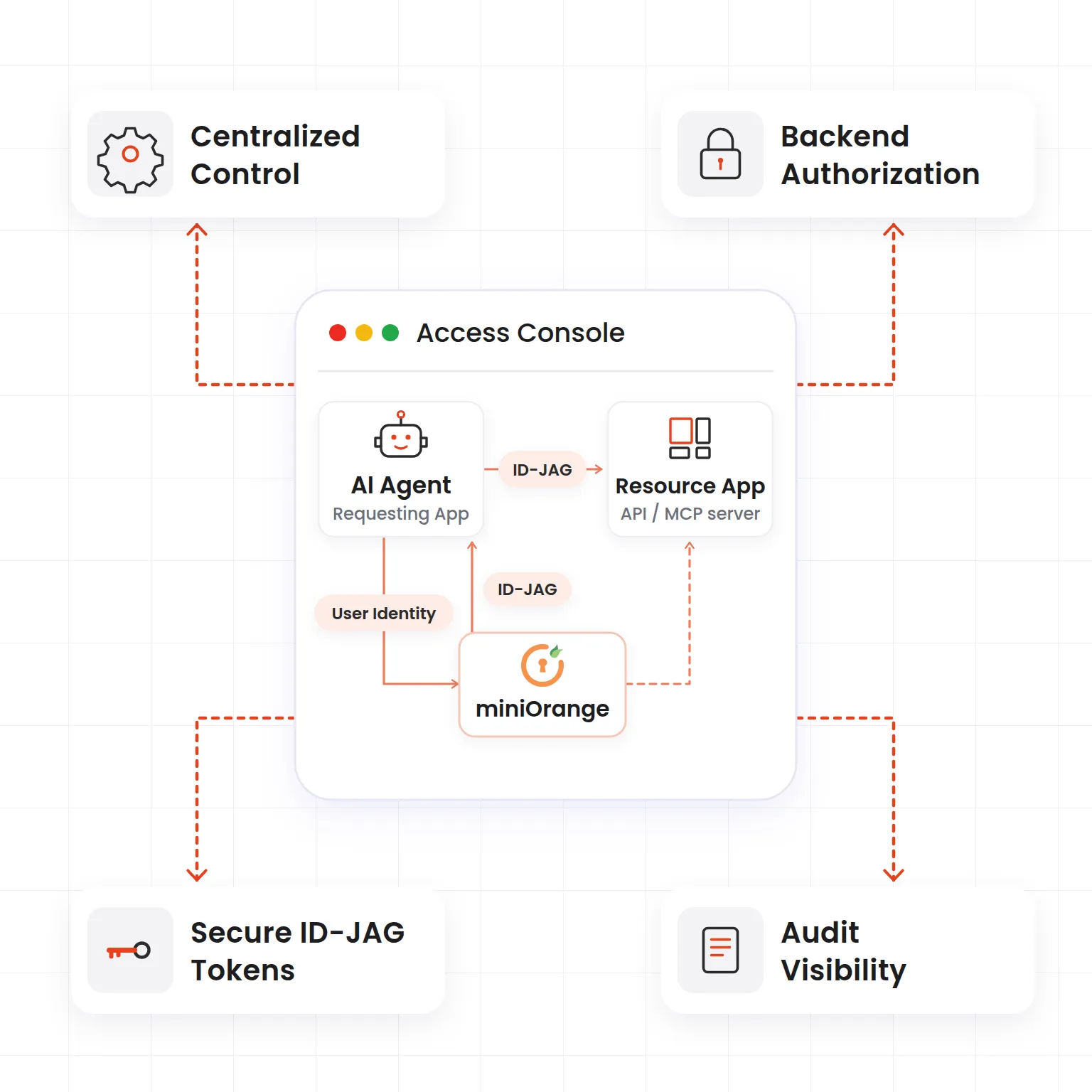
Connect enterprise applications and AI agents through identity-governed authorization. See how miniOrange Cross-App Access uses ID-JAG-based token exchange to manage access to supported application APIs.
Cross-App Access uses a four-step backend authorization process to connect a requesting application with a resource application.
The employee signs in to the requesting application through miniOrange SSO. After successful authentication, the application receives an ID token that represents the user’s verified identity.
The requesting application sends the user’s ID token to miniOrange. miniOrange verifies the user’s assignment to the target resource application and issues an ID-JAG if the access conditions are met.
The requesting application submits the ID-JAG to the resource application’s authorization server. The server validates the grant and, if the request is approved, issues its own access token.
The requesting application calls the resource application’s API or supported MCP server using the access token. The resource application applies its own authorization rules to the requested data and actions.
The questions your security team asks, answered for today's model and for Cross-App Access.
Question
Today: consent per app
With miniOrange Cross-App Access
Each user, on a consent screen
An admin, once, as an Access Grant
No
Every grant and every refusal is in the Cross-App Access Report
A long-lived refresh token
A signed ID-JAG valid for 5 minutes, then the apps own token
Whatever the user clicked Allow on
Only the one app named in the ID-JAG
Only at the original consent
On every exchange: user must be assigned and the account active
Find and revoke it in each app separately
Turn off the Access Grant; no new ID-JAGs are issued
A pop-up per app
Nothing; access works in the background
AI agents often need information from business applications to complete tasks. Cross-App Access enables supported agents to obtain user-specific API access through an identity-governed authorization flow.
Example: An employee asks an AI assistant to list their assigned support tickets. The agent requests access to the ticketing application's API, and authorization is governed by the employee's application assignment and the resource application's permissions.
Connect supported AI agents and MCP clients to internal systems using backend token exchange rather than relying on interactive browser-based consent flows.
Example: An enterprise AI assistant queries an internal knowledge system through an MCP server using an access token issued for the relevant user.
Applications that need to retrieve information from other applications can use configured cross-app access grants without requiring a separate interactive consent experience for each connection.
SaaS vendors can support enterprise customers whose identity providers govern which users may access connected resources.
Example: A SaaS vendor configures its authorization server to accept ID-JAGs, allowing eligible enterprise users to access its API through an approved integration.
Cross-App Access enables one application or AI agent to access another application's API on behalf of a user. The authorization flow uses identity-based access policies and configured application connections to determine whether a grant can be issued.
ID-JAG stands for Identity Assertion JWT Authorization Grant. It is an IETF OAuth draft standard that defines a signed JWT-based authorization grant used by a requesting application to obtain an access token from a resource application's authorization server.
It is designed to support AI agents and MCP clients that can perform the required backend token-exchange flow. The resource application's authorization server must also support the required grant validation and token issuance mechanisms.
The resource application's authorization server must support accepting ID-JAGs through the required JWT bearer grant flow, validating the grant and issuing its own access token. Integration requirements depend on the resource application's capabilities.
SSO allows users to authenticate and access assigned applications without signing in separately to each one. Cross-App Access addresses a different requirement: enabling an application or AI agent to access another application's API under user-specific authorization policies.
ID-JAG is being developed as an IETF OAuth working-group draft. Refer to the IETF ID-JAG draft for its specification and current status.
The flow uses user-associated authorization grants, short-lived tokens, audience restrictions, signature validation and replay protection. The resource application must also enforce appropriate permissions, token validation and access policies.
OAuth 2.0 supports interactive consent and backend token exchange. Cross-App Access uses ID-JAG-based token exchange, where miniOrange verifies configured application assignments before issuing a grant, eliminating separate consent prompts.