Hello there!
Need Help? We are right here!

Your DPDP Compliance Deadline Is Approaching. May 2027 is closer than you think.
Need Help? We are right here!
Search Results:
×
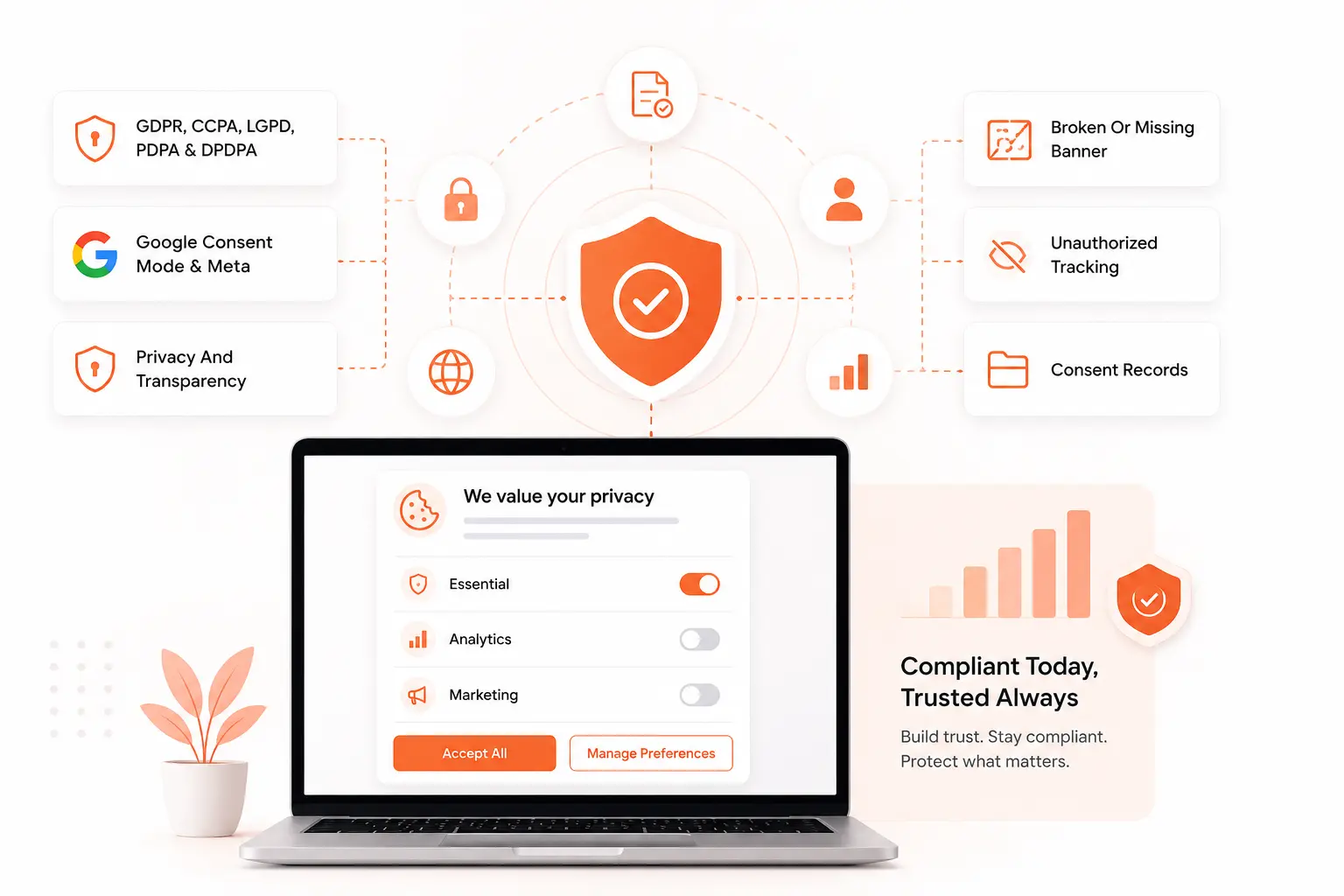
Every privacy law on the books requires verifiable, documented consent before tracking technology fires on your site. And ad platforms enforce it too.
Cookie Consent Management Platform (CMP) scans every tracker on your site, categorizes it, and blocks it until your visitor says “Yes.” All through a customizable banner built around your brand and your legal requirements.

Automatically scan your website & build a full inventory of all cookies, tags, trackers, pixels, and beacons, including first-party and third-party.

Pre-built customizable templates for GDPR, LGPD, CCPA, and DPDPA. Reviewed by miniOrange’s legal & privacy team, so they're built against actual regulatory requirements.

Every tracked element gets sorted by category: strictly necessary, functional, analytics, and advertising. Your users see exactly what they're consenting to.

No tracking script fires until the user accepts. This is what GDPR and DPDPA require in practice. The platform enforces it at the tag level.

Users can update or withdraw consent anytime through a self-service portal. If they submit a DSAR, the platform’s consent history provides the information needed to respond.

The platform generates your cookie policy and keeps it current. When the scanner finds a new tracker, the policy updates automatically without you touching anything.

A live record of every cookie and tracking technology running on your site. Useful for audits and DPIAs, or for the next time a privacy regulator asks what you're running.

Automatically track when each user's consent was collected and re-surface the banner when it expires. No manual triggers, no developer work, your compliance doesn't lapse between visits.
Get up and running in 4 steps
Install the script on your website (one tag, no developer required for most setups).
Run the first automated scan and review your complete cookie inventory.

Choose a pre-built banner template or configure a custom one.
Enable auto-blocking and go live.
Get a setup configured to your tech stack, regions & compliance requirements.
miniOrange's cookie consent management platform connects with Google Tag Manager, Meta Ads, Google Analytics, Salesforce, HubSpot, Shopify, Klaviyo, Braze, Heap, Tableau, Azure, Snowflake, BigQuery, Amazon S3, Redshift, Twilio Segment, Mparticle, AdRoll, LinkedIn Ads, Oracle DB, MySQL and more.
Consent signals pass directly to your tag management system. Advertising tags don’t fire until a user accepts, and analytics only loads when they do.











Compliant across 22 languages and all the major global regulations
EU cookie consent rules mainly come from the ePrivacy Directive (the cookie-specific rule, in force since 2002), which requires consent before non-essential cookies are stored or accessed, and GDPR, which requires that consent be freely given, specific, informed, and unambiguous. miniOrange’s platform supports this by blocking scripts until consent is given, recording consent decisions, and making withdrawal easy.
California’s privacy laws give consumers the right to opt out of having their data sold or shared, and your website has to make that easy. miniOrange builds the “Do not sell or share my personal information” experience into your consent flow to help streamline California privacy handling.
Brazil’s LGPD requires a valid legal basis for personal data processing, and consent must be informed and specific where it is used as that basis. miniOrange blocks all non-essential tracking scripts until the user actively consents, collects that consent in a legally valid format, and logs it for audits.
India’s DPDPA applies to the processing of digital personal data in India and requires proper notice, lawful processing, and consent management where consent is the basis for processing. miniOrange’s platform helps collect consent, support withdrawal, and maintain logs for accountability.
Thailand's PDPA demands explicit opt-in consent for personal data processing. And cookie-based tracking often needs explicit user consent in practice. miniOrange blocks all tracking scripts until the user actively consents, records preferences, and helps you manage consent consistently.

Ad pixels, retargeting scripts, and analytics tools make cookie consent complex. The platform categorizes and gates each one without breaking your tracking setup.

SaaS products typically run 10-30 3rd party tools, analytics, support widgets, session recording, & product telemetry. Most of them are added one at a time with no central record. The scanner finds all of them & gives you a full inventory.

Financial services collect behavioural data through cookies, and the platform gives concrete consent logs and cookie inventory to your compliance team.

Cookies on healthcare sites can carry sensitive data signals. Blocking before consent matters more here than in most places.

Ad-supported sites live and die by advertising cookies. Geo-based banners let you comply in regulated markets without affecting users in markets with lighter requirements.

GDPR & DPDPA apply to public sector sites as well, and citizens expect the same consent controls as any other website.
With miniOrange's cookie consent management platform, see exactly what they are, who set them, and whether you have consent on record.
Built by privacy experts and backed by legal.

Every pre-built banner was reviewed by miniOrange’s in-house legal and privacy team, not auto-generated from a regulation summary.

Every consent action gets timestamped & logged. When a regulator or auditor asks for proof, the records are all there.

Cookie consent sits inside miniOrange’s Privacy as a Service suite. DSAR handling, consent management & identity lifecycle enforcement are all on the same platform if you need them.