Configure MAC Address Based Restriction
MAC address-based restriction offers a robust security layer by regulating access according to the distinctive MAC address of devices. This capability empowers you with genuine device-based restriction, ensuring a heightened level of control over authorized access.
Connect with External Source of Users
miniOrange provides user authentication from various external sources, which can be Directories (like ADFS, Microsoft Active Directory, OpenLDAP, AWS etc), Identity Providers (like Microsoft Entra ID, Okta, AWS), and many more. You can configure your existing directory/user store or add users in miniOrange.
Follow the step-by-step guide given below to Configure MAC Address Based Restriction
1. Configure Device Restriction Policy
Device restriction lets admins control application access using device trust. You can use Agentless Device Restriction (browser-based fingerprinting) or Agent-Based Device Restriction (installed agent with risk scoring) depending on your security requirements.
- Login to Self Service Console >> Policies >> Adaptive Access Policy section from the left side menu.
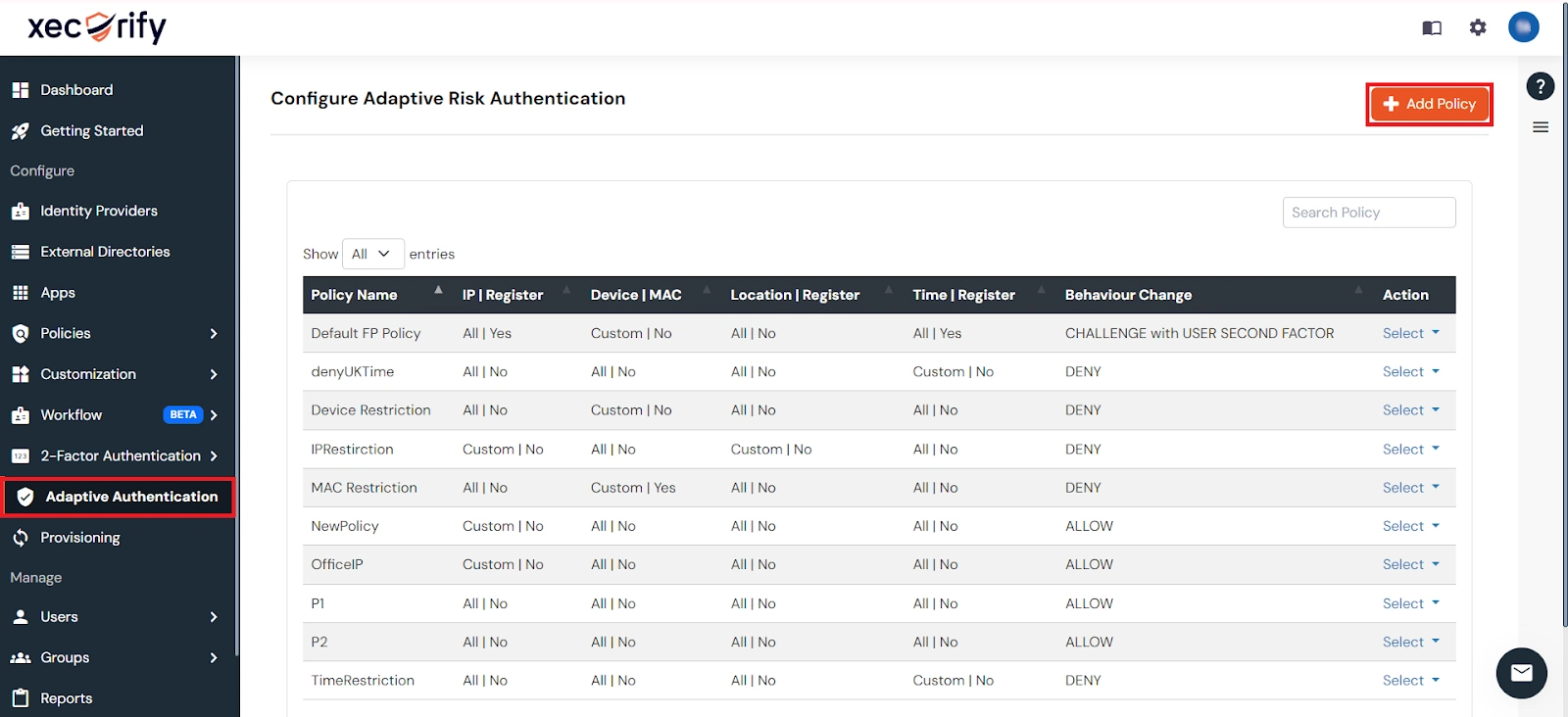
- Click on the Create Policy button on the upper right. Add a suitable policy name and click on Create Policy.
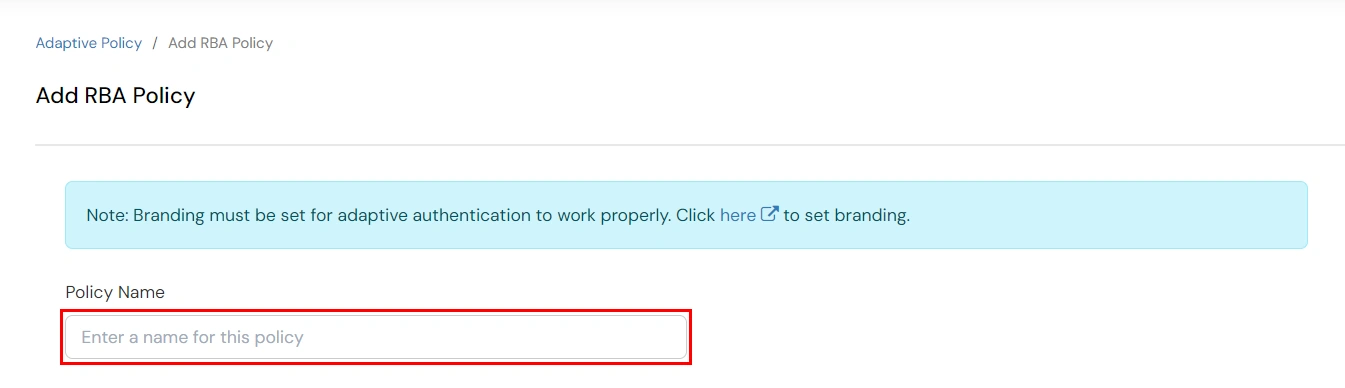
1.1 Policy Overview
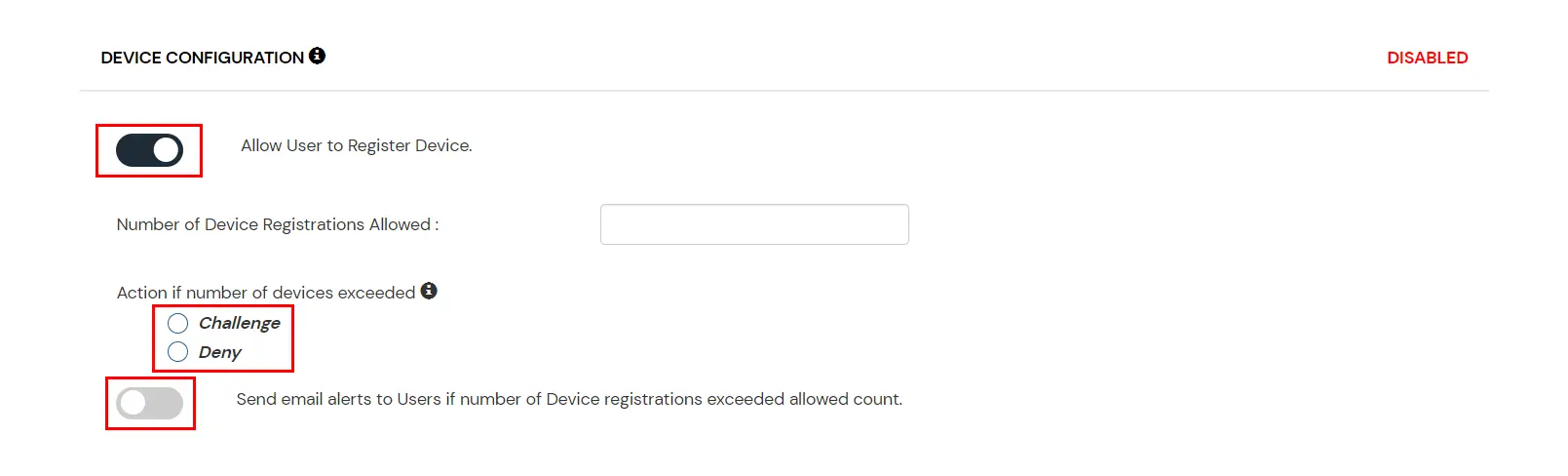
- Enable the Device Configuration toggle.

- You can configure device restriction using either Agentless or Agent-Based methods:
Agentless Device Restriction
- Number of Device Registrations Allowed: Specifies the maximum number of devices a user can register.
- Enable Mobile Device Restriction: Blocks login attempts from mobile devices.
- Enable Device Auto-Registration: Allows automatic device registration.
Agent-Based Device Restriction
- Prerequisites for enabling Agent-Based Device Restriction:
- All end users must install the Device Agent on their devices before accessing the application.
- Users without the agent are blocked and see: Please install the miniOrange Device Agent on your device and try again.
- The Device Agent is currently supported on Windows devices only.
- Click Download Agent to get the installation file for end users.
- Under Device Registration Method, choose one of the following:
- Self Registration by User: Users can register their own devices up to the defined limit. Provides flexibility with moderate security.
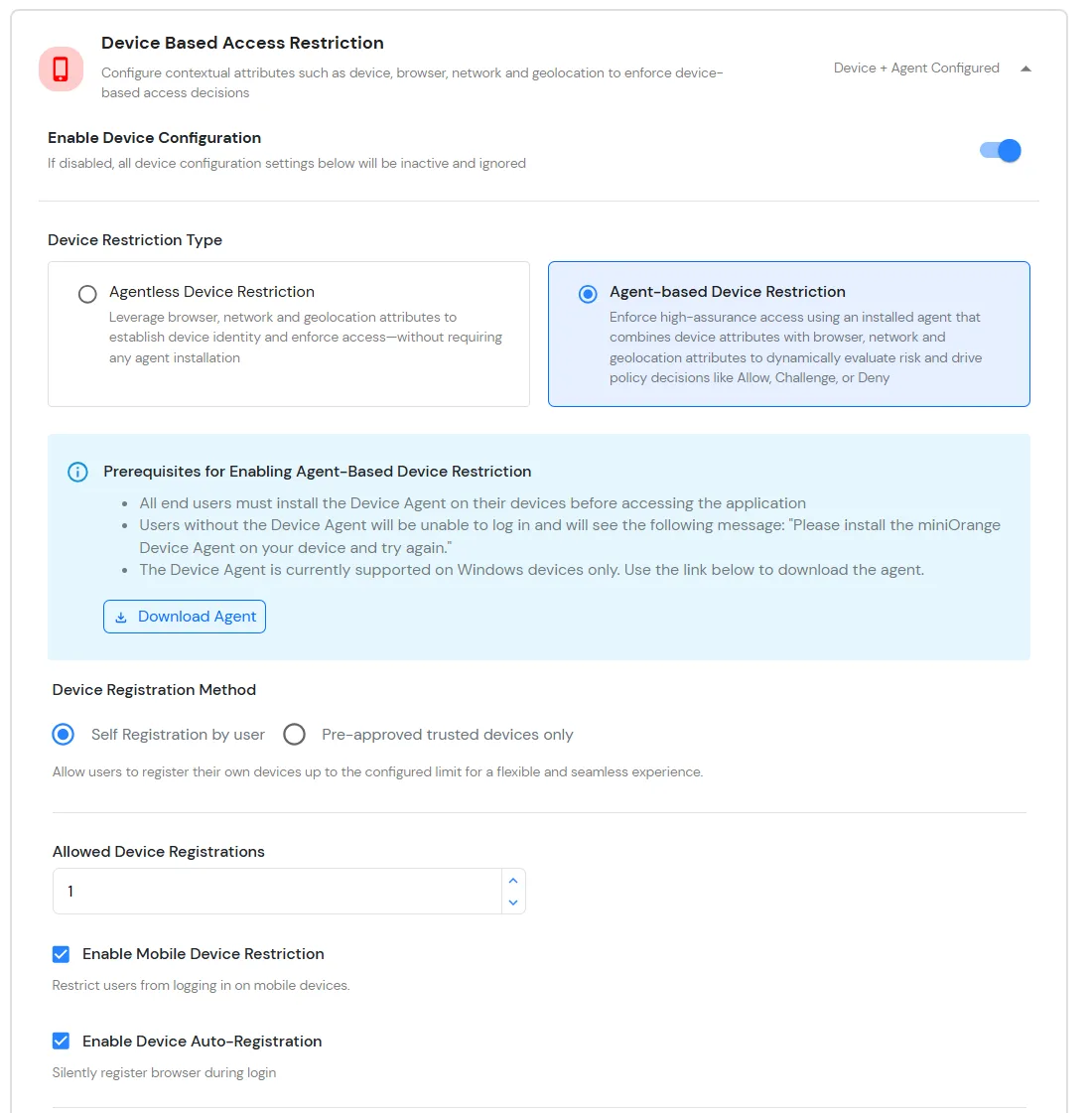
- Number of Device Registrations Allowed: Specifies the maximum number of devices a user can register.
- Enable Mobile Device Restriction: Blocks login attempts from mobile devices.
- Enable Device Auto-Registration: Allows automatic device registration.
- Pre-Approved Trusted Devices Only: Higher security. The admin manually manages trusted device information. Select this option and click Upload Pre-Approved Trusted Devices (CSV) to import devices (you can skip this step if devices are already uploaded).
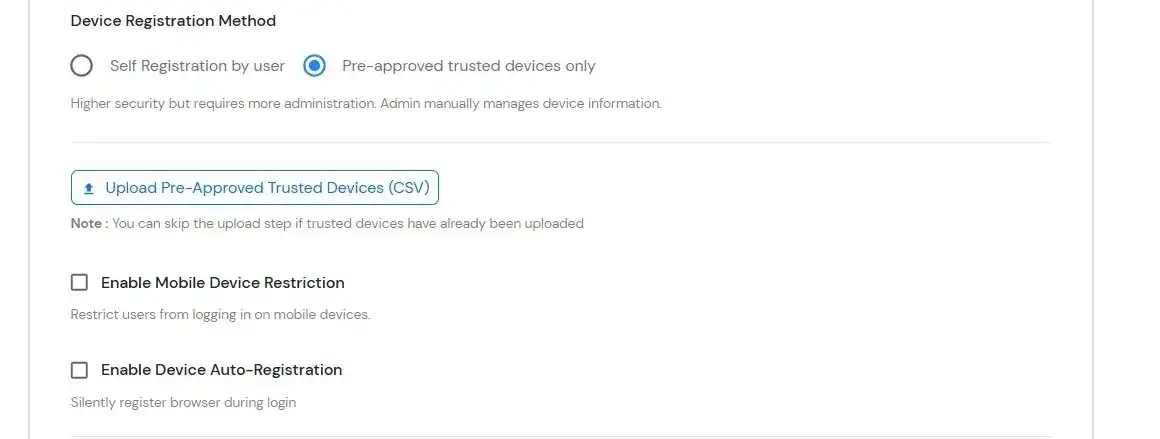
- Upload a CSV file containing pre-approved users and devices (users must already exist in miniOrange). Download Sample CSV for reference.
- Configure the following options:
- Enable Mobile Device Restriction: Blocks login attempts from mobile devices.
- Enable Device Auto-Registration: Allows automatic device registration.
- Configure Risk Engine for Device Trust Evaluation
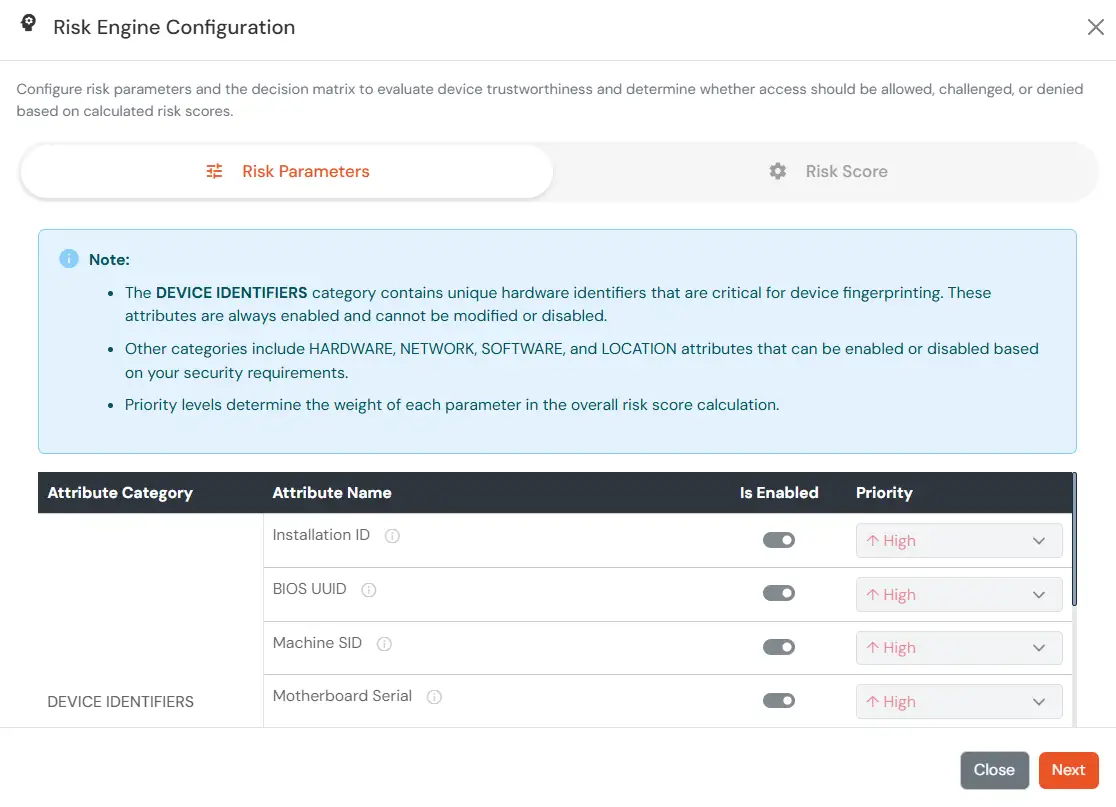
The Risk Engine allows you to evaluate device trustworthiness by analyzing multiple device attributes and calculating a risk score. Based on this score, user access is allowed, challenged or denied during login and device registration.
- Navigate to the Risk Engine section and click Configure.

- Configure Risk Parameters:
- In the Risk Parameters tab, review the list of device attributes grouped by category.
- The Device Identifiers category contains mandatory attributes (such as Installation ID, BIOS UUID, Machine SID, etc.). These attributes are always enabled and cannot be disabled or reprioritized, as they are critical for device fingerprinting.
- For other categories (Hardware, Network, Software, Location), enable the attributes you want to use for device trust evaluation.
- Set a Priority for each enabled attribute:
- High: Strong impact on risk score
- Medium: Moderate impact
- Low: Minimal impact
- Click on Save Changes.
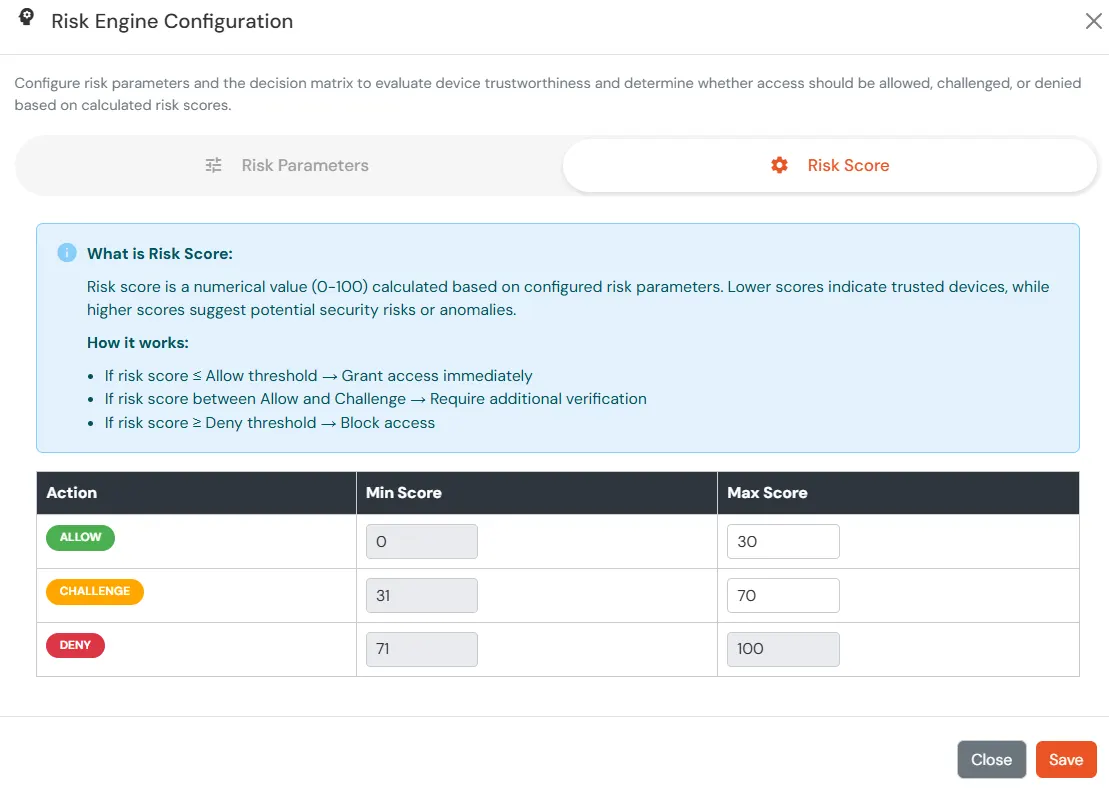
- Configure Risk Score
- In the Risk Score, define the score ranges (0–100) that determine the authentication outcome during user login.
- Lower risk scores indicate trusted devices.
- Higher risk scores indicate potential security risks or anomalies.
- Configure the thresholds as follows:
- Allow: Allow user to authenticate without challenge and registration.
- Challenge: Allow user authentication with a challenge, e.g., when the device limit is exceeded.
- Deny: Deny user authentication, e.g., when the device limit is exceeded, when device attribute is mismatch.
1.2 Action for Behavior Change
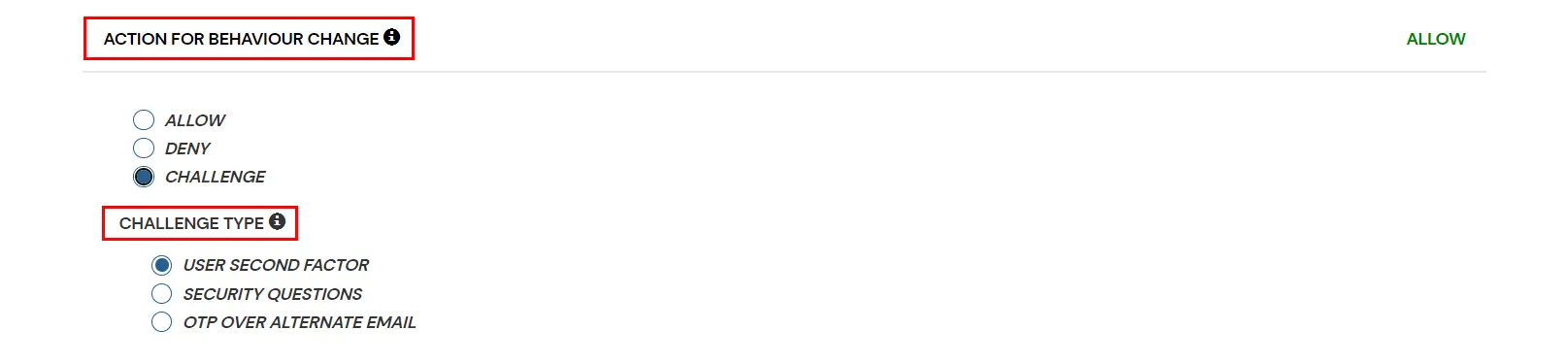
- You can configure one of the three possible actions for your Adaptive Access Policy as explained below:
| Attribute |
Description |
| Allow |
Allow users to authenticate and use services if Adaptive Access Policy condition is true. |
| Deny |
Deny user authentications and access to services if Adaptive Access Policy condition is true. |
| Challenge |
Challenge users with one of the three methods mentioned below for verifying user authenticity. |
Challenge Type Options:
| Factors |
Description |
| User Second Factor |
The user needs to authenticate using the second factor they have selected or been assigned, such as
- OTP over SMS
- PUSH Notification
- OTP over Email and many more.
|
| KBA |
The system will ask the user for 2 of 3 questions they have configured in their Self-Service Console. Only after the correct answers to both questions will the user be allowed to proceed further. |
| OTP over Alternate Email |
User will receive an OTP on the alternate email they have configured through the Self Service Console. Once the user provides the correct OTP, they are allowed to proceed further. |
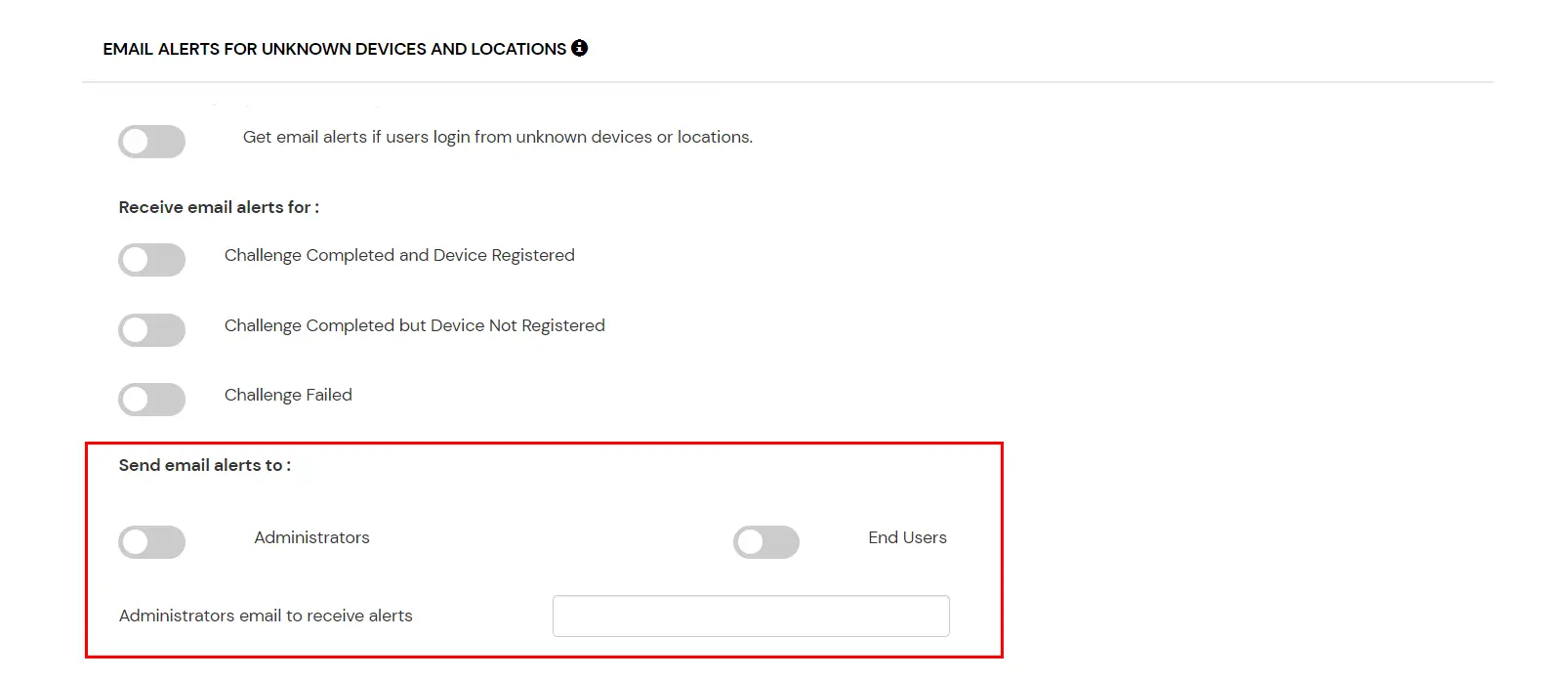
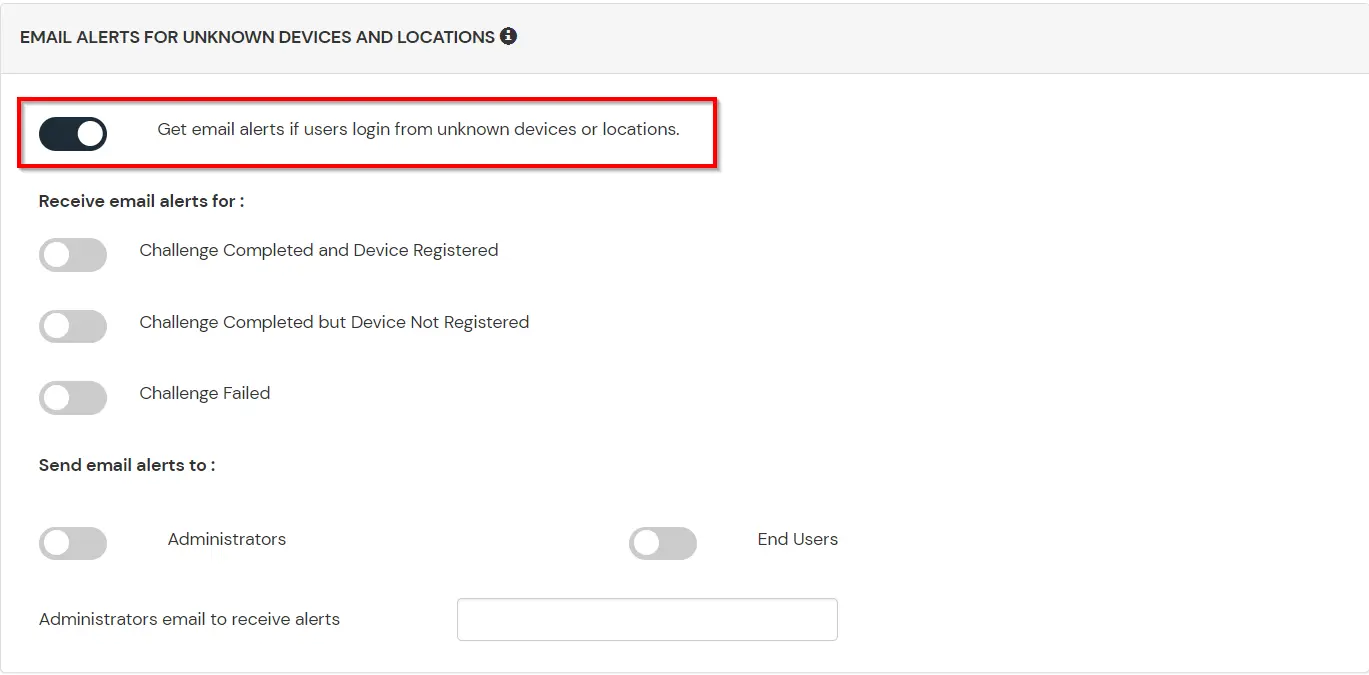
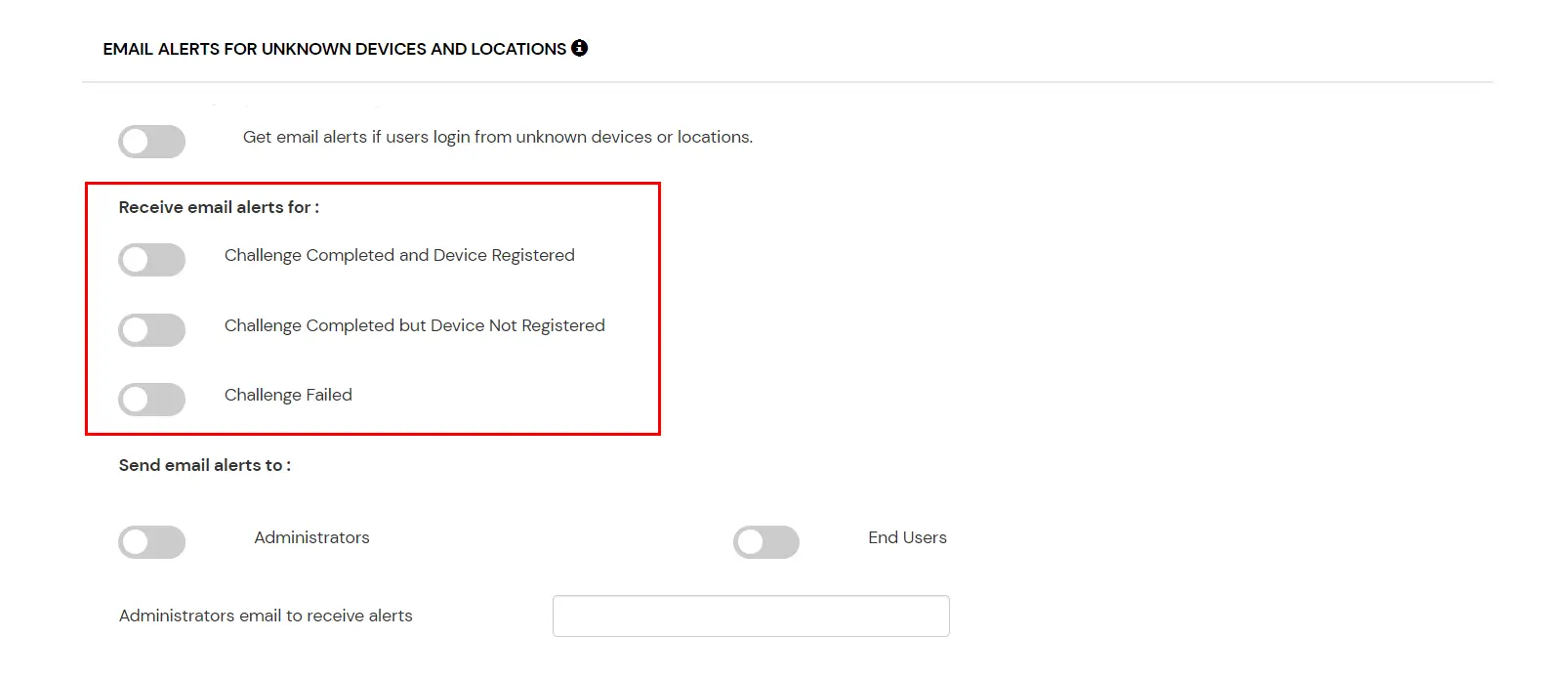
1.3 Email Alerts and Custom Error Message
1.4 Review
Review the configured policy conditions, behavior change actions, email alert settings and custom error messages before creating the adaptive authentication policy. This step provides a consolidated view of all configured settings, allowing you to verify the policy configuration and make any necessary changes before saving.
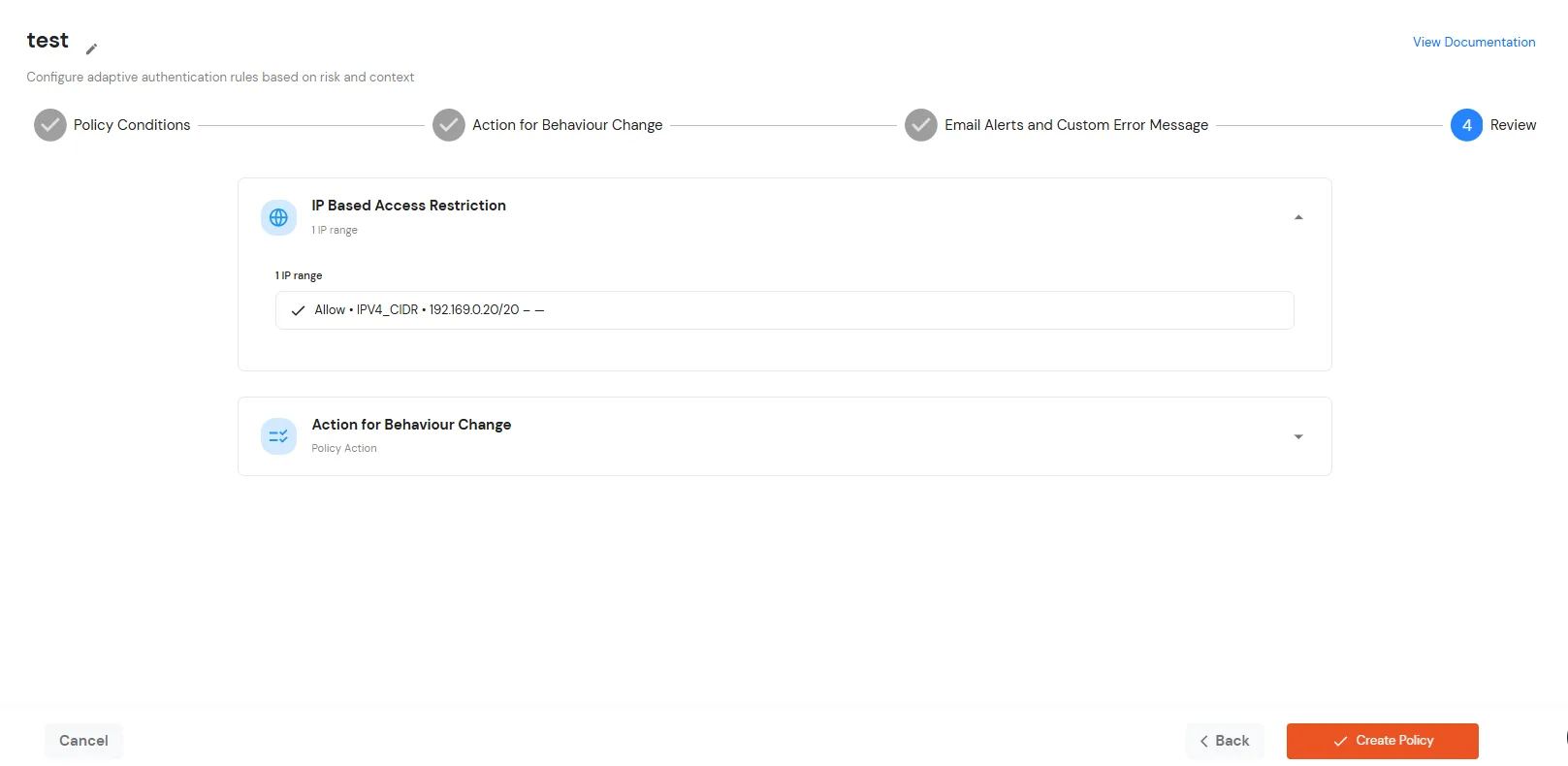
- Once you have verified all configurations, click Create Policy to save and activate the policy.
- You will see the policy listed once it’s successfully added.
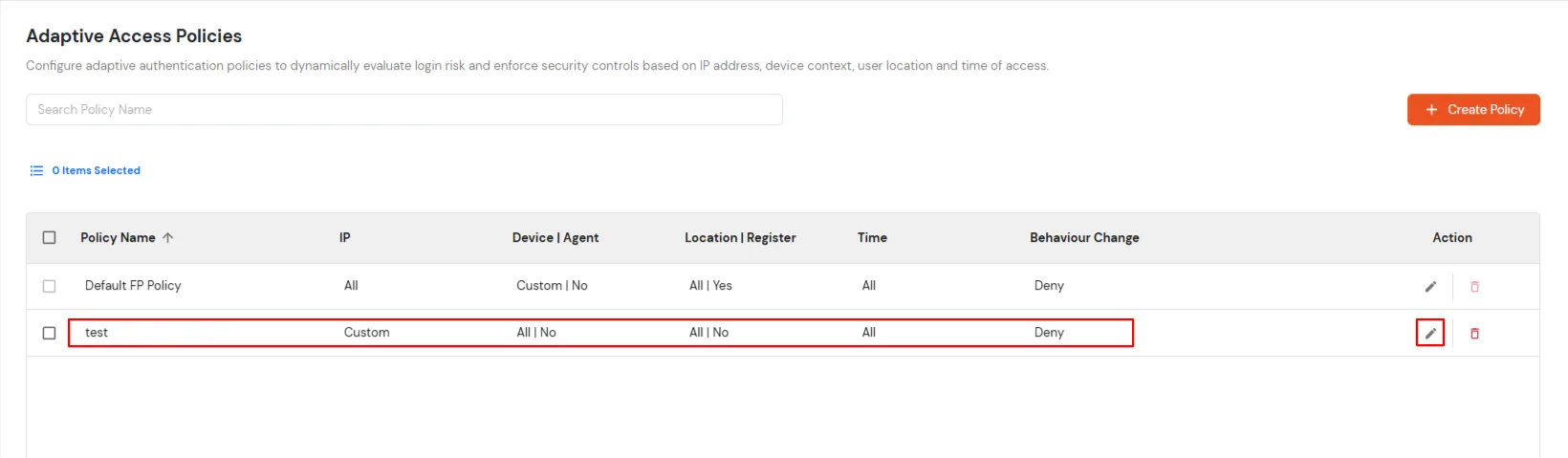
2. Get the download links from the Adaptive Policy list
- Go to the Adaptive Authentication section.
- Click on select >> Get MAC Agents option against your policy.
(This option is only available for policies where you have enabled MAC address based restriction).

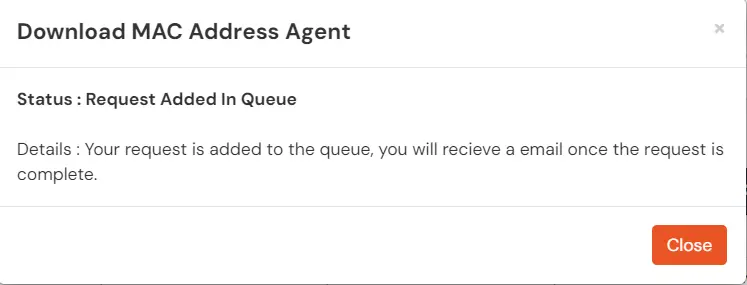
- If your request was already added to the queue and completed, then you will receive the download links for the Windows and Linux systems.
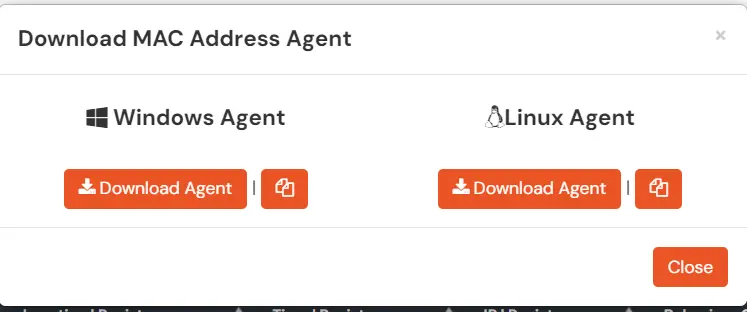
- If your request was already added to the queue but is not completed yet, then you will see the appropriate message mentioning the same. You will receive an email on the admin’s email address once your request is processed.
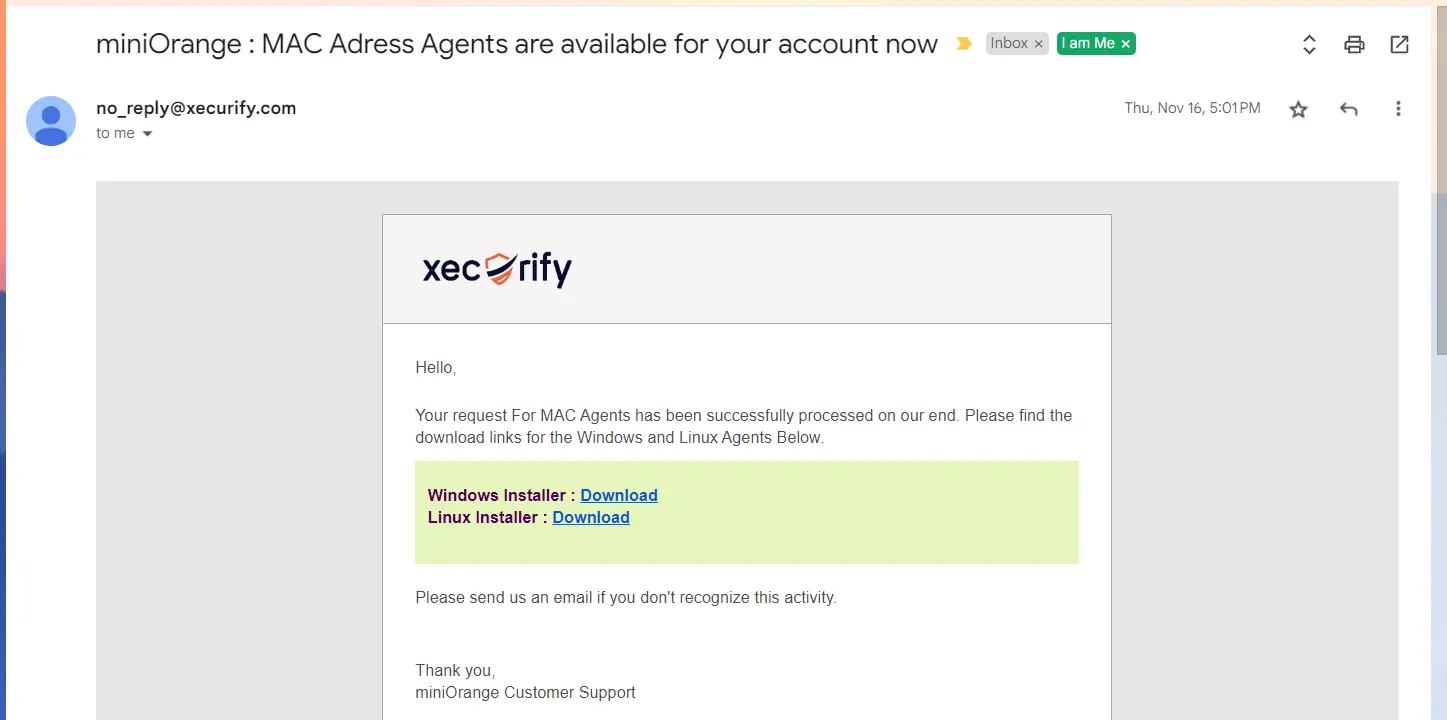
- If your request was in the queue previously and is not processed yet, then you will see the appropriate message mentioning the same.
3. Install The Agent on Windows
- The Windows Installer For the Agent is a one click install. Run the installer with Admin privileges.
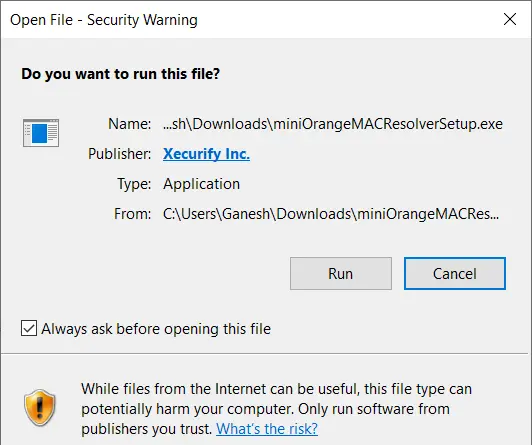
- If you get a security warning as shown below, click on Run to continue with the installation.
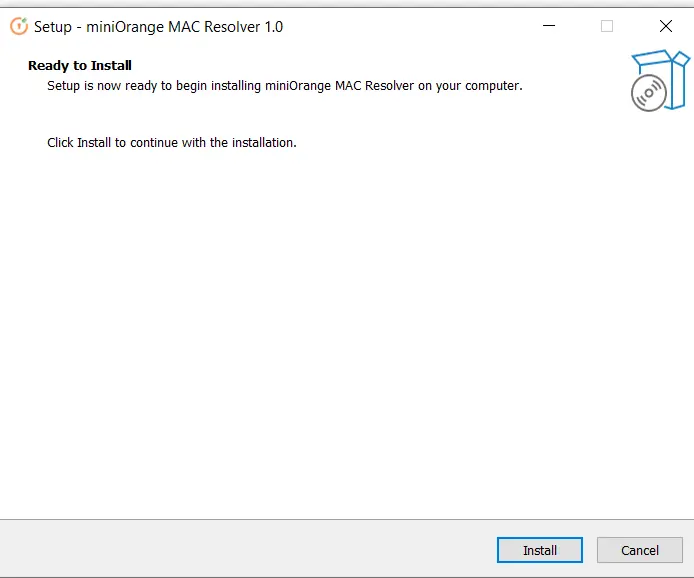
- Once the installation wizard is open, click on the install button to complete the installation.
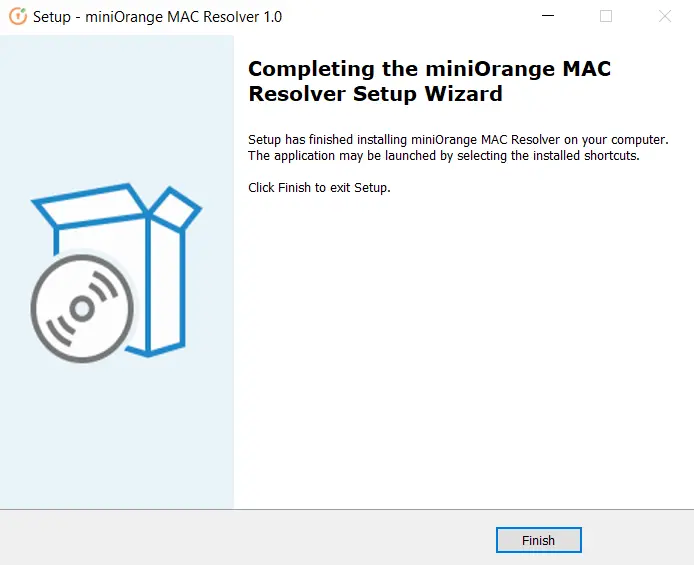
- Once the installation is complete, you will see the following screen.
4. Install the Agent in Linux Systems
- Make sure you are logged in to the Linux System as the SuperUser (root).
- Download the Zip file for the Agent on your Linux machine.
- Unzip the file and run the command:
sh installScript.sh
This will install the agent and create the required services for it.

- To view all available commands for the installation, run the command:
sh installScript.sh -h

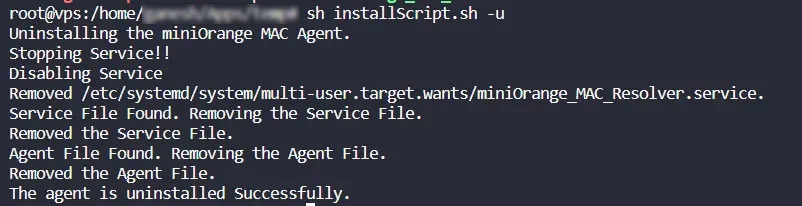
- To uninstall the Agent, run the command:
sh installScript.sh -u
5. Enable Restriction for MAC
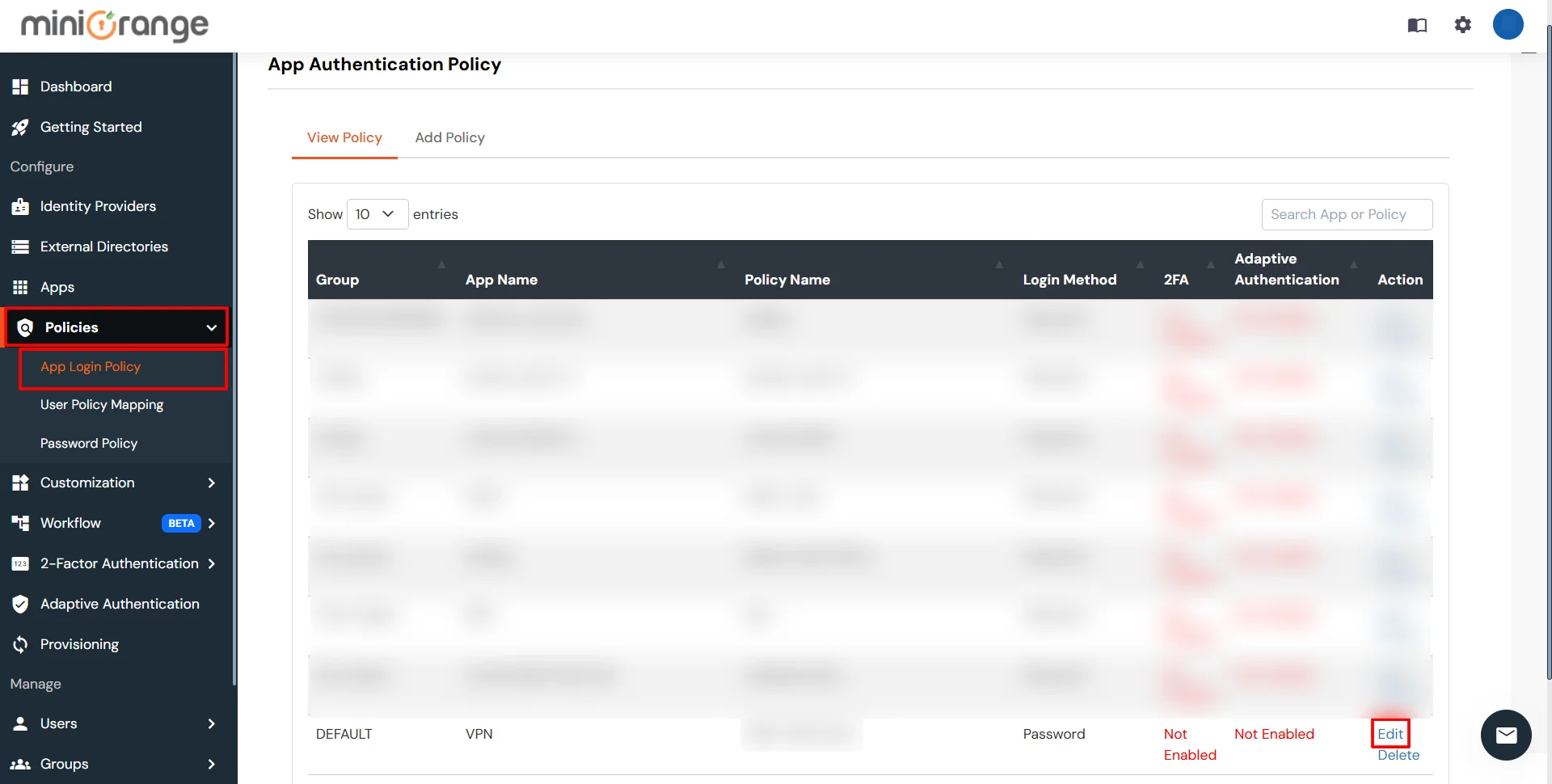
- Login to Self Service Console >> Policies >> App Login Policy.
- Click on the Edit icon for the predefined app policy.
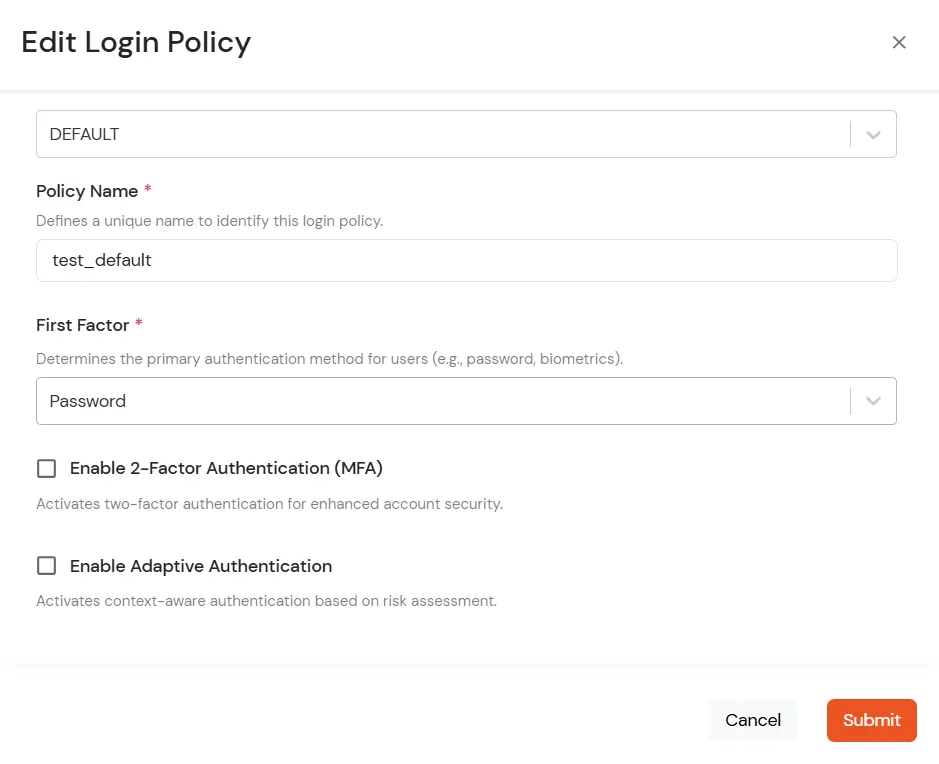
- Set Group Name and Policy Name as required. Select Password as First Factor.
- Enable Adaptive Authentication on Edit Login Policy page and select the required restriction method as an option.
- From Select Login Policy dropdown select the policy we created in last step.
- Apply Restrictions Using: Select how IP Restriction should be evaluated when multiple adaptive authentication restrictions are configured.
- AND: The configured IP Restriction and all other enabled restrictions must be satisfied before access is granted.
- OR: The configured IP Restriction or at least one other enabled restriction must be satisfied before access is granted.
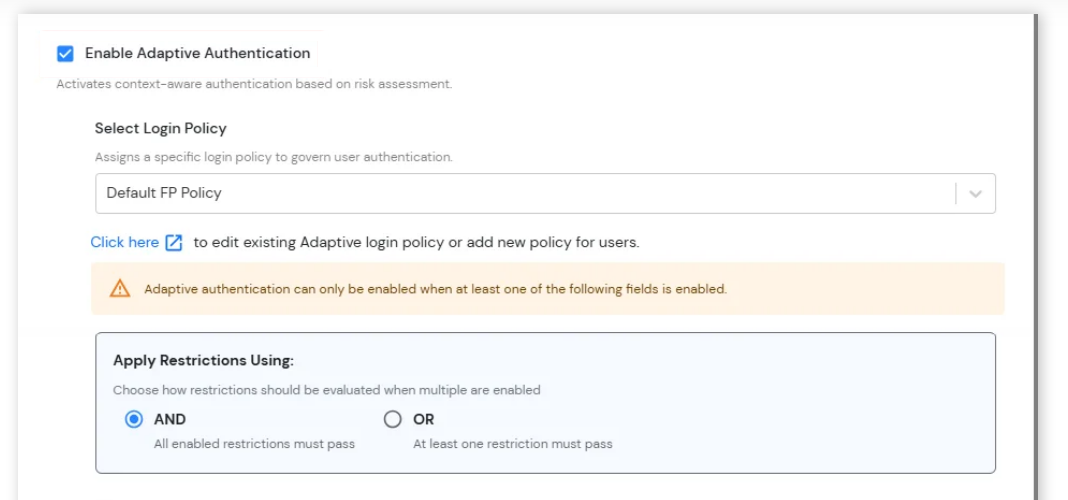
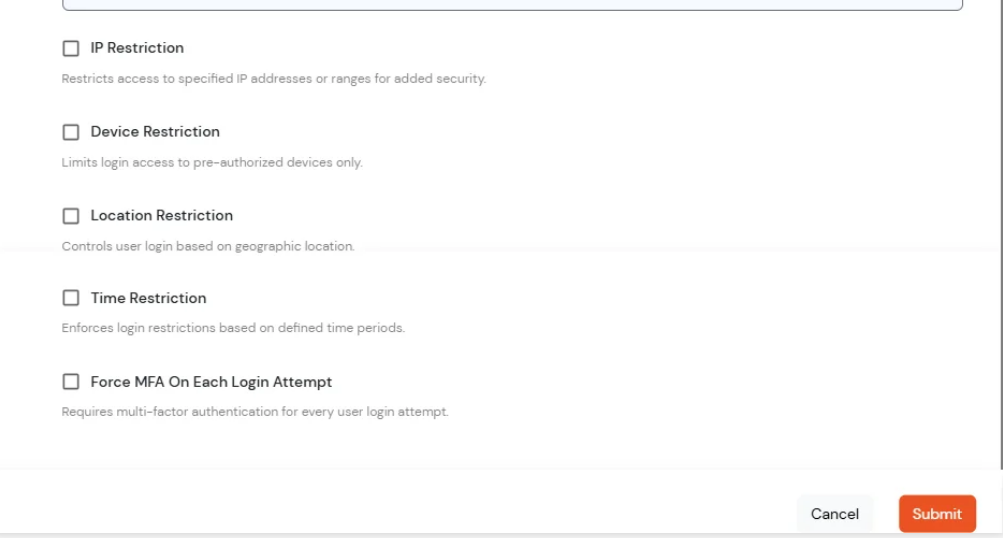
- Adaptive Authentication Restrictions: Configure additional login restrictions and verification conditions along with the existing configured Restriction to strengthen account security and control user access based on contextual risk factors.
External References